Helping design and engineering professionals discover, evaluate and specify technologies and processes that shorten the design cycle and enable success.



Digital Engineering April 2026
In the latest issue of Digital Engineering, we take a look at the latest innovations in design for additive manufacturing, including the use of natural language inputs, social media cosplayers, and AI integration. The issue also includes a feature…

January Special Focus Issue: Design for Additive
In this Special Focus Issue of Digital Engineering, learn about the latest advancements in design for additive manufacturing, including new software tools, additive in automotive, custom medical devices, and more.
Different groups have taken different approaches to 3D printing for construction, with some seeming less likely than others. Recently, a group of students from the Bartlett School of Architecture developed their own method of leveraging AM for building. The group calls itself Amalgamma and has dubbed its printing method, “Fossilized.”
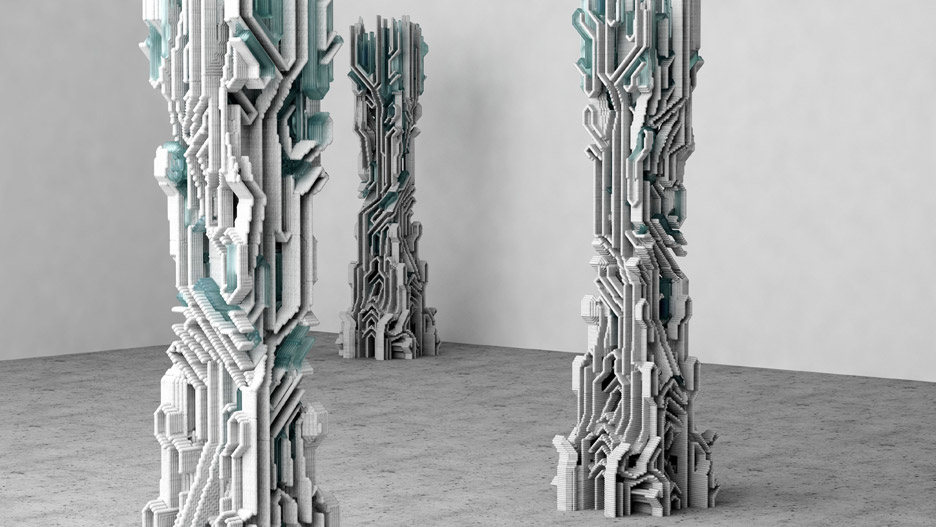 3D printed columns built using Amalgamma's new concrete printing process. Courtesy of Amalgamma.
Fossilized combines two different AM processes to build structures using the smallest amount of material possible. The first process used is the standard extrusion method, in which ready-to-pour concrete mixed with a binding agent is squeezed out in 1 cm lines that build on each other to create a three-dimension object. This is basically the same technique used by D-Shape and other concrete construction processes.
The other printing method incorporated into the Fossilized process is powder bed printing. Generally, when using powder bed printing, a binding agent is injected into the bed where it hardens powdered material into solid objects. One benefit of the powder bed process is that it doesn’t require a separate support material that allows 3D printing to build overhangs or oddly shaped designs.
With Amalgamma’s process, the powder material (which looks rather like rock salt) only exists to act as a support material. Each time a layer is built through material deposition, the support material seeks out areas that require additional support and combines with the wet building material to form a multi-material structure that is stronger than what could be produced through extrusion alone.
The main benefit to the Fossilized process is that it can produce structurally sound building pieces that require far less material to construct when compared to solid walls or columns built by simply dumping concrete into place. Less material used results in lower construction costs and environmental costs from transportation.
While useful for some construction needs, Amalgamma admits their process isn’t viable for large-scale architecture because of material constraints. As an example, rather than building an entire wall, the process is better used for creating material light pillars. Fossilized could also be used to build “chunks” of architecture, basically offering a digital catalog of potential pieces to be added to a building.
Below you’ll find a video from Amalgamma.
Source: Amalgamma


John Newman is a Digital Engineering contributor who focuses on 3D printing. Contact him via [email protected] and read his posts on Rapid Ready Technology.
Follow DE
Join over 90,000 engineering professionals who get fresh engineering news as soon as it is published.






About Us · Contact Us · Editorial Team · Advertising · Privacy Policy · Subscriber Services · © 2026 Digital Engineering 24/7 · Peerless Media