Helping design and engineering professionals discover, evaluate and specify technologies and processes that shorten the design cycle and enable success.



Digital Engineering April 2026
In the latest issue of Digital Engineering, we take a look at the latest innovations in design for additive manufacturing, including the use of natural language inputs, social media cosplayers, and AI integration. The issue also includes a feature…

January Special Focus Issue: Design for Additive
In this Special Focus Issue of Digital Engineering, learn about the latest advancements in design for additive manufacturing, including new software tools, additive in automotive, custom medical devices, and more.
Creating a seamless workflow and ensuring security of valuable design intellectual property (IP)—those are two major challenges slowing adoption of additive manufacturing as a primary production method and the charter of a budding partnership between AMFG Software and LEO Lane.
AMFG Software, which markets workflow automation software for AM, and LEO Lane, a maker of software that protects design IP and controls the quality of AM parts, are combining their key strengths and melding their product offerings in an attempt to address this problem. As part of their arrangement, the pair intend to integrate their software to offer a secure solution for end-to-end AM workflow management, which encompasses capabilities for virtual inventories and on-demand production.
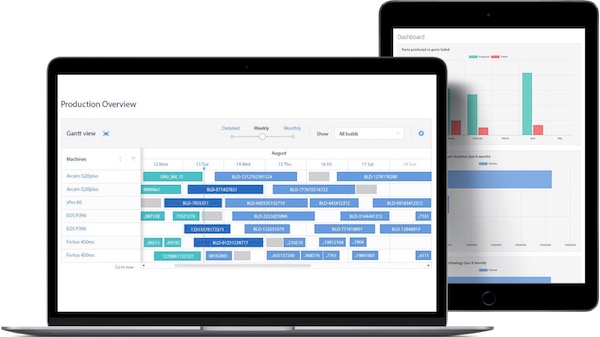
AMFG’s platform enables companies to create and automate an end-to-end workflow for AM jobs, including production scheduling, post-processing scheduling and file preparation. The software, which can be used with most AM technologies and 3D printers, manages everything from the initial quote process through cost estimation, specifying part properties, managing project communications status, and planning production and post-processing work.
“We handle workflows from the virtual file until the printed part leaves a company to the requesting individual,” says Felix Doerr, AMFG’s head of business development.
Unlike traditional manufacturing where one project might load up a production system for months, creating hundreds of thousands of the same part, AM runs lend themselves to individualized or small-batch series of parts, all of which are created differently even though they are produced on the same machine. Traditionally, this work is managed in a paper-based workflow or with spreadsheets, which doesn’t scale when you add more products and printers.
“A lot of traditional manufacturers start out with one printer and that’s not a problem, but as they add more printers, they’re looking not into changing their process, but thinking about how they can improve and organize themselves” and that’s where a workflow management solution fits in.
For its part, LEO Lane’s tools provide capabilities for real-time tracking of digital assets, IP protection, and controls over consistency, quality, and quantity of parts produced. Security is a critical piece of the AM puzzle, Doerr says, because the technology is still heavily used for prototyping and thus there are sensitive files with proprietary design data that must be protected.
While you can currently use the two platforms in a standalone mode, it makes more sense to combine them in an integrated fashion, according to Doerr:
“If you can lock files down or open them during specific steps, it gives customers more control over their parts. Integrating the tools enables customers to use the capabilities much more easily and establishes another level of trust that doesn’t exist today.”
The pair plan to release their first pilot of the integrated solution in the first quarter of this year with more widespread availability later in 2019. The joint solution is being developed in tandem with an industrial company, but the companies declined to name the customer.


Beth Stackpole is a contributing editor to Digital Engineering. Send e-mail about this article to [email protected].
Follow DE
Join over 90,000 engineering professionals who get fresh engineering news as soon as it is published.






About Us · Contact Us · Editorial Team · Advertising · Privacy Policy · Subscriber Services · © 2026 Digital Engineering 24/7 · Peerless Media