Helping design and engineering professionals discover, evaluate and specify technologies and processes that shorten the design cycle and enable success.



Digital Engineering April 2026
In the latest issue of Digital Engineering, we take a look at the latest innovations in design for additive manufacturing, including the use of natural language inputs, social media cosplayers, and AI integration. The issue also includes a feature…

January Special Focus Issue: Design for Additive
In this Special Focus Issue of Digital Engineering, learn about the latest advancements in design for additive manufacturing, including new software tools, additive in automotive, custom medical devices, and more.
With that we come to Arcam’s new electron beam melting system (EBM), the Arcam Q10. As is true for all EBM machines (ASTM directed energy deposition), the Q10 uses an electron beam to melt powdered metals. Commonly used metals include titanium and cobalt-chrome. This new design is meant to replace the A1 for orthopedic manufacturing.
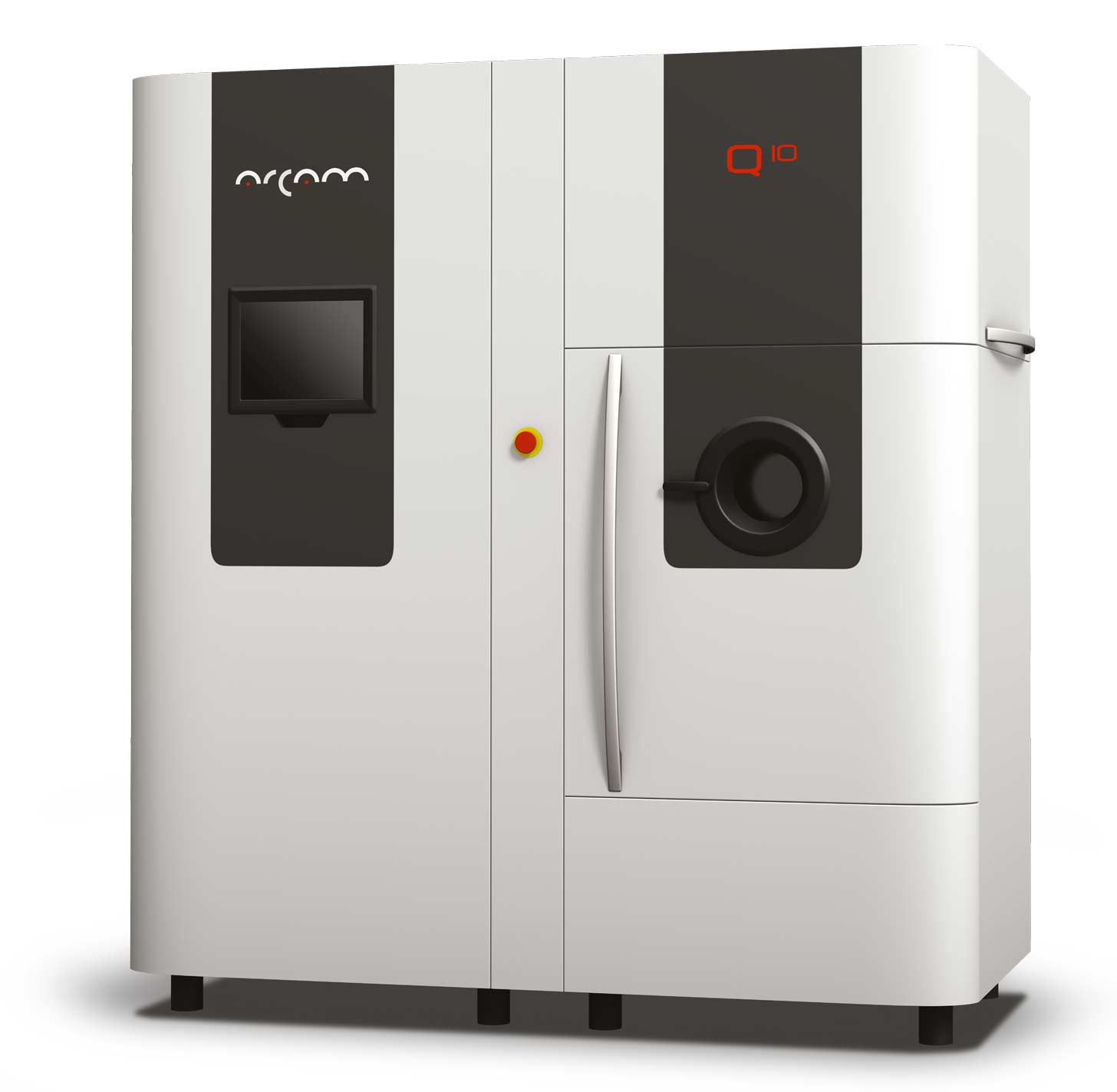
Arcam’s newest system was designed to produce orthopedic implants, and so incorporates a layer verification camera system to monitor the 3000 W electron beam. The Q10 offers a 200 mm x 200 mm x 180 mm (7.87 in. x 7.87 in. x 7.08 in.) build envelope, and has a minimum beam diameter of 100μ.
According to Arcam’s website, “The size of the build area is chosen to allow for optimal stacking of the most common implant types and the build chamber interior is developed for easy powder handling and fast turn-around times.”
This system also shows that not all AM research and development is going into larger systems. While the 3D printers that can build entire aircraft wings might receive more news coverage, smaller systems like this one continue to work away in the background, quietly improving lives of people who rely on orthopedic implants.
Below you’ll find a short video about Arcam’s EBM system by the Oak Ridge National Laboratory.
Source: Arcam


John Newman is a Digital Engineering contributor who focuses on 3D printing. Contact him via [email protected] and read his posts on Rapid Ready Technology.
Follow DE
Join over 90,000 engineering professionals who get fresh engineering news as soon as it is published.






About Us · Contact Us · Editorial Team · Advertising · Privacy Policy · Subscriber Services · © 2026 Digital Engineering 24/7 · Peerless Media