Helping design and engineering professionals discover, evaluate and specify technologies and processes that shorten the design cycle and enable success.


Alert!
Digital Engineering ceased publication on July 1, 2026. This website remains available as an archive of engineering content.
For inquiries or information, please email [email protected].

Digital Engineering April 2026
In the latest issue of Digital Engineering, we take a look at the latest innovations in design for additive manufacturing, including the use of natural language inputs, social media cosplayers, and AI integration. The issue also includes a feature…

January Special Focus Issue: Design for Additive
In this Special Focus Issue of Digital Engineering, learn about the latest advancements in design for additive manufacturing, including new software tools, additive in automotive, custom medical devices, and more.
The Department of Energy’s Oak Ridge National Laboratory and JuggerBot 3D, an industrial 3D printer equipment manufacturer, have launched a second R&D collaboration through the Manufacturing Demonstration Facility, or MDF, Technical Collaboration Program.
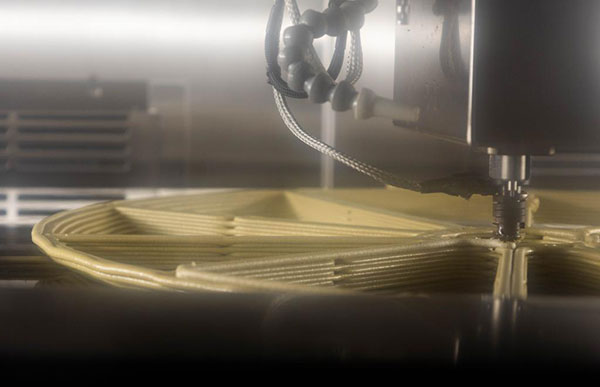
The two organizations plan to grow options for large-format 3D printing into a new set of materials—thermoset polymers such as epoxies, vinyl esters and polyurethanes—and develop systems that can print thermosets and thermoplastics.
“Creating innovative solutions with industry partners is what the MDF does best,” says MDF Director Ryan Dehoff. “Our strengths in digital, materials and additive manufacturing, combined with the expertise and interesting challenges industry brings, allow us to advance U.S. competitiveness.”
JuggerBot 3D’s first collaboration with ORNL addressed the quality of pellet-fed, large-format printing for thermoplastics. Together, ORNL and JuggerBot 3D increased print quality and consistency, enabling pellet-fed 3D printing to be a solution for more applications. These include flow conveyance components for hydroelectric dams, customized pipe and tube adapters, and pipeline alignment check fixtures for the oil and gas industries.
That project started with tweaking ORNL slicing software and JuggerBot 3D equipment to work in tandem. The software calculates printhead path, speed, temperature and other parameters to create a 3D version of the object.
“When our company first transitioned to pellet-fed 3D printing, we faced a big risk because there were no available slicers that could do what we envisioned,” says Zachary DiVencenzo, president and co-founder of JuggerBot 3D. “That is, until we met the ORNL team. Their existing slicer software was the foundation we needed to grow. Now, the updated open-source Slicer 2 showcases how ORNL innovates for all advanced manufacturing.”
Next, the collaborative team explored methods for calibrating the JuggerBot 3D pellet-fed extruder’s speed and material output in real time. The researchers developed a bead characterization system using laser technology to measure the width of deposited polymer beads, enabling the extruder to compensate to print with greater accuracy.
The last phase focused on maximizing efficiency through automation. “JuggerBot 3D had the idea, which we’ve commercialized since then, to develop a material database housed within our printer that contains critical process parameters for hundreds of thousands of materials,” DiVencenzo says.
Typically, operators must provide details about the machine, printing speed, system calibration and material process parameters for the slicing software. However, the combination of ORNL Slicer 2, new calibration technology and the JuggerBot 3D Material Card results in a data-driven, automated process operators can run without specialized knowledge.
“Operators only need to know which machine they’ll be using. They can slice the CAD design once, then the system pulls in the Material Card data and does the rest,” ORNL researcher Alex Roschli says. “They won’t need to run the entire calibration process each time they change materials. This can save days or weeks.”
This project runs in parallel to a JuggerBot 3D project for the Air Force Research Laboratory. The company has been awarded $4 million to develop a large-scale advanced manufacturing system capable of processing thermoplastics and liquid resin thermosets.
ORNL and JuggerBot 3D will refine the slicing software and printer hardware to process thermosets independently and thermosets and thermoplastics simultaneously. JuggerBot 3D will then create and integrate new thermoset Material Cards. This collaboration, like the first, will culminate in technologies to be incorporated into production workflows, which creates opportunities for the MDF ecosystem of manufacturers, end users and universities.
The MDF, supported by DOE’s Advanced Materials and Manufacturing Technologies Office, is a nationwide consortium of collaborators working with ORNL to catalyze the transformation of U.S. manufacturing. Connect with the MDF.
Sources: Press materials received from the company and additional information gleaned from the company’s website.


DE's editors contribute news and new product announcements to Digital Engineering. Press releases may be sent to them via [email protected].
Follow DE






About Us · Contact Us · Editorial Team · Advertising · Privacy Policy · Subscriber Services · © 2026 Digital Engineering 24/7 · Peerless Media