Helping design and engineering professionals discover, evaluate and specify technologies and processes that shorten the design cycle and enable success.



May 2026 Special Focus: Artificial Intelligence in Design and Simulation
In this Special Focus Issue, learn about the latest developments in the integration of artificial intelligence into engineering workflows.

Design & Simulation Software Guide 2025
In this Special Issue, Digital Engineering presents its second annual guide to design and simulation software vendors.
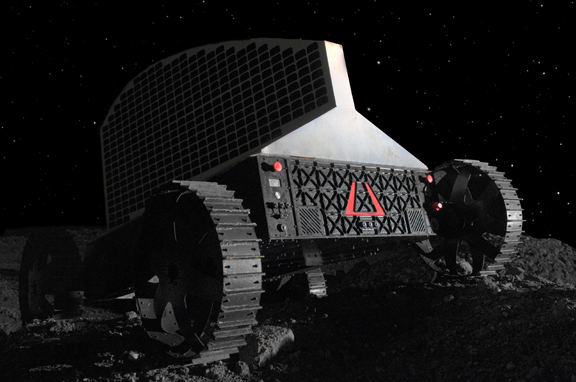
Astrobotic, a Pittsburgh-based space robotic technology developer, is currently one of the teams competing for the $30 million Google Lunar X Prize. To win, Astrobotic and roughly 20 other teams are racing against one another — and against time — to be the first "to safely land a robot on the surface of the Moon, have that robot travel 500 meters over the lunar surface, and send video, images and data back to the Earth," as the rules specify.
Since Astrobotic relies on software driven simulation, conducted primarily in ANSYS and MathWorks MATLAB, the company can improve its odds in the competition by speeding up its simulation workflow. But Astrobotic came up against the "dead node" issue — workstations that became unavailable for other uses because their resources were fully consumed in simulation computing.
Then Astrobotic discovered the power of a GPU-accelerated HP Z800 workstation. Equipped with NVIDIA Maximus technology, the system came with not one but two GPUs: a NVIDIA Quadro GPU to address CAD-related visualization; a NVIDIA Tesla GPU to address compute-intense simulation jobs.
ANSYS, Astrobotic's primary simulation software, is already refined to take advantage of GPU-acceleration. Jason Calaiaro, Astrobotic's CIO, said, “The NVIDIA Maximus-powered system is like getting three people’s worth of use on a single machine. This system is a beast. We haven’t yet found anything it can’t handle, even simultaneous CAD, analysis, and additional number crunching in remote rendering jobs.”
With the new workstation, Astrobotic was able to bring life back into its dead nodes. Now, engineers can design and simulate simultaneously on the same machine.
In the above podcast, Jason Calaiaro, Astrobotic's CIO, goes into greater details on his experience with NVIDIA Maximus technology.
 In the above podcast, Louis Gaiot, HP's graphics & compute solutions product manager, discusses HP's GPU-accelerated Z series workstations; and Srinivas Kodiyalam, NVIDIA's strategic alliances manager, HPC applications, discusses the type of simulation jobs that can benefit from GPU's parallel processing power.
For more information on how Astrobotic and other companies sped up their workflows, download the whitepaper "Design and Simulate in Parallel," which was by DE editors and sponsored by HP and NVIDIA.


Kenneth Wong is Digital Engineering's resident blogger and senior editor. Email him at [email protected] or share your thoughts or suggestions at digitaleng.news/facebook.
Follow DE
Join over 90,000 engineering professionals who get fresh engineering news as soon as it is published.






About Us · Contact Us · Editorial Team · Advertising · Privacy Policy · Subscriber Services · © 2026 Digital Engineering 24/7 · Peerless Media