Helping design and engineering professionals discover, evaluate and specify technologies and processes that shorten the design cycle and enable success.



Digital Engineering April 2026
In the latest issue of Digital Engineering, we take a look at the latest innovations in design for additive manufacturing, including the use of natural language inputs, social media cosplayers, and AI integration. The issue also includes a feature…

January Special Focus Issue: Design for Additive
In this Special Focus Issue of Digital Engineering, learn about the latest advancements in design for additive manufacturing, including new software tools, additive in automotive, custom medical devices, and more.
Robotics was (and is) another transformative technology, and while the promise of a robot servant in every home hasn’t quite materialized, there can be no question the technology has changed the face of manufacturing. Given the generally modular nature of robots, it was only a matter of time before AM and robotics joined forces, and that time is at hand.
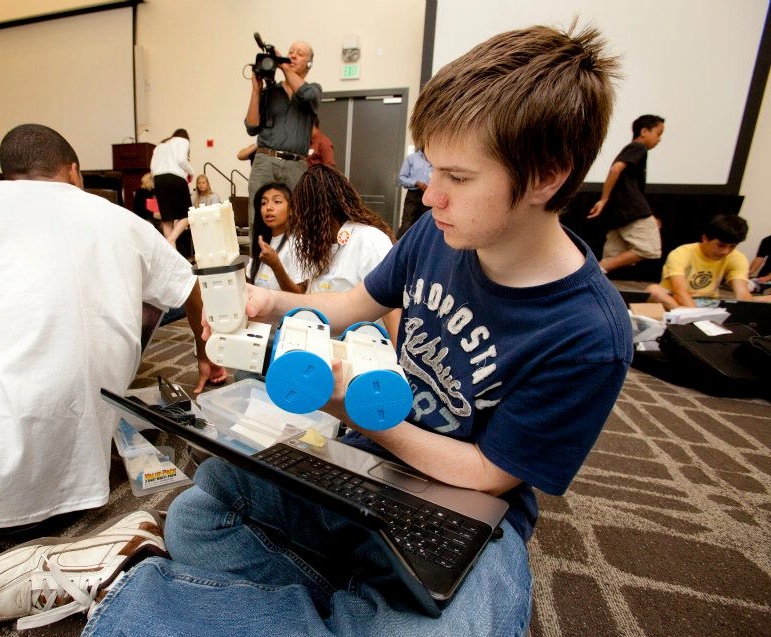
Barobo makes robots designed for education, rather than manufacturing, and has rolled out a new method of making robots more accessible than ever using 3D printing as its medium. The company has hosted plans for its customizable Mobot on its website (available for free download) that can be built and modified using AM.
“We’re breaking from traditional business models and relying on our users to, not just assemble the robot, but play an active role in manufacturing the plastic parts,” said Graham Ryland, president and co-founder of Barobo. “We’ve proven the technology in the classroom and want to get it into students’ hands as quickly and cheaply as possible. Relying on customers to manufacture their own plastic parts wasn't an option just a few years ago, but 3D printing technology has made this new way of rolling out an educational product possible."
Robots are one way to get students interested in STEM (science, technology, engineering and math) fields at an early age. By offering the plans for free, Barobo is giving schools the chance to enrich their curriculum for the price of Mobot kit, which runs a reasonable $139.95, plus materials involved in 3D printing.
The Mobot consists of several flexible robot parts that can be fixed together with plastic connection pieces. With the flexibility of AM, students will be able to design original connections for the Mobot, further enhancing its educational value.
While this particular robot is fairly simplistic, the general idea of using AM to design a robot specifically for your needs seems solid to me. A larger 3D printer and more complex circuitry could give companies a way to modify their robotic labor force without having to go to outside sources. This could lead to savings in both time and money, and highlights the potential of AM.
Below you’ll find a video about the Mobot.
Source: PRWeb


John Newman is a Digital Engineering contributor who focuses on 3D printing. Contact him via [email protected] and read his posts on Rapid Ready Technology.
Follow DE
Join over 90,000 engineering professionals who get fresh engineering news as soon as it is published.






About Us · Contact Us · Editorial Team · Advertising · Privacy Policy · Subscriber Services · © 2026 Digital Engineering 24/7 · Peerless Media