Helping design and engineering professionals discover, evaluate and specify technologies and processes that shorten the design cycle and enable success.


Interactive Supercomputing Wins $150,000 Government Grant
Interactive Supercomputing Inc. (Waltham, MA) was awarded a U.S. research grant aimed at parallelizing popular desktop computing applications to run on high-performance computers. The $150,000 grant from Oak Ridge National Labs (Oak Ridge, TN) will be used to develop toolkits that parallelize the algorithms and models resulting from popular desktop technical computing software such as MATLAB, Python, R, and IDL, also called Very High Level Language (VHLL) applications.
The goal of the grant is to enable scientists and engineers to tap the parallel processing capabilities of high-performance computers while minimizing development time.
The Oak Ridge National Labs project will explore where it is best to parallelize codes written in a VHLL, with potential applications including climate modeling, nanotechnology, biology, and modeling fusion reactions. The project will use existing mathematical libraries and solvers on the servers, accessing them from a VHLL on the desktop.
ISC’s Star-P software will serve as the project’s testing platform. Star-P is an interactive parallel computing platform that allows users to code algorithms and models on the desktop using familiar VHLLs and then run them on parallel servers or clusters without re-programming in C, Fortran, or MPI.
“Considering the growing importance of parallel computing architectures,” said Eckart Jansen, VP of advanced development at ISC, “as well as the scientific reach of the Oak Ridge National Labs, this ... should have a big impact in many areas of science, such as clean energy, environmental protection, and national security.”
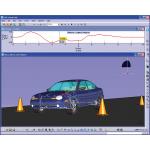
LMS International (Leuven, Belgium), which develops simulation and testing systems for the automotive industry, and IPG Automotive (Karlsruhe, Germany) entered into a partnership to integrate IPG-DRIVER, IPG’s virtual driver model, into the LMS Virtual.Lab Motion software.
 |
| LMS International |
The newest release from Hewlett-Packard (Palo Alto, CA), based on BladeSystem infrastructure, gives users the ability to access workstation compute power using client devices or Microsoft Windows-based workstations, PCs, and notebooks. The new HP ProLiant Blade Workstation is designed for users in manufacturing as well as the public sector and financial trading.
Specific workstation features include fully certified and supported HP Remote Graphics software, real-time streaming video, 3D graphics, and multiple display support. Additional benefits and enhancements include improved data security, disaster recovery support, system uptime, and easy availability and scalability.
Lloyds TSB Corporate Markets (London, UK) recently customized its 255-position trading floor with 280 HP ProLiant xw25p Blade Workstations. The devices are used by traders in the foreign exchange, derivatives, and global commodities markets, as well as by sales traders in the derivatives and interest-rate trading markets.
More information on the new Blade System is available on the HP workstations page.
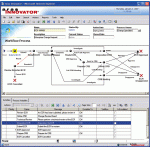
Jettisoning its old licensing model in favor of free and open-source software, Aras Corporation (Lawrence, MA) has announced it will forego a traditional sales force and beef up its service and consulting forces as it offers Aras Innovator 8 exclusively on the Microsoft .NET platform.
“Open source means unlimited user access to the system,” said Aras President Peter Schroer during a recent phone conference. Schroer went on to explain that his company was switching its licensing model to wipe out the big upfront capital expenditure obstacle many companies face when looking at a product lifecycle management (PLM) application. “By delivering the Aras Innovator solutions as enterprise open source on Microsoft, we provide software licensing simplicity and align with the technologies that companies already have and understand.”
 |
| Aras Corp. |
Visual Numerics, Inc. (Houston, TX) will integrate and distribute the Intel Math Kernel Library (Intel MKL) with its IMSL Fortran Numerical Library version 6.0 early this year. In addition to a substantial performance increase for IMSL Fortran users, Visual Numerics says the combination will improve support for IMSL library customers on Intel processor-based platforms. The bundle covers both distributed and shared memory models.
More specifically, Visual Numerics plans to bundle the Intel optimized BLAS, LAPACK, and ScaLAPACK functionality from the Intel Math Kernel Library into the company’s IMSL Fortran Numerical Library.
Intel MKL is a set of mathematical functions for engineering, scientific, and financial applications requiring high performance on Intel processors. The joint offering provides improved IMSL computational performance across all Intel platforms including Intel Core 2 Duo, Pentium 4, Itanium 2, and the new Dual and Quad-Core Intel Xeon processors.
Capvidia (Leuven, Belgium), a developer of 3D CAD translation software, and Jotne EPM Technology (Oslo, Norway), a software company for industrial data management, have joined forces to launch a new product for long-term 3D data archiving.
EDMmodelServer for 3D and PLM will support the implementation of the EN9300 standard (LOTAR) for archiving 3D data and has been extended to include verification of 3D STEP models via Capvidia’s proprietary 3DTransVidia technology, which solves data incompatibility problems resulting from non-uniform 3D model interpretations by different CAD systems.
We incorrectly reported the memory capability of the Dell Precision 490 workstation in the January issue. Click here for the Precision 490 review. In fact, up to 32GB of RAM can be accommodated by the Precision 490 using 4GB DIMMs.
To vote for your favorite from this issue, go to the last page of the Products section by clicking here.

DE's editors contribute news and new product announcements to Digital Engineering. Press releases may be sent to them via [email protected].
Follow DE
Join over 90,000 engineering professionals who get fresh engineering news as soon as it is published.






About Us · Contact Us · Editorial Team · Advertising · Privacy Policy · Subscriber Services · © 2026 Digital Engineering 24/7 · Peerless Media