Helping design and engineering professionals discover, evaluate and specify technologies and processes that shorten the design cycle and enable success.



May 2026 Special Focus: Artificial Intelligence in Design and Simulation
In this Special Focus Issue, learn about the latest developments in the integration of artificial intelligence into engineering workflows.

April 2026 Special Focus Issue: Generative Design
In this Special Focus Issue, Digital Engineering takes a look at how generative design solutions can be used across different types of design problems and with a variety of manufacturing approaches to accelerate design space exploration, and…
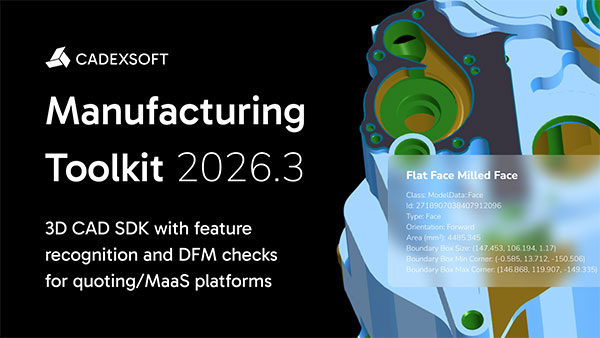
CADEXSOFT has released Manufacturing Toolkit 2026.3 — a CAD SDK for developers building quoting and model-as-a-service platforms, with design for manufacturability checks, native B-Rep, feature recognition, and web visualization.
Manufacturing Toolkit 2026.3 highlights:
Feature recognition updates
The updated recognition logic now identifies shallow and narrow forming features as beads more consistently, improving classification accuracy for typical sheet metal reinforcement geometry. CNC machining feature recognition has been improved to prevent cylindrical or conical geometry containing internal elements from being incorrectly recognized as holes or countersinks.
Wall Thickness updates
Wall Thickness analysis has been extended with the introduction of the new Ray Marching algorithm and updated analyzer parameters.
Wall Thickness functionality has also been extended across the MTK ecosystem. MTK Web examples have been reworked with improved thickness-based coloring, configurable thickness ranges for custom color mapping, and interactive display of thickness values on mouse hover at any point on the model surface.
MTK Workbench now allows users to set the Ray Marching method directly in the UI, supports vertex selection in triangle inspection mode, and displays thickness values in tooltips at triangle vertices.
Nesting updates
Nesting support has been extended across the Manufacturing Toolkit ecosystem. MTK Workbench now includes a dedicated Nesting mode that allows running nesting computations for specified patterns directly from the UI.
MTK Web updates
The updated measurement application programming interface includes:
MTK Workbench updates
Structure View usability has been improved with keyboard navigation, “expand all” and “collapse all” actions for large branches, and support for displaying the Model object as the root item together with its properties.
The Measurements module now supports axis-aligned bounding box (AABB), oriented bounding box (OBB), and bounding cylinder measurements. AABB visualization and related information are now also available directly in the Properties panel.
Machining mode has been improved with explicit hole grouping by diameter, while feature display now shows diameters instead of radii for clearer manufacturing-oriented interpretation. DFM Analysis now validates parameters against allowed ranges.
Sources: Press materials received from the company and additional information gleaned from the company’s website.

The company has developed a Manufacturing Toolkit that is an all-in-one software development kit

DE's editors contribute news and new product announcements to Digital Engineering. Press releases may be sent to them via [email protected].
Follow DE
Join over 90,000 engineering professionals who get fresh engineering news as soon as it is published.






About Us · Contact Us · Editorial Team · Advertising · Privacy Policy · Subscriber Services · © 2026 Digital Engineering 24/7 · Peerless Media