Helping design and engineering professionals discover, evaluate and specify technologies and processes that shorten the design cycle and enable success.




Digital Engineering April 2026
In the latest issue of Digital Engineering, we take a look at the latest innovations in design for additive manufacturing, including the use of natural language inputs, social media cosplayers, and AI integration. The issue also includes a feature…

January Special Focus Issue: Design for Additive
In this Special Focus Issue of Digital Engineering, learn about the latest advancements in design for additive manufacturing, including new software tools, additive in automotive, custom medical devices, and more.
3D Systems reports that Cadillac Formula 1 Team, the newest entrant to the FIA Formula One World Championship, deployed seven SLA 3D printing systems to advance wind tunnel testing prior to the 2026 Formula 1 season and for development of production parts.
The combination of these large-format additive manufacturing systems, integrated with 3D Systems software, along with Accura Xtreme White 200, Accura Xtreme Blackand Accura HPC materials, enabled fast, critical wind tunnel testing within diminishing race deadlines, 3D Systems reports.
3D Systems’ SLA solutions are developed specifically for production-grade manufacturing delivering tin sharp part corners, small extruded and embossed feature details, side wall details and layer lines on angled faces. It enables tool-free manufacturing, eliminating weeks of lead time and reducing costs, 3D Systems reports.
The Cadillac Formula 1 Team worked hard to meet the barriers to entry and secured its place in the 2026 Formula 1 season in time for the Formula 1 Qatar Airways Australian Grand Prix 2026 in March.
The team worked with 3D Systems’ Application Innovation Group (AIG), a global team of additive manufacturing engineers, designers, and technicians.
“3D Systems was founded on innovation, pioneering the additive manufacturing industry and we are continuing to lead it into an era of high-precision, highly repeatable production at scale,” says Elvis Perez, senior vice president, Sales, 3D Systems. “We are pleased that our work has enabled Cadillac Formula 1 team to enter the 2026 Formula 1 season despite the short timelines and strict qualification conditions.”
Sources: Press materials received from the company and additional information gleaned from the company’s website.

From digitization, design and simulation through manufacturing, inspection and management, our comprehensive portfolio of technologies provides a seamless, customizable workflow designed to optimize products and processes while accelerating…
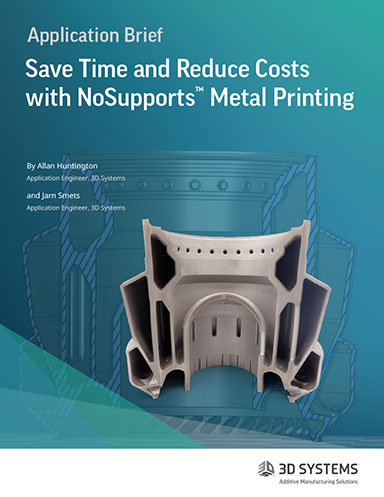
Save Time and Reduce Costs with NoSupports™ Metal Printing
Metal 3D printing is a high energy process in which it is possible for unmanaged heat and stress to build up and impact part quality, this guide presents a step-by-step methodology for how to apply NoSupports to a hot end section of a larger turbomachinery part.

DE's editors contribute news and new product announcements to Digital Engineering. Press releases may be sent to them via [email protected].
Follow DE
Join over 90,000 engineering professionals who get fresh engineering news as soon as it is published.






About Us · Contact Us · Editorial Team · Advertising · Privacy Policy · Subscriber Services · © 2026 Digital Engineering 24/7 · Peerless Media