Helping design and engineering professionals discover, evaluate and specify technologies and processes that shorten the design cycle and enable success.


Alert!
Digital Engineering ceased publication on July 1, 2026. This website remains available as an archive of engineering content.
For inquiries or information, please email [email protected].

Digital Engineering April 2026
In the latest issue of Digital Engineering, we take a look at the latest innovations in design for additive manufacturing, including the use of natural language inputs, social media cosplayers, and AI integration. The issue also includes a feature…

January Special Focus Issue: Design for Additive
In this Special Focus Issue of Digital Engineering, learn about the latest advancements in design for additive manufacturing, including new software tools, additive in automotive, custom medical devices, and more.
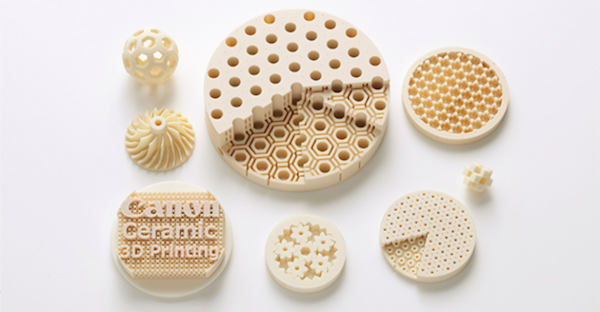
Canon has developed a new proprietary ceramic material and 3D printing technology to create ceramic parts with complex geometries. The company says the new material will perform better than existing ceramic materials for 3D printing, which often contain resin and experience significant shrinkage during the post-annealing process.
Because of the properties of the new material, the printed parts can be made with greater accuracy, as well as heat and corrosion resistance, according to the company.
The alumina-based material can be used with selective laser melting (SLM) machines and Canon’s new parts production solution. According to the company:
“Through this technology, a 3D printer can be used to stably produce ceramic parts with such complex geometries as hollow and porous structures, which are difficult to achieve through ordinary metal molding or cutting processes. For example, when creating honeycomb shapes with hexagonal hollows and a diameter of approximately 19 mm, parts can be produced with high accuracy with differences in external dimensions before and after the annealing stage of less than 0.8%.”

Canon is targeting a variety of markets, including parts for electric furnaces and industries where parts are subjected to chemical exposure. Both Canon and its Canon Machinery division are evaluating the technology for internal applications, including prototyping parts for industrial equipment.
Canon also plans to expand the use of the new print technology to medical applications by developing compatible materials for prototyping and small-lot environments.
Canon originally entered the 3D printing market in 2015 with a resin-based print technology and a partnership with 3D Systems. In 2017, the company introduced an entry-level 3D printer (the Marv FDM printer) in the Chinese market. Earlier this month, UK-based 3D print service bureau Hobs 3D acquired the 3D printing assets of Canon UK.
Source: Canon

Canon U.S.A., Inc. is a leader in professional business and consumer imaging equipment and information systems. Our extensive product line and digital solutions enable businesses and consumers worldwide to capture, store, and distribute…

Brian Albright is the editorial director of Digital Engineering.
Contact him at [email protected].






About Us · Contact Us · Editorial Team · Advertising · Privacy Policy · Subscriber Services · © 2026 Digital Engineering 24/7 · Peerless Media