Helping design and engineering professionals discover, evaluate and specify technologies and processes that shorten the design cycle and enable success.



Digital Engineering April 2026
In the latest issue of Digital Engineering, we take a look at the latest innovations in design for additive manufacturing, including the use of natural language inputs, social media cosplayers, and AI integration. The issue also includes a feature…

January Special Focus Issue: Design for Additive
In this Special Focus Issue of Digital Engineering, learn about the latest advancements in design for additive manufacturing, including new software tools, additive in automotive, custom medical devices, and more.
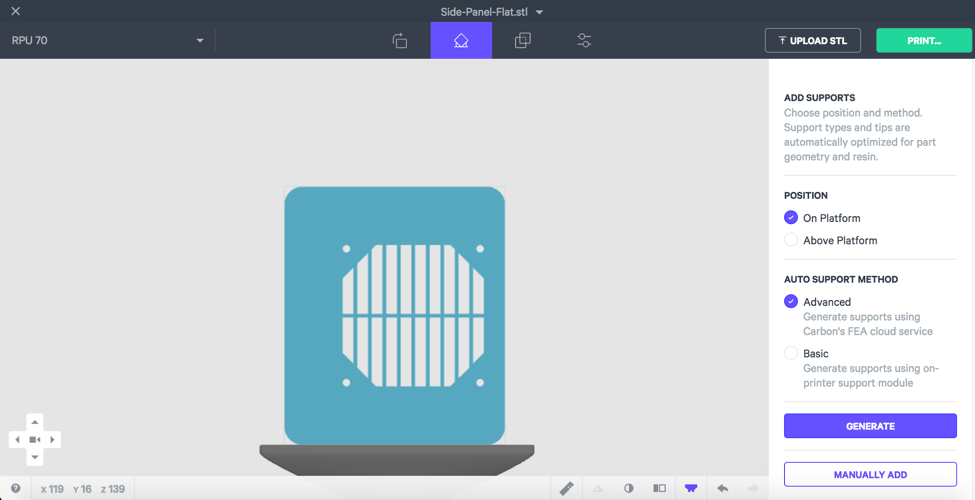 User-friendly interface for Carbon's 3D-print system, showing support-creation options: generated automatically, either locally or via cloud-based simulation, or manually. Image courtesy of Carbon.
Carbon is one of those companies that realize hardware, software and materials play equal roles in getting to that best-and-final result. Not only does it generate software updates every six weeks, it sees how simulation is crucial to getting the most out of each design iteration, fast. “Carbon’s software creates a digital canvas on which every cubic millimeter of a part can be designed, controlled, and optimized before it’s printed,” says Roy Goldman, director of software at Carbon.
Kirby Freeman, Carbon software product manager, says the Advanced Auto Supports feature creates an optimized support-structure layout based on finite element analysis (FEA) of expected stresses as the part builds up. There are also manual support design-options (calculated locally on the printer) where users can choose either classic “bar” or newer “fence” type structures. All the tools can be applied on one part, so users can fine-tune as desired. “We encourage users to analyze many orientations of their parts to find the ones that meet their needs (e.g., lower stresses, cosmetic surfaces that are unsupported, ability to fit many parts in one build),” she says.
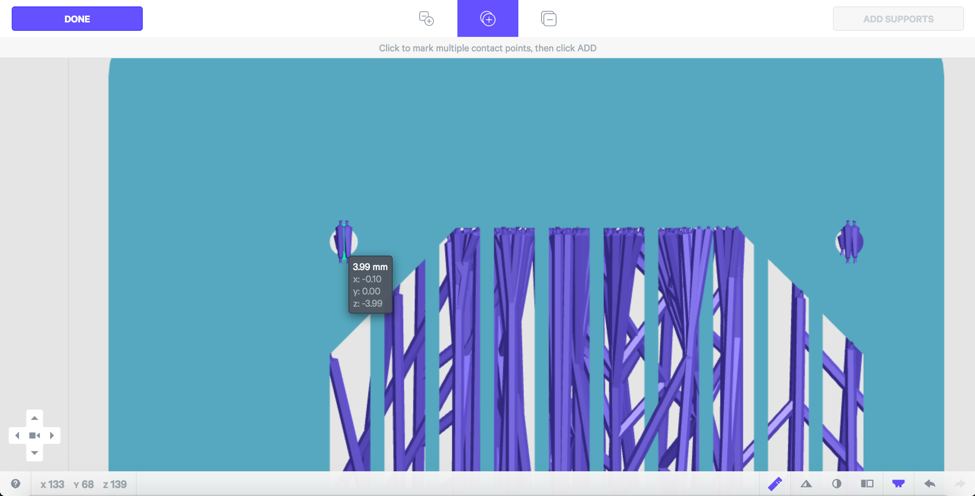
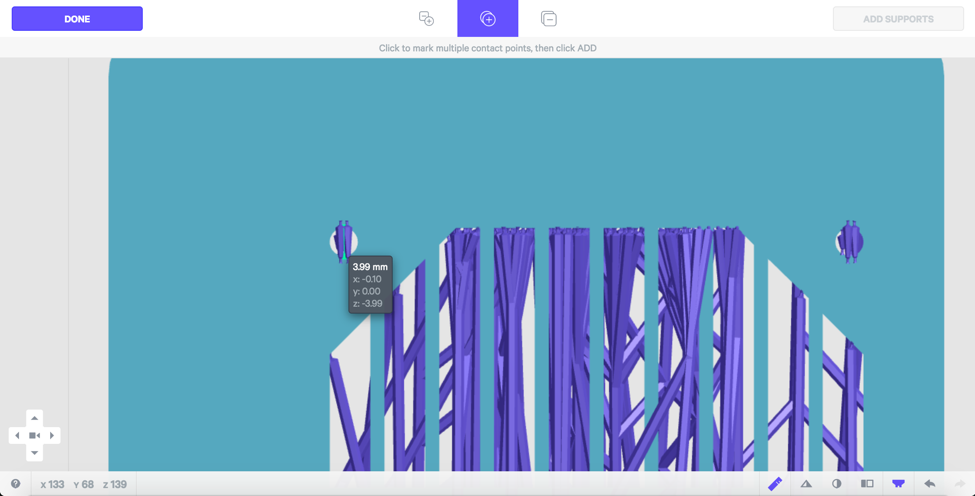 Close-up of part (turquoise) prepared for 3D printing on Carbon systems, showing Advanced Auto Supports added (blue). Number, size and placement of supports determined using Carbon’s FEA-based simulation software. Image courtesy of Carbon.
Clear, visual results showing the ready-to-print 3D part in the layout volume belie the sophisticated math and engineering taking place through cloud-based compute solution. Not only are the support structures derived from part geometry – such as height of a given point above the build platform – but also from the mechanical properties of the build material.
The FEA simulation uses a moving domain analysis to model Carbon’s Digital Light Synthesis (DLS) technology down to the micron level throughout the build process, then predicts potential warping and/or cracking. For a given part orientation, the software calculates where to place support bars or a fence-structure to counteract such problems. There’s no need for a user to understand meshing strategies, the green strength of the build-material or the physics of DLS itself.
“Intelligently derived support structures help, but they’re just the start of the story,” Freeman points out. “We’re racing to stay ahead of the products our customers want to make. The simulations are the bigger story; we know that the industry needs tools that focus not just on getting out one prototype, but that allow people to design new geometries and then iterate toward the accurate, cost-effective manufacturing of thousands of parts. This release is an important step towards bringing design and manufacturing-grade tools to the additive space.”
For another take on this news from Carbon, see “Carbon 3D Print Software Updated,” a DE’s Editor’s Pick of the Week.


Pamela Waterman worked as Digital Engineering's contributing editor for two decades. Contact her via DE-Editors@ digitaleng.news.
Follow DE
Join over 90,000 engineering professionals who get fresh engineering news as soon as it is published.






About Us · Contact Us · Editorial Team · Advertising · Privacy Policy · Subscriber Services · © 2026 Digital Engineering 24/7 · Peerless Media