Helping design and engineering professionals discover, evaluate and specify technologies and processes that shorten the design cycle and enable success.


CD-adapco reports that one of the major technological advancements in STAR-CCM+ v10.02 is the introduction of a new capability for the remote execution of a CAD client. This feature, explains the company, allows users to make changes in the CAD software through STAR-CCM+ while it’s running on a remote cluster.
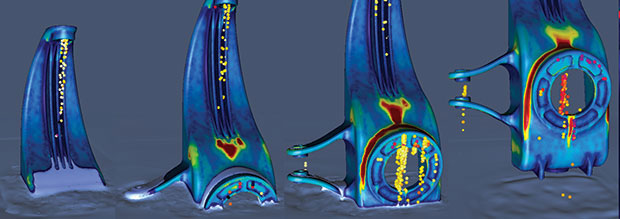 This STAR-CCM+ v10.02 image shows a time lapse of a dip-coating process of an armature. A new computationally affordable feature in STAR-CCM+ v10.02 combines the volume of fluid and fluid film modeling capabilities to predict the paint thickness on a part and the droplets of excess paint falling away from the part. Image courtesy of CD-adapco.
Also added to the technology is functionality for multiphase modeling with a new interaction model between VOF (volume of fluid), Fluid Film and Lagrangian models. This capability, CD-adapco says, “dramatically” lowers computational costs and mesh counts. The company adds that this also opens up new application areas, such as crankcase and gearbox sloshing in addition to parts dipping and coating.
Also new in version 10.02 is a Large Scale Interface (LSI) multiphase model that combines the benefits of VOF and Eulerian Multiphase modeling, which, in essence, captures many different co-existing flow regimes. STAR-CCM+ v10.02 also sees enhancements to its Eulerian Multiphase, VOF and DEM (discrete element method) features.
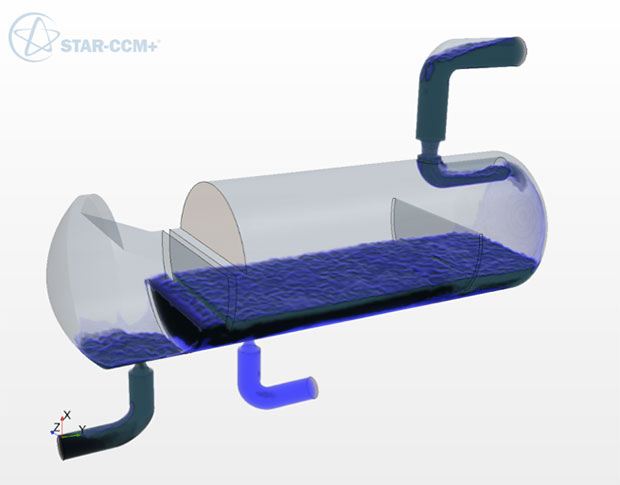 A new Large Scale Interface (LSI) multiphase model introduced in STAR-CCM+ v10.02 allows users to combine mixed and stratified flows. This example shows a mixture of oil and water entering a separation device then stratifying due to gravity. Image courtesy of CD-adapco.
CD-adapco says that the highlight of version 10.02’s user experience is a new standalone, complimentary and license-free tool called STAR-View+. With STAR-View+, users can view and interact with a light representation of the original file as well as collaborate and share simulation results with colleagues. STAR-View+ supports animations of scenes, transient results and recording of interactions.
Additional user experience enhancements reported by CD-adapco include faster display latency and improved graphical interaction due to enhanced GPU (graphics processing unit) interaction. GPU interaction features include the ability for users to adjust the strain put on the GPU while rendering. The user experience has also been enriched with adjoint-based error estimation as well as betterments to mesh deviation analysis and the depth selection mode, according to the company.
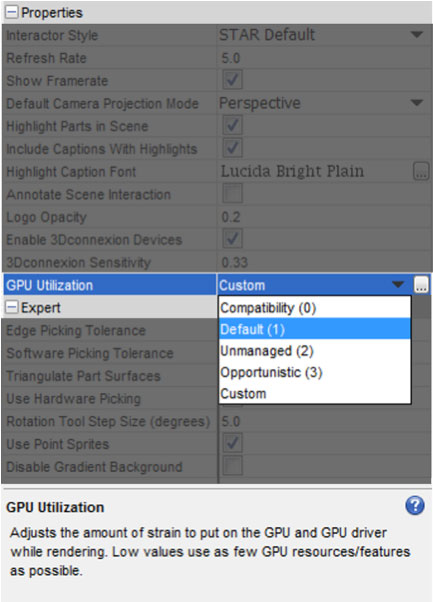 STAR-CCM+ v10.02 debuts new graphics utilization features that enable users to adjust the strain put on the GPU while rendering. Image courtesy of CD-adapco.
Productivity enhancements, the company states, include “significantly reduced” turnaround time for data mapping, condensed scalability and memory usage. Users can now also report on parts without affecting performance while solving, and a Parts-based thin mesher gives users the flexibility to construct custom workflows for an application at hand.
The company reports that the STAR-CCM+ v10.02 platform incorporates 40 new features that were suggested by the CD-adapco community. Among these is Wake Refinement, which adds a draft angle to more accurately capture the wake behind parts.
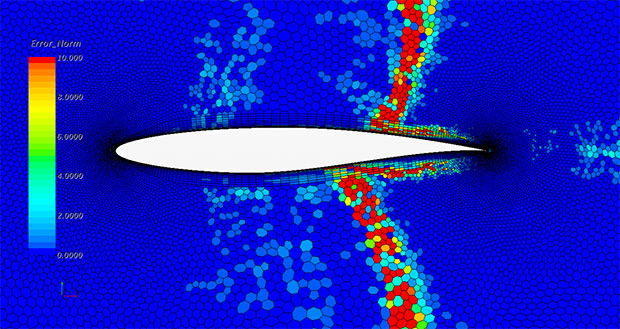
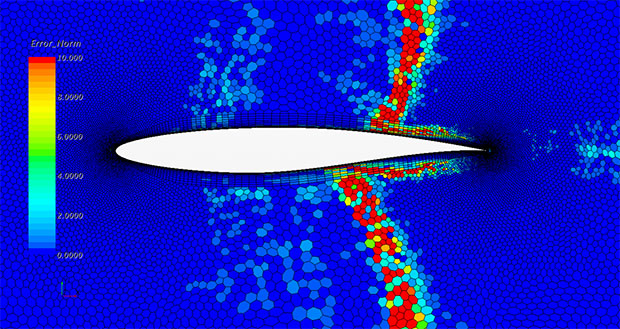 The STAR-CCM+ adjoint error estimation functionality shows where in the mesh the greatest error is with respect to cost functions. Users can utilize data to refine or coarsen a mesh using table refinements. This screen shot depicts a field showing the errors affecting the drag on an airfoil. Image courtesy of CD-adapco.
“Our vision for MDX will make our customers more competitive in their marketplace,” said Jean-Claude Ercolanelli, senior vice president of Product Management at CD-adapco, in the STAR-CCM+ v10.02 press announcement. “This is achieved by providing robust, automated, and smart technologies that enable engineers to maximize the output of their simulations through designs exploration. In addition, our ongoing commitment to enrichments in the customer experience and productivity improvements allows our users to maximize the benefits of MDX.”
For more information, visit CD-adapco.
Learn more about Large Scale Interface modeling in STAR-CCM+ v10.02.
Learn more about adjoint-based error estimation improvements in STAR-CCM+ v10.02.
Learn more about wake refinement and Parts-based thin meshing.
See why DE's editors selected STAR-CCM+ v10.02 as their Pick of the Week.
Sources: Press materials received from the company and additional information gleaned from the company's website.


Anthony J. Lockwood is Digital Engineering's founding editor. He is now retired. Contact him via [email protected].
Follow DE
Join over 90,000 engineering professionals who get fresh engineering news as soon as it is published.






About Us · Contact Us · Editorial Team · Advertising · Privacy Policy · Subscriber Services · © 2026 Digital Engineering 24/7 · Peerless Media