Helping design and engineering professionals discover, evaluate and specify technologies and processes that shorten the design cycle and enable success.


Sponsored
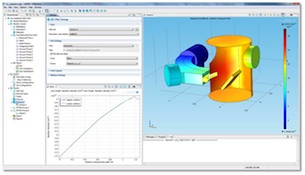
Dear Desktop Engineering Reader: Disclosure: I do word-weenie work on occasion for COMSOL, the sponsor of today's Check It Out video. I'm paid for this write-up by DE. The opinion expressed is mine. Neither organization tried to influence my opinion. COMSOL recently introduced the Microfluidics Module as an extension to its core product, COMSOL Multiphysics. Although COMSOL Multiphysics is an industrial-strength operating environment for modeling and simulating physics-based systems, it has a user interface that makes it readily accessible to occasional users, such as designers, as well as power users. From that user interface, you define your geometry and meshes, specify your physics, solve, and visualize your results. It has predefined physics interfaces -- which are also user-definable -- for analyses like fluid flow, heat transfer, structural mechanics, and electromagnetics. The important thing -- which returns us to the subject of today's Check It Out -- is that COMSOL Multiphysics is engineered almost as if it were a mathematics/physics kernel. This attribute means two things. First, your fundamental math, PDEs (partial differentiation equations), and physics algorithms are defined in terms of functionality -- integrated and coded for efficiency, extensibility, and adaptability. Two, all that engineering infrastructure plus the user interface, visualization algorithms, etc. are standardized to provide the same functions and operations across multiple platforms. This creates an environment where you can study multiple physics phenomena in a single run. It also means that COMSOL can develop highly specialized, highly efficient extension modules that focus solely on the unique, complex algorithms required for a given type of physics situation without burdening the module with the overhead that bogs down a lot of single-purpose software and applications that are kludges of disparate tools. The Microfluidics Module is that sort of efficient extension. It builds off COMSOL Multiphysics and enables you to study microfluidic devices and rarefied gas flows. For example, it has tools for single- and multi-phase flows, transport and chemical reactions, flow in porous media, and rarefied flows. Since the Microfluidics Module leverages COMSOL Multiphysics, you can couple your modeling of these effects with thermal and electromagnetic effects. Application areas such as lab-on-chip devices, digital microfluidics, biosensors, electrokinetic and magnetokinetic devices, inkjet technology, and vacuum system design are within in the Microfluidics Module's purview. COMSOL supplies the Microfluidics Module with a suite of tutorials. Today's Check It Out is one of them. It'll give you the idea of what this module can do for you far better than anything I can say. Hit the link -- no registration required -- and take a few minutes to watch an analysis that you might never have seen before. Thanks, pal. -- Lockwood Anthony J. Lockwood |


DE's editors contribute news and new product announcements to Digital Engineering. Press releases may be sent to them via [email protected].
Follow DE
Join over 90,000 engineering professionals who get fresh engineering news as soon as it is published.






About Us · Contact Us · Editorial Team · Advertising · Privacy Policy · Subscriber Services · © 2026 Digital Engineering 24/7 · Peerless Media