Helping design and engineering professionals discover, evaluate and specify technologies and processes that shorten the design cycle and enable success.


Alert!
Digital Engineering ceased publication on July 1, 2026. This website remains available as an archive of engineering content.
For inquiries or information, please email [email protected].
Sponsored

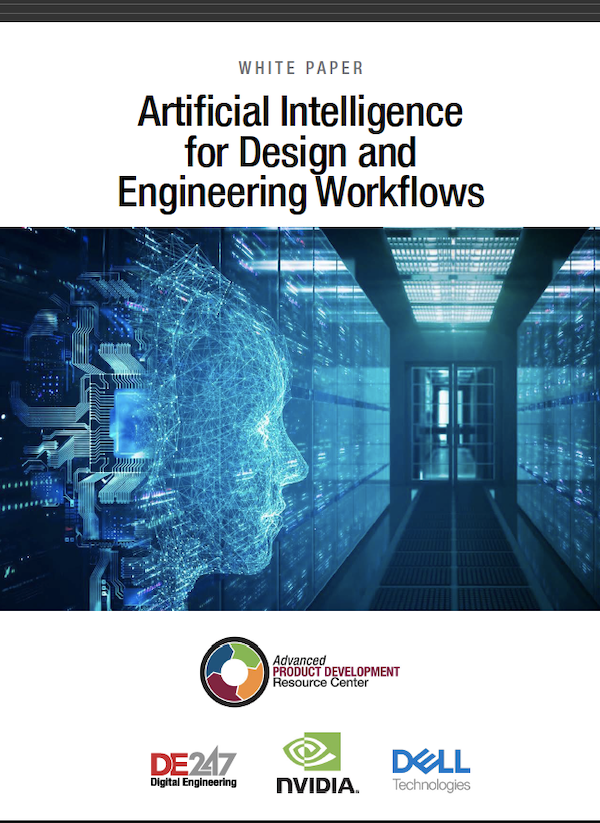
Artificial Intelligence for Design and Engineering Workflows
In this white paper, learn how artificial intelligence and machine learning can improve design and simulation.

Technology Focus: Designing for Optimization & Simulation
Simulation is pervasive, with people from different departments and backgrounds discovering new ways to put it to use, in all of its varied forms.
In October at a series of user events, COMSOL unveiled the latest features in its COMSOL Multiphysics 6.4 software. The release includes a significant expansion of GPU acceleration support, something that had previously only been available in some niche workflows within the solution.
COMSOL partnered closely with NVIDIA, leveraging the chipmaker's NVIDIA cuDSS (Cuda Direct Sparse Solver).
We spoke to Bjorn Sjodin, vice president of product management at COMSOL, about GPU acceleration.
For COMSOL users, what will GPU acceleration mean for them? What types of improvements can they expect? Will their update process for the product change at all?
Bjorn Sjodin: In previous releases we added niche support for GPU acceleration, whereas now we are doing so widescale. In previous versions, we added GPU support for people working with acoustics, to simulate cabin acoustics in automotive, or room acoustics for office spaces or concert halls. A few releases ago, we also added GPU acceleration for neural network training to accelerate the creation of simulation applications in our Application Builder. That can be accelerated with surrogate models.
NVIDIA has released a solver (NVIDIA cuDSS) that they have developed for GPUs that is a matrix algebra solver, which is exactly what we need for our multiphysics simulations in COMSOL. The nice thing for us then is that these types of solvers they have added can be used for any type of physics. We have seen benchmarks where it performs up to 5X faster than our current CPU-based solvers.
Do you have recommended hardware configurations to support the GPU features (i.e., memory, specific NVIDIA cards, etc.)?
The main thing for users to know is that they must have NVIDIA GPUs. As long as you have a modern NVIDIA GPU, then the software will run on those. If you pay for a more expensive GPU card, you get better performance.
Why did COMSOL decide to expand GPU acceleration in this particular release?
We happened to time the release with the development of this NVIDIA solver, so we will be one of the first software vendors to support this. This wouldn’t be possible without NVIDIA.
What do your users need to know about accessing GPU acceleration in the product and getting the most out of it?
It will be automatically installed by the COMSOL installer. If you have an NVIDIA card, you get this automatically. The main thing users need to be concerned about is whether they have an NVIDIA card.
How does GPU support carry over to the COMSOL Application Builder?
The simulation apps that people can develop with Application Builder in COMSOL are built on the same platform as the main software. Whatever we make available in the full software is available in the simulation apps as well. So GPU support will be available for those apps. That includes compiled simulation apps created with the COMSOL Compiler, which allows you to take applications and compile them to be a standalone executable.

The new release supports OpenAI API for chatbots. How do you view the role of AI in simulation workflows moving forward? Where do you see it having value?
We leverage AI in two ways. One is through surrogate models that can accelerate things like optimization and simulations apps. This compresses the physics model into something fast to evaluate that can be run behind the scenes.
There are also large language models (LLMs). With LLMs, we supported OpenAI models, and now they have created an API that we support in order to connect with solutions like Google Gemini or Claude.
When users open up our chatbot window, it links to their preferred LLM. We have instructed the chatbot to look in our manual first. So we combine the general knowledge the model has, with our manual, and we have noticed it gives much more precise answers. You can get advice on how to improve a design. It could even go so far as to tell you which boundary you should monitor, or which variable you should be concerned about. Another workflow is coding. When you create simulation apps or use our API to automate workflows, the chatbot can help make that coding faster, and can help with debugging models, for example. It’s like having a personal assistant helping you out with your work.
To learn more about NVIDIA cuDSS, read this blog. You can learn more about COMSOL Multiphysics 6.4 here and in this upcoming webinar.


Brian Albright is the editorial director of Digital Engineering.
Contact him at [email protected].






About Us · Contact Us · Editorial Team · Advertising · Privacy Policy · Subscriber Services · © 2026 Digital Engineering 24/7 · Peerless Media