Helping design and engineering professionals discover, evaluate and specify technologies and processes that shorten the design cycle and enable success.




May 2026 Special Focus: Artificial Intelligence in Design and Simulation
In this Special Focus Issue, learn about the latest developments in the integration of artificial intelligence into engineering workflows.

April 2026 Special Focus Issue: Generative Design
In this Special Focus Issue, Digital Engineering takes a look at how generative design solutions can be used across different types of design problems and with a variety of manufacturing approaches to accelerate design space exploration, and…
While every prosthesis is designed to be functional (and some to have artistic merit), they are artificial replacements for living material. Not so with the ear developed by Dr. Jason Spector and Dr. Lawrence J. Bonassar. The bioprinting process uses living material to create a structure that remains alive after being implanted and becomes another functional biological part of the human body.
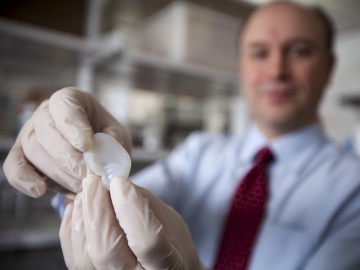
"This is such a win-win for both medicine and basic science, demonstrating what we can achieve when we work together," said Dr. Bonassar, associate professor and associate chair of the Department of Biomedical Engineering at Cornell University.
The research performed by Spector and Bonassar is meant to combat microtia, “… a congenital deformity in which the external ear is not fully developed.” Around four children out of every 10,000 are born with the condition, which usually only effects a single ear. Many times, the inner ear is fully formed, but the outer ear is deformed or missing altogether.
The bioprinting process begins with a 3D scan of an intact ear, to generate a 3D printed mold. Researchers then add animal-derived collagen into the mold, and top it off with nearly 250 million cartilage cells. The collagen acts like a scaffold for the cartilage, directing its growth. Since cartilage doesn’t require a blood supply to survive, the process manages to bypass the need for vascularization, which has yet to be perfected with AM.
"The process is fast," said Dr. Bonassar. "It takes half a day to design the mold, a day or so to print it, 30 minutes to inject the gel and we can remove the ear 15 minutes later. We trim the ear and then let it culture for several days in a nourishing cell culture medium before it is implanted."
From there, the cartilage is given three months to fully grow, slowly replacing the collagen.
"Eventually the bioengineered ear contains only auricular cartilage, just like a real ear," added Dr. Spector.
Once an ear has reached full development, it can be implanted into a patient. Spector and Bonassar say than the best time for implanting the new ear is when a patient is around five or six years old.
"We don't know yet if the bioengineered ears would continue to grow to their full size, but I suspect they will," said Dr. Spector. "Surgery to attach the new ear would be straightforward -- the malformed ear would be removed and the bioengineered ear would be inserted under a flap of skin at the site."
The research team intends to have fully developed the process in the next three years. If the project proves to be successful, it’s just the beginning of what could be possible for bioprinting.
Below you’ll find a video about the process.
Source: Weill Cornell Medical College


John Newman is a Digital Engineering contributor who focuses on 3D printing. Contact him via [email protected] and read his posts on Rapid Ready Technology.
Follow DE
Join over 90,000 engineering professionals who get fresh engineering news as soon as it is published.






About Us · Contact Us · Editorial Team · Advertising · Privacy Policy · Subscriber Services · © 2026 Digital Engineering 24/7 · Peerless Media