Helping design and engineering professionals discover, evaluate and specify technologies and processes that shorten the design cycle and enable success.




May 2026 Special Focus: Artificial Intelligence in Design and Simulation
In this Special Focus Issue, learn about the latest developments in the integration of artificial intelligence into engineering workflows.

Design & Simulation Software Guide 2025
In this Special Issue, Digital Engineering presents its second annual guide to design and simulation software vendors.
Engineers don’t spend a lot of time trying to predict the weather, but they do think about how weather (and other elements) can affect the performance of their designs. Exposure to chemicals, water, salt and other substances can lead to corrosion of metal parts. If engineers can predict the potential effects of corrosion on their designs and how to mitigate them, it can have as much of an impact on product life and performance as mechanical and thermal stresses.
There are a number of corrosion simulation software products now available from vendors like Corrdesa, Elsyca, OLI Systems, COMSOL (the Corrosion Module), BEASY, WebCorr, Thermo-Calc Software and others. With an accurate view of corrosion risk, engineers can optimize design and material selection, recommend mitigation techniques (such as coatings), increase part life, reduce costs and improve sustainability.
Improved corrosion simulation data can have a huge impact on costs. Data reported by the Association for Materials Protection and Performance and the World Corrosion Organization estimates the global cost of corrosion at a whopping $2.5 trillion annually. In 2016, the U.S. Department of Defense (DoD) spent $20 billion on corrosion-related costs. According to market research firm Skyquest, the global anti-corrosion coatings market size reached $33.8 billion in 2023 and is poised to grow from $35.05 billion in 2024 to $46.87 billion by 2032, with a compound annual growth rate of 3.7%.
However, applying simulation to this problem is a relatively novel idea for many companies.
“Corrosion simulation is a new discipline and there is some obvious skepticism,” says Alan Rose, CEO of Corrdesa. “We have to produce tools for many different user profiles and our simulation software needs to link to different silos of design.”
But the benefits can be significant, with Rose noting that an organization like the DoD can save hundreds of millions of dollars by adjusting materials and coating choices through simulation.
Corrdesa was able to create a tool to model galvanic corrosion in part because of electrochemical simulation modules introduced in some CFD packages like Simcenter Star-CCM+ that were targeted at new battery technologies. The corrosion simulation market is growing thanks to additional advancements in compute capabilities and software features.
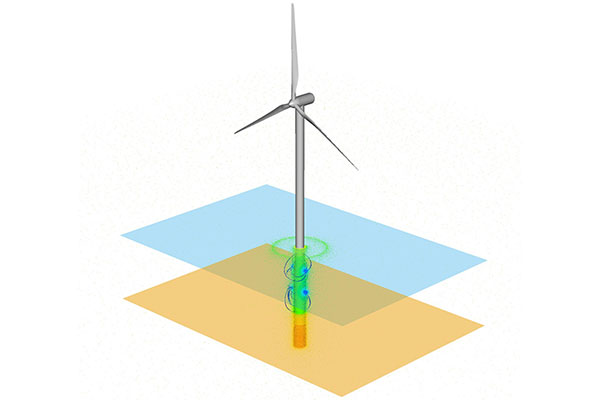
Although Siemens and Corrdesa work closely together, other vendors are developing different tools. The Corrosion Module is an add-on to COMSOL Multiphysics, and lets engineers model corrosion processes and protection systems. According to COMSOL, “the modeling process is streamlined by the software’s capacity to describe the transport processes in an electrolyte, including the transport of ions and neutral species as well as the balance of current in metal structures. The Corrosion Module also includes capabilities for describing in detail the charge transfer reactions that are responsible for corrosion occurring at electrolyte–metal surfaces.”
The solution includes a thermodynamic database with electrode potentials and a selection of kinetic expressions for the most common redox reactions at these surfaces. The software can model corrosion and protection system performance in one, two, and three dimensions using the finite element (FEM) and boundary element methods (BEM).
Elsyca has its origins in electroplating applications. Its CorrosionMaster tools can identify potential corrosion risks in a given design, as well as the efficacy of proposed corrosion mitigation strategies. According to Christophe Baeté, head of the Protect division and corrosion engineering manager at Elsyca, because corrosion is a microscale phenomenon, you need very fine and detailed meshing and a high resolution for corrosion simulation.
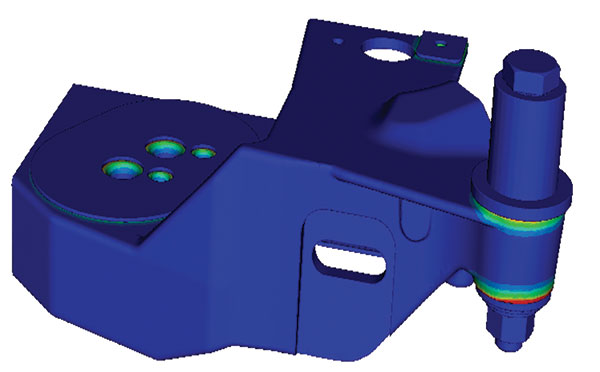
“Besides that, you need boundary conditions. The electrochemistry is defined by the correlation between a potential corrosion and the corrosion current,” he says. “This relationship between potential and current is a polarization curve, which is defined in a laboratory or in the field.”
If there are different metals in an assembly, that can result in different polarization curves. There can also be dissimilar behavior on the same structure with the same material due to environmental variations. Conductivity, for example, will be different if the product will operate in a sea water environment versus a soil-based application.
“That determines how the current will exchange between surfaces and that will control the corrosion,” he says.
Corrosion simulation is very demanding in terms of the required physical data needed for analysis, and can be computationally demanding as well. “To do risk analysis using the polarization data approach, you must have data gathered in the environment to make that analysis,” Rose says. “But once you have it, you can’t wear out the data. We can use it again and again.” He adds that in many applications, there are already sensors in place on airplanes, pipelines and other structures that gather data on salinity, humidity and temperature.
Elsyca works with oil and gas pipeline customers; offshore wind facilities; offshore platforms; vessels/ships; automotive; and defense applications. For example, Elsyca published a case study that includes evaluation of an Audi A6 door model for galvanic corrosion risks.
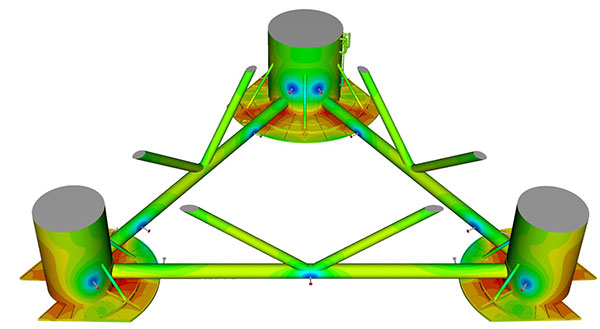
Evaluating two designs (one with a steel-based outer shell, an aluminum-based inner sheet shell and zinc-galvanized steel rivets and screws; the other with the outer and inner shells made of aluminum), they were able to show a greater degree of corrosion in the mixed material design. The simulation results indicated “that undertaking predictive modeling practices in an early phase of the component design is instrumental in proper material selection.”
The Corrdesa tool can be integrated into a commercial CAD system. The software can find each material interface, apply electrochemical data and provide a corrosion risk map to help identify potential hot spots.
Corrdesa has partnered with Siemens Digital Industries Software on a project for the U.S. Air Force to help reduce corrosion risk. Corrdesa combined its expertise in galvanic corrosion prevention applications with Siemens Teamcenter software and Simcenter STAR-CCM+ software. The solution is expected to save the Air Force hundreds of millions of dollars by streamlining corrosion simulation and optimizing designs and material selection. As noted earlier, Corrdesa was already using STAR-CCM+ for electrochemical modeling.
Based on the materials selected, the results provide a prediction of the amount of corrosion or material loss in microns per year. Engineers can analyze different materials to minimize corrosion or add sacrificial or barrier coatings to reduce corrosion. Once the material selection is finalized, the solution can also help create maintenance schedules for the finished structures. (You can read the full case study here.)
There are other emerging approaches that are helping to advance corrosion modeling. Siemens Energy (another division of the company) is using digital twins built on the NVIDIA Omniverse virtual platform to model corrosion in heat recovery steam generators (HSRGs). Steam and water can cause corrosion that affects the lifetime of the parts in these generators, and Siemens estimates that a 10% reduction in planned downtime of 5.5 days for repairing HRSGs could save nearly $2 billion per year.
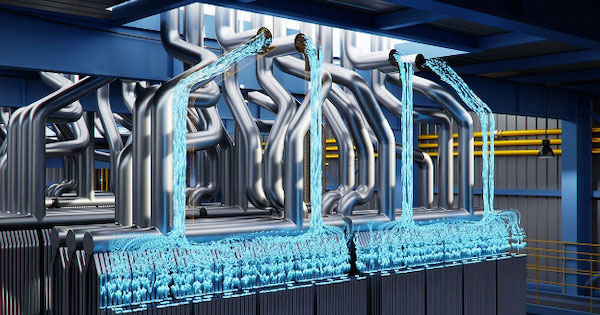
The pressure, temperature and velocity are fed into a physics/machine learning model created with the NVIDIA PhysicsNeMo framework to simulate how steam and water flow through the pipes in real time. The flow conditions in the pipes are then visualized with NVIDIA Omniverse to help Siemens Energy understand and predict the aggregated effects of corrosion in real time. The digital twin lets Siemens Energy simulate the corrosive effects of heat, water, gas and other elements on metal over time, then develop an effective maintenance schedule.
Corrosion simulation tools can also be integrated with other physics. Baeté at Elsyca says that corrosion simulations can be combined with mechanical failure analysis, for example.
“We can do simulations where the metals of components are simulated over time, so each time the corrosion rate is calculated and the metal loss, the CAD model is updated as well as the mesh. You can analyze the reduction in size of the component over time. That’s very valuable if you can combine the thinning of the material with mechanical stress analysis. You can also integrate CFD with corrosion simulation.”
“We have done this, but it’s not a standard workflow yet,” Corrdesa’s Rose adds. “But we have had customers tell us that they do their stress analysis or fatigue analysis based on certain assumptions. Those assumptions can be refined because we can get a handle on material loss and where it might occur, so you can do stress and fatigue analysis on slightly altered or corroded geometries.”


Brian Albright is the editorial director of Digital Engineering.
Contact him at [email protected].

Join over 90,000 engineering professionals who get fresh engineering news as soon as it is published.






About Us · Contact Us · Editorial Team · Advertising · Privacy Policy · Subscriber Services · © 2026 Digital Engineering 24/7 · Peerless Media