Helping design and engineering professionals discover, evaluate and specify technologies and processes that shorten the design cycle and enable success.



April 2026 Special Focus Issue: Generative Design
In this Special Focus Issue, Digital Engineering takes a look at how generative design solutions can be used across different types of design problems and with a variety of manufacturing approaches to accelerate design space exploration, and…

Electrum utilizes the 3DEXPERIENCE platform on the cloud to develop their new electric motorcycle
Electrum, a new brand of electric motorcycles, utilizes the 3DEXPERIENCE platform. Their mission is to support Indonesia’s shift to low-carbon, sustainable transport and to ultimately help the country’s government achieve its vision of net…
Creo 5.0 delivers new functionality in five areas:
Peter Sutton, PTC’s senior director, CAD marketing, says the idea behind the Creo 5.0 upgrade is to streamline what’s often a disjointed design process, allowing users to go from concept to manufacturing in a single design environment.
“Designers have accepted that the tools worked that way because there was nothing they could do about it,” Sutton says. “You no longer need to have multiple, disconnected pieces of software when everything can be solved in one [platform].”
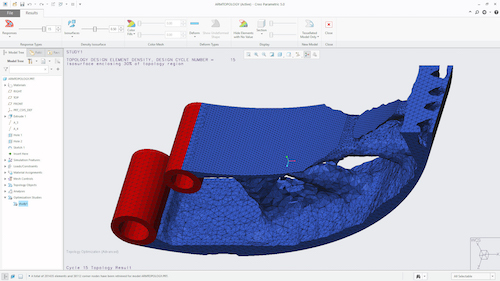
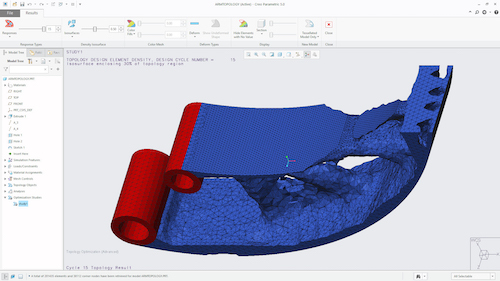 The new Creo Topology Optimization Extension automatically creates optimized designs based on a defined set of objectives and constraints. Image Courtesy of PTC.
Rather than working with a separate topology optimization tool, Creo 5.0 now includes the Creo Topology Optimization Extension, which enables users to create optimized designs based on a defined set of objectives and constraints. This is the first time topology optimization has been married with the core Creo CAD platform, serving as a gateway, Sutton explains, for the new area of generative design. Not only are early customers using the new topology optimization capabilities for optimizing AM practices, they are also leveraging the tools for concept design. “They’re putting in loads and getting an idea of how things can look even if they don’t use the output,” he says. “It’s a great tool for helping them think outside the box.”
Creo 5.0 also introduces the ability to design, optimize, validate, and print-check complex designs for AM. The new additions allow for lattice creation and have direct connections to popular 3D printers from Stratasys and 3D Systems as well as Materialise-enabled offerings in both polymer or metal solutions. Also new is Creo Mold Machining, an extension which delivers dedicated high-speed machining capabilities optimized for molds, dies, electrodes, and prototype machining.
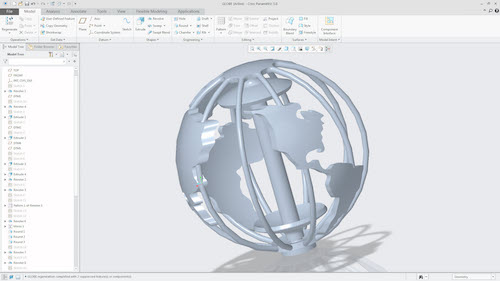 Creo 5.0 enables customers to print production-grade parts, including metals, directly from the CAD software. Image Courtesy of PTC.
“We’re streamlining the AM workflow so everything is all done parametrically,” Sutton says, explaining that today much of the work in prepping designs for AM is done outside the CAD environment, requiring duplication of effort. “In Creo 5.0, all the work is done parametrically so you don’t have to spend all that extra time recreating work you’ve already done or spending money on additional pieces of software.”
Other new areas in the Creo 5.0 release:


Beth Stackpole is a contributing editor to Digital Engineering. Send e-mail about this article to [email protected].
Follow DE
Join over 90,000 engineering professionals who get fresh engineering news as soon as it is published.






About Us · Contact Us · Editorial Team · Advertising · Privacy Policy · Subscriber Services · © 2026 Digital Engineering 24/7 · Peerless Media