Helping design and engineering professionals discover, evaluate and specify technologies and processes that shorten the design cycle and enable success.



May 2026 Special Focus: Artificial Intelligence in Design and Simulation
In this Special Focus Issue, learn about the latest developments in the integration of artificial intelligence into engineering workflows.

April 2026 Special Focus Issue: Generative Design
In this Special Focus Issue, Digital Engineering takes a look at how generative design solutions can be used across different types of design problems and with a variety of manufacturing approaches to accelerate design space exploration, and…
Delcam has launched an integrated solution for the design, machining and inspection of electrodes, through a combination of developments in the company's PowerSHAPE CAD software, PowerMILL CAM system and PowerINSPECT inspection software.
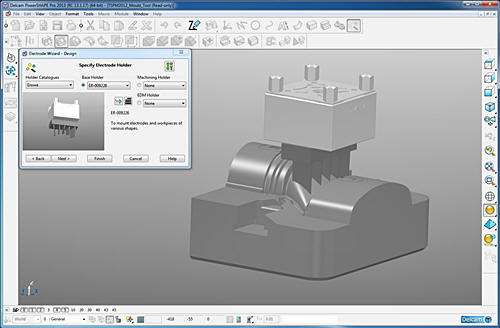
Delcam has developed a new file format, the .Trode file, which contains all the information for each electrode project, including not only the electrode design but also the machining and inspection information, plus the set-up sheets for its manufacture and use. According to the company, having all the required information in a single file simplifies data management as well as increasing overall efficiency.
The initial design stage of the process benefits from the increased range of direct modeling tools available within PowerSHAPE. Users can now define the region where the electrode will be used, extract the shape needed to produce the required feature in the part, and then edit the design to provide clearance from the main surface of the tool and to blend it into the blank size needed to fix the electrode into its holder.
Analysis tools are available to check that the draft angles and minimum radii used in the design will not cause downstream problems, while the ability to simulate the action of the electrode ensures that it will operate as expected. Catalogues of blanks and holders are included from Erowa, Hirschman and System 3R. Users can add their own standard sizes to these databases.
Once the design has been finalized, spark gaps can be specified to provide the machining offsets required in PowerMILL to cut the roughing and finishing electrodes. Inspection points can also be added so that the measurement of the electrode in PowerINSPECT can be automated. Then, set-up sheets for the electrode's manufacture and use can be produced automatically, either to a standard format or to a user-defined template.
Companies that produce multiple electrodes of similar sizes from the same material can develop templates within PowerMILL to machine them in a standardized way. Burn, clearance and blank faces of the electrode are automatically color-coded within PowerSHAPE so that they can be recognized within PowerMILL.
Specifying the inspection points within PowerSHAPE means that the probe path in PowerINSPECT and the production of the inspection report can also be automated, including undertaking a best-fit analysis of the machined electrode. The results of the inspection are added to the .Trode file for quality control records.
For more information, visit Delcam.
Sources: Press materials received from the company and additional information gleaned from the company's website.


DE's editors contribute news and new product announcements to Digital Engineering. Press releases may be sent to them via [email protected].
Follow DE
Join over 90,000 engineering professionals who get fresh engineering news as soon as it is published.






About Us · Contact Us · Editorial Team · Advertising · Privacy Policy · Subscriber Services · © 2026 Digital Engineering 24/7 · Peerless Media