Helping design and engineering professionals discover, evaluate and specify technologies and processes that shorten the design cycle and enable success.



Digital Engineering April 2026
In the latest issue of Digital Engineering, we take a look at the latest innovations in design for additive manufacturing, including the use of natural language inputs, social media cosplayers, and AI integration. The issue also includes a feature…

January Special Focus Issue: Design for Additive
In this Special Focus Issue of Digital Engineering, learn about the latest advancements in design for additive manufacturing, including new software tools, additive in automotive, custom medical devices, and more.
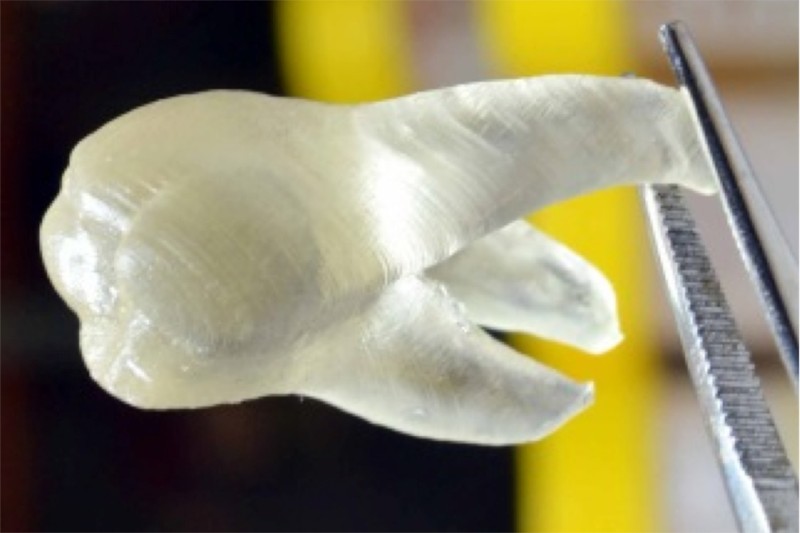
It won’t be long before the days of dental molds made by biting down on gunk are replaced by digital dentistry that relies on 3D imaging and 3D printing. Dentists have already begun to use AM to build new teeth for their patients. Now, a new technology that uses 3D printing could improve the lifespan of dental implants by fighting the bacteria that attacks teeth.
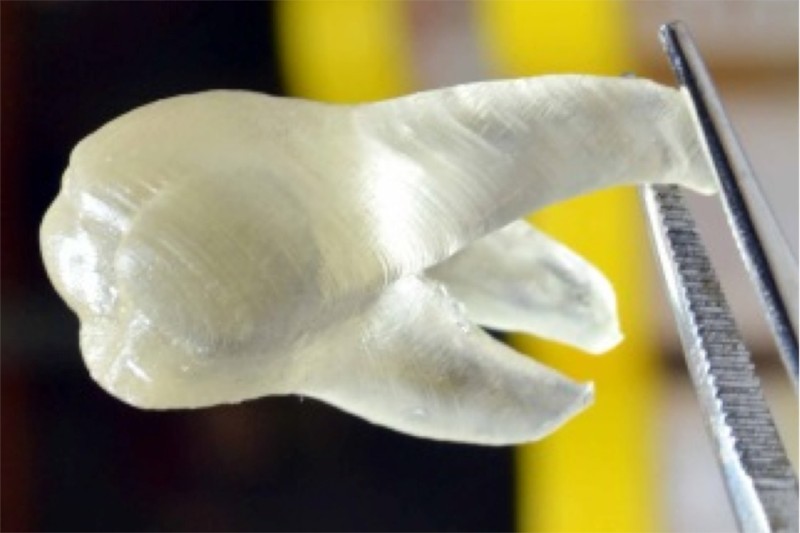 This 3D printed dental prosthetic could help fight bacteria. Courtesy of J. Yue, P. Zhao, J. Y. Gerasimov et al.
Researchers at the University of Groningen in the Netherlands have developed a process involving AM that aids in the battle against prosthetic tooth decay. Rather than printing with standard dental materials, the researchers have created an antimicrobial plastic containing embedded quaternary ammonium salts. The salts are positively charged, causing negatively charged bacterial membranes to explode upon coming in contact with the prosthetic tooth.
This research opens up new possibilities for combining AM and dental work, and could be an important next step for 3D printing in the dental field. From the paper, “3D-Printable Antimicrobial Composite Resins:”
3D printing is seen as a game-changing manufacturing process in many domains, including general medicine and dentistry, but the integration of more complex functions into 3D-printed materials remains lacking. Here, it is expanded on the repertoire of 3D-printable materials to include antimicrobial polymer resins, which are essential for development of medical devices due to the high incidence of biomaterial-associated infections.
Testing has revealed the new material kills 99% of Streptococcus mutans, the bacteria responsible for tooth decay. Standard materials only account for a 1% kill rate. The difference could result in big savings for patients, who, according to the study, spend millions on replacing damaged prosthetics every year.
Below you’ll find a video that demonstrates digital dentistry.
Sources: New Scientist, Advanced Functional Materials


John Newman is a Digital Engineering contributor who focuses on 3D printing. Contact him via [email protected] and read his posts on Rapid Ready Technology.
Follow DE
Join over 90,000 engineering professionals who get fresh engineering news as soon as it is published.






About Us · Contact Us · Editorial Team · Advertising · Privacy Policy · Subscriber Services · © 2026 Digital Engineering 24/7 · Peerless Media