Helping design and engineering professionals discover, evaluate and specify technologies and processes that shorten the design cycle and enable success.




Digital Engineering April 2026
In the latest issue of Digital Engineering, we take a look at the latest innovations in design for additive manufacturing, including the use of natural language inputs, social media cosplayers, and AI integration. The issue also includes a feature…

January Special Focus Issue: Design for Additive
In this Special Focus Issue of Digital Engineering, learn about the latest advancements in design for additive manufacturing, including new software tools, additive in automotive, custom medical devices, and more.
Desktop 3D printer developer MakerBot Industries recently launched the Method, which it describes as a “performance 3D printing” system. The company explains by that it means the Method is intended to bridge the gap between desktop and industrial 3D printing by offering individual designers and engineers features previously available only on industrial 3D printers, albeit at a significantly lower cost.
MakerBot reports that Method leverages industrial technologies and expertise from Stratasys, its parent company. Among these technologies are a circulating heated chamber, dual performance extruders, a PVA (polyvinyl alcohol) water soluble support material, dry-sealed material bays and an ultra-rigid metal frame. The Method 3D printer, an FDM (Fused Deposition Modeling) additive manufacturing technology-based system, is suitable for applications ranging from advanced concept development to functional part testing.
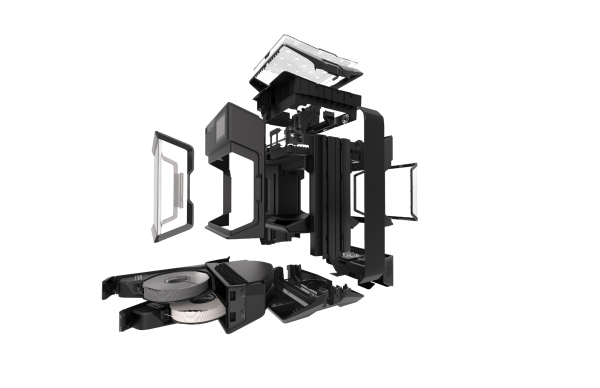
MakerBot explains that the system's circulating heated chamber controls the temperature and quality of every layer. It creates a full, active heat immersion environment during the entire duration of the print and enables printed materials to cool at a controlled rate. This is said to deliver higher dimensional accuracy while improving layer adhesion and part strength.
The high-speed dual performance extruders have a dual-drive gear system that secures print materials and a 19:1 gear ratio that, says MakerBot, provides up to 3X the push force of a typical desktop 3D printer. The company adds that this allows Method to provide a consistent feed of material into the hot end to produce consistent geometry. Additionally, the thermal core is up to 50% longer than a standard desktop hot end, which reportedly enables faster extrusion rates and allows for smooth extrusion throughout high-speed movements and accelerations.
MakerBot, citing its internal testing of selected geometries, reports that the Method delivers repeatable and consistent parts with ± 0.2 mm dimensional accuracy as well as vertical layer uniformity and cylindricity. The Method's dual extrusion system when combined with water-soluble PVA provides a superior surface finish, and enables unlimited design freedom as well as unrestricted geometries such as complex overhangs without scarring, the company adds.
Specifications include a maximum single-extrusion build volume of 7.5x7.5x7.75 in. (LxWxH; 19x19x19.6 cm); dual extrusion is 6.0x7.5x7.75 in. (15.2x19x19.6 cm). Layer resolution ranges from 20 to 400 microns. The Method measures 17.2x16.3x25.6 in. (LxWxH; 43.7x41.3x64.9 cm), and weighs 65 lbs. (29.5 kg).
The Method's workflow is said to provide print speeds up to 2X faster than desktop 3D printers, based on the company's internal print speed testing compared to popular desktop 3D printers when using the same layer height and infill density settings. User workflow conveniences include the Smart Spool, which provides such operating information as type, color and amount of material remaining via an RFID chip as well as a 5-in. touchscreen that provides the status updates and menu navigation.
The Method's built-in onboard camera allows users to monitor their print progress remotely with MakerBot Print software or the MakerBot Mobile app. The print software also integrates with 25 different CAD solutions. Designers and engineers can save 3D files as projects and share them via a native cloud management platform.
The Method deploys with a flexible steel build plate and WiFi connectivity as well as 21 sensors for monitoring the material drawers, extruders, print chamber and other components. Miscellaneous features include out-of-the-box deployment with guided setup and automated maintenance procedures.
The dry-sealed material bays' built-in sensors monitor for humidity and alerts users of any environmental changes. MakerBot materials ship in vacuum-sealed metalized polyester bags that keep out contaminants and moisture. The company offers two categories of materials for use with Method: Precision and Specialty. MakerBot reports that it extensively tests its precision materials, which include a tough thermoplastic for durable and strong prototypes and fixtures, a PLA (polylactic acid) biodegradable thermoplastic as well as the water-soluble PVA.
MakerBot says its specialty materials are for users looking for materials with advanced properties. The first material available on the platform is PETG (polyethylene terephthalate glycol), a widely used polymer with excellent engineering properties. The company notes that more specialty materials will follow.
“Current desktop 3D printers derive their DNA from hobbyist 3D printers and are insufficient for many applications in the professional segment,” said Nadav Goshen, MakerBot CEO, in the Method press announcement. “We believe that Method is the next step in helping organizations adopt 3D printing at a larger scale. ... It is built for professionals who need immediate access to a 3D printer that can deliver industrial performance to accelerate their design cycles.”
MakerBot anticipates shipments of the Method 3D printer to start shortly. Pricing begins at $6,499, which includes starter material, an accessory toolkit and service plan. Pre-orders are now available at a reduced rate.
To learn more about the Method desktop 3D printer, click here.
Watch the Method overview video.
Learn more about the Method's features.
Browse the Method's technical specs.
Check out the Method cost calculator.
Read DE contributing editor Beth Stackpole's report “MakerBot Meets Industrial 3D Printing.”
See why DE's Editors selected the MakerBot Method 3D desktop printer as their Pick of the Week.
Sources: Press materials received from the company and additional information gleaned from the company's website.

At MakerBot, we believe the easier the user experience, the more you can focus on developing your ideas. Whether you're already 3D printing or just starting out, learning how to read, write, and talk about your process with the right terms…

Anthony J. Lockwood is Digital Engineering's founding editor. He is now retired. Contact him via [email protected].
Follow DE
Join over 90,000 engineering professionals who get fresh engineering news as soon as it is published.






About Us · Contact Us · Editorial Team · Advertising · Privacy Policy · Subscriber Services · © 2026 Digital Engineering 24/7 · Peerless Media