Helping design and engineering professionals discover, evaluate and specify technologies and processes that shorten the design cycle and enable success.



Design & Simulation Software Guide 2025
In this Special Issue, Digital Engineering presents its second annual guide to design and simulation software vendors.

Design & Simulation Software Guide
In this Special Issue, Digital Engineering presents its inaugural guide to design and simulation software vendors, including listings for CAD, CAM, simulation, generative design, PLM, rendering and visualization, design for additive manufacturing,…
Teams of builders, electricians, plumbers, architects, structural engineers and numerous other professions have the challenge of coming together around a shared task of turning a design document into a physical structure. They do so amidst a constantly changing backdrop of regulations and building codes.
“Say there are a couple of levels of parking under the building,” says Breawn Felix, who is a regional virtual design and construction manager at Swinerton Inc., a diversified construction firm based in Southern California. “They may not have the head-height clearance required to accommodate ADA [Americans with Disability Act] vehicles, or you might have a big exhaust pipe running through the garage that could require a redesign.”
It's Felix's team’s job to take a building from the bid phase to reality. Now, she’s doing it with the help of three-dimensional imaging technology that captures every stage of a construction project in a digital twin that can be used for inspection and modeling.
Even small problems can take weeks to fix, particularly when construction teams don’t agree on who’s at fault. “Change orders can be contentious because no one knows for sure who is responsible” said Jeevan Kalanithi, chief executive of OpenSpace Labs Inc., which built the digital twin technology.
Although his background expertise is in machine learning and robotics, Kalanithi got a taste of the challenges builders face from his previous venture, a maker of commercial drones whose software is used extensively by construction and mining companies to survey projects in progress.
That led to the idea of using 3D imaging to document construction projects on an ongoing basis, while also enabling contractors, architects and project managers to collaborate. OpenSpace is a cloud service that works with a variety of off-the-shelf 3-D cameras to create what Kalanithi described as “a combination of a teleporter and a time machine.”
The software combines computer vision systems like those used in self-driving cars with indoor navigation technology that helps robots traverse indoor spaces. Builders attach the camera to a helmet and walk through the site. The video is captured by OpenSpace’s Vision Engine, which creates a timestamped record.
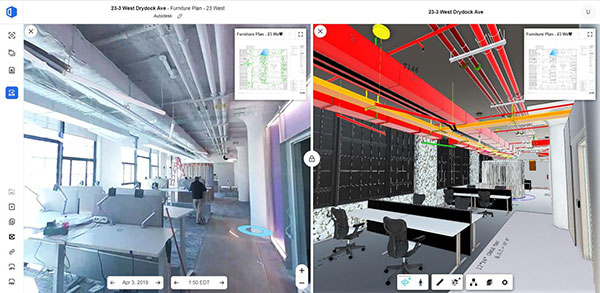
The video images can be matched to blueprints or computerized designs to show a side-by-side comparison of what the project is supposed to look like and its actual status (pictured). OpenSpace’s software takes care of synchronizing the video with the project design. Workers can annotate hotspots on the video and launch discussions with other members of the construction team.
Vision Engine also has limited calculation capabilities. “We can tell you how much concrete was needed versus how much was poured or how much drywall has been used compared to plan,” Kalanithi says. “It’s a single version of the truth.”
The payoff comes on multiple levels. In traditional construction, the discovery of a problem may require architecture construction engineers to get on planes to visit the site, incurring time and cost and taking skilled professionals away from other work. With the digital twin, he says, “instead of having to drive or fly to the site, they can look at it and see what’s needed in two seconds.”
Construction is “an industry with lots of uncertainty that can create conflict,” Kalanithi says. “We provide the truth serum—the system of record that lets people get on the same page without a lot of complexity or architectural forensics.” The videos also serve as a historical record that can be used after construction is completed to pinpoint the location of hidden materials like pipes and electrical conduits.
Felix needs no convincing. Prior to adopting OpenSpace, Swinerton documented progress by “sending project engineers to the site with a camera and taking hundreds of photos that went on a server,” she says. “If there was a problem, it could take hours to find the one photo we needed.”
Spotting problems is also easier. “We can do a split-screen view of the design and the real world to see what might be out of compliance or installed in the wrong location,” she says. “The value-add is impossible not to see.”
Swinerton is currently using the technology on about 85 projects in southern California, some of which involve hundreds of contractors and engineers. OpenSpace doesn’t charge by the user but recommends that as many members of the construction team as possible be included. Felix says training time is minimal.
The time savings alone have changed the business, she says. “If I see an issue, I can send it to you and you can get back to me right away,” she said. “It’s no more 15 emails; one click of a button and we all have the same focal point.”
OpenSpace, which has raised more than $88 million in funding, is reportedly being used in 70 countries on all seven continents, including Antarctica. More than 6 billion square feet of floor space have been captured and archived, or about the equivalent of 2,000 Empire State Buildings. “It’s growing a lot faster than even I expected,” Kalanithi says.
Sources: Press materials received from the company and additional information gleaned from the company’s website.


DE's editors contribute news and new product announcements to Digital Engineering. Press releases may be sent to them via [email protected].
Follow DE
Join over 90,000 engineering professionals who get fresh engineering news as soon as it is published.






About Us · Contact Us · Editorial Team · Advertising · Privacy Policy · Subscriber Services · © 2026 Digital Engineering 24/7 · Peerless Media