Helping design and engineering professionals discover, evaluate and specify technologies and processes that shorten the design cycle and enable success.



Design & Simulation Software Guide 2025
In this Special Issue, Digital Engineering presents its second annual guide to design and simulation software vendors.

Design & Simulation Software Guide
In this Special Issue, Digital Engineering presents its inaugural guide to design and simulation software vendors, including listings for CAD, CAM, simulation, generative design, PLM, rendering and visualization, design for additive manufacturing,…
ERP (enterprise resource plannning), PLM (product lifecycle management), and BPM (business process management) belong to the same class of corporate acronyms: They all make you cringe. In many cases, they turn out to be precursors to lengthy implementation periods, reshuffling familiar workflows, tripping over new (yet surprisingly unexciting) software interfaces, and being asked to do the simplest tasks in the most complex fashion.
That's why Kenesto's goal, as expressed by its marketing chief Alex Neihaus, seems lofty and idealistic: "We want to create a business process automation system that people will love and use," he said.
Kenesto is a newcomer to the enterprise software scene (so new that it's website currently says "Coming soon!"). But it's a company reinforced with veteran CAD and PLM talents. Familiar names in its executive team include Mike Payne (previously at PTC, SolidWorks, and SpaceClaim) and Jerry Meyer (previously direct of engineering, Dassault Systemes MatrixOne). Neihaus, now at Kenesto, cofounded Vuuch, a social media-style collaboration plug in for CAD users.
In Introduction to Kenesto, a seven-page document summarizing the company's position, the company writes, "Billions have been spent on the process automation software category. 'Stovepiped' process systems begin with a specific part of the company, for example, manufacturing processes. These systems, which hope to expand from manufacturing to the rest of the enterprise, have become particularly complex, expensive, disruptive to the enterprise and unable to keep up with the changing needs of the business."
Kenesto strives to be different, according to the document, by being "people-centric, product-based and enterprise-scalable."
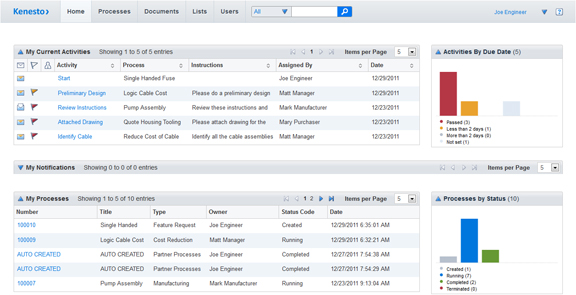
Instead of asking employees to fit their work habits to a rigid process, Kenesto gives users the option to initiate a workflow and route it to the people they need to direct their queries to. In creating the workflow, users work in an environment that mimics an email client ("as easy as email, only better," Neihaus would say), with similar options to attach drawings and Excel sheets.
Kenesto is cloud-hosted, as most Software as a Service (SaaS) offerings are. It uses Amazon cloud services to store documents you choose to share with others in the workflow. You get to specify the rights granted to recipients (for example, can they download a copy, or just view online?). The software's built-in viewer, which supports roughly 250 common office and drawing file types, lets you view files without the original authoring program. (Current drawing support is limited to 2D; 3D support will be added later, according to Neihaus.)
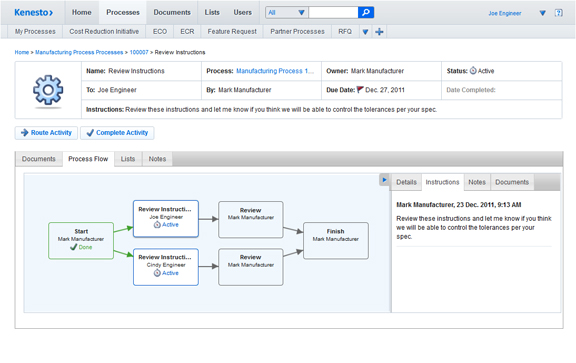
The business process, as visualized in Kenesto, appears as a flow chart, with live links to participants' contact, profile, and list of actions. Most important, Kenesto allows the one who initiates the workflow to reroute items to others or skip steps to move a transaction along. (This comes in handy, for instance, if one of the engineers who need to review a document is on vacation.)
The software is currently in Beta. Kenesto hasn't published any pricing yet, but, Neihaus revealed that it would be sold through a reseller channel as subscriptions. Subscription fees will be based on capacity, instead of seats. ("Think of it like shared cellphone minutes," said Neihaus.)
Kenesto's plan is to initially offer the software as a standalone application. But integration with PLM and ERP systems is not out of the question, in my view. Such an integration, I foresee, would allow Kenesto to draw from the larger enterprise system's project documents, read-right privileges, file check-in/check-out features, and predefined contact lists.
Kenesto's current interface is simple, straightforward, and easy to grasp. But it seems to be tailored to ad hoc collaboration involving a series of exchanges among a small number of people. For projects involving many separate teams simultaneously working on change orders, approvals, and revisions, Kenesto may add value, but an enterprise system that provides a bird's eye view of the parallel processes and participants is still needed.


Kenneth Wong is Digital Engineering's resident blogger and senior editor. Email him at [email protected] or share your thoughts or suggestions at digitaleng.news/facebook.
Follow DE
Join over 90,000 engineering professionals who get fresh engineering news as soon as it is published.






About Us · Contact Us · Editorial Team · Advertising · Privacy Policy · Subscriber Services · © 2026 Digital Engineering 24/7 · Peerless Media