Helping design and engineering professionals discover, evaluate and specify technologies and processes that shorten the design cycle and enable success.



Digital Engineering April 2026
In the latest issue of Digital Engineering, we take a look at the latest innovations in design for additive manufacturing, including the use of natural language inputs, social media cosplayers, and AI integration. The issue also includes a feature…

January Special Focus Issue: Design for Additive
In this Special Focus Issue of Digital Engineering, learn about the latest advancements in design for additive manufacturing, including new software tools, additive in automotive, custom medical devices, and more.
|
Dr. Richard Siderits, a pathologist and assistant professor at Robert Wood JohnsonUniversity MedicalSchool, has configured his own desktop rapid prototyping system for creating 3D models of biological objects.
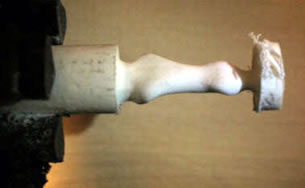
Siderits uses a NextEngine Desktop 3D Scanner to scan organic objects directly into Caligari trueSpace as 3D models. He uses trueSpace to modify or reverse engineer the models as needed. Finally, he creates solid models or molds of the objects with the Roland MDX15 CNC milling machine and Fourth Axis attachment.
The entire system fits on his desktop, cost less than $8,000, and creates accurate solid models and part molds (within 0.002-inch accuracy) from start to finish usually in less than an hour. Other approaches to rapid prototyping were either less accurate or much more expensive.
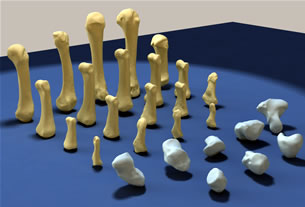
“The ability to create real models of biological objects in less than an hour right on my desktop is remarkable, and trueSpace is at the heart of this system,” said Dr. Siderits. “trueSpace allows me to assemble and modify 3D models extremely quickly. For example, a research project sponsored by the PittsburghSupercomputing Center involved quickly scanning in all the bones of the human hand to provide files that can be used in advanced robotic applications. It’s easy to add attachment points for muscle wires to the 3D bone models using trueSpace and then send the new files to the desktop milling machine.”
According to Dr. Siderits, the applications for this system are virtually limitless for anyone who needs to scan, modify, and create physical molds or accurate models. This could include forensic scientists, archaeologists, medical researchers, plastic surgeons and even home hobbyists.
Dr. Siderits is working on projects such as creating a set of openly available 3D files of the human hand bones so researchers can develop more realistic robotic hand systems and creating a tooth mold from chewing gum collected at a crime scene. The tooth mold can be permanently saved in a forensics file, whereas the actual piece of gum would deform or disintegrate over time.


DE's editors contribute news and new product announcements to Digital Engineering. Press releases may be sent to them via [email protected].
Follow DE
Join over 90,000 engineering professionals who get fresh engineering news as soon as it is published.






About Us · Contact Us · Editorial Team · Advertising · Privacy Policy · Subscriber Services · © 2026 Digital Engineering 24/7 · Peerless Media