Helping design and engineering professionals discover, evaluate and specify technologies and processes that shorten the design cycle and enable success.



Digital Engineering April 2026
In the latest issue of Digital Engineering, we take a look at the latest innovations in design for additive manufacturing, including the use of natural language inputs, social media cosplayers, and AI integration. The issue also includes a feature…

January Special Focus Issue: Design for Additive
In this Special Focus Issue of Digital Engineering, learn about the latest advancements in design for additive manufacturing, including new software tools, additive in automotive, custom medical devices, and more.
Dyndrite reports that its team has been selected by America Makes and the National Center for Defense Manufacturing and Machining (NCDMM) under the Office of the Under Secretary of Defense Manufacturing Technology Office (OSD ManTech) Artificial Intelligence for Material Allowables in Additive Manufacturing (AIM-4AM) project call.
The Dyndrite-led team includes Mimo Technik, which will execute controlled LPBF builds and testing coordination, and RTX, which will serve as the technology transition partner to help ensure application relevance and support transition requirements for defense and aerospace applications.
The AIM-4AM program is a $2 million initiative seeking to develop an AI-driven framework to identify and quantify risks within the existing material allowables approach for Laser Powder Bed Fusion (LPBF). This project will demonstrate the framework using 17-4PH stainless steel in the H1025 condition. The initiative is intended to help reduce the time, cost, and testing burden associated with traditional additive manufacturing qualification and certification workflows while maintaining rigorous statistical and engineering confidence, according to Dyndrite.
The selected project will focus on combining machine learning, process-aware modeling, and statistically informed validation methods to support more agile and production-relevant qualification workflows for additive manufacturing.
“Additive manufacturing qualification has historically required extensive C/D basis physical testing because the black box nature of machines creates uncertainty in the process and risk,” says Harshil Goel, founder and CEO of Dyndrite. “This program is about helping quantify and manage that uncertainty more intelligently using ML-assisted methods grounded in process control, data pedigree, statistical confidence, and validation testing.”
As part of the program, the Dyndrite team will:
The program aligns with broader Department of Defense and industry priorities focused on accelerating additive manufacturing industrialization while improving repeatability, scalability, and confidence in qualified AM production. Dyndrite’s role in the project builds upon its broader work in software-defined manufacturing, feature-aware process development, process automation, and scalable LPBF qualification workflows.
“This initiative represents an important step toward modernizing how additive manufacturing materials are qualified for production use,” adds Goel. “The long-term opportunity is not simply reducing testing. It is accelerating the adoption of additive manufacturing through smart parameter development, and building confidence in the manufacturing process.”
The AIM-4AM program is managed by America Makes and NCDMM with funding support from the Office of the Under Secretary of Defense Manufacturing Technology Office (OSD ManTech).
For more on the AIM-4AM program, click here.


As the national accelerator for additive manufacturing (AM) and 3D printing (3DP), America Makes is the nation’s leading and collaborative partner in AM and 3DP technology research, discovery, creation, and innovation. Structured as a…
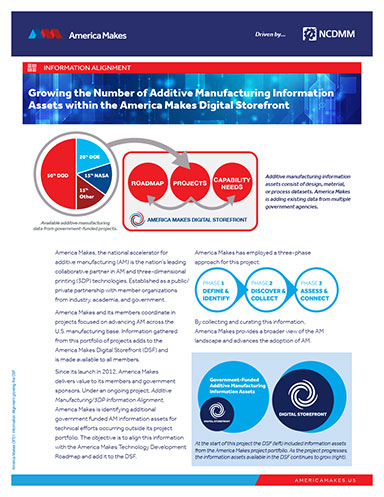
Additive Manufacturing/3DP Information Alignment
Growing the number of additive manufacturing information assets within the America Makes digital storefront.

DE's editors contribute news and new product announcements to Digital Engineering. Press releases may be sent to them via [email protected].
Follow DE
Join over 90,000 engineering professionals who get fresh engineering news as soon as it is published.






About Us · Contact Us · Editorial Team · Advertising · Privacy Policy · Subscriber Services · © 2026 Digital Engineering 24/7 · Peerless Media