Helping design and engineering professionals discover, evaluate and specify technologies and processes that shorten the design cycle and enable success.


Sponsored
 Dear Desktop Engineering Reader:
 DMLS (direct metal laser sintering) additive manufacturing systems are really cool technology. The problem, however, has been you make widgets and handfuls of one-off parts, and DMLS systems tend to be industrial sized, making them prohibitively expensive as far as you're concerned. The focus of today's Pick of the Week marks a change in all that.
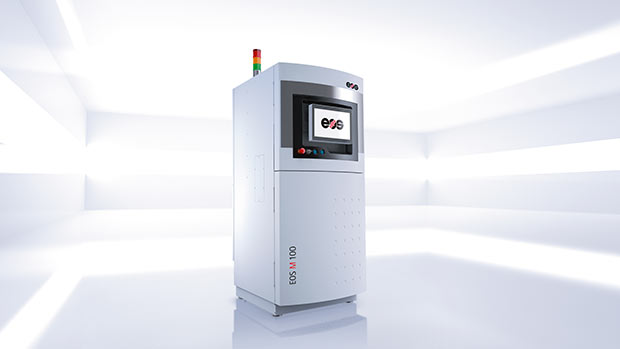
EOS GmbH, the German outfit that pioneered DMLS, has introduced its new EOS M 100 DMLS system. Your takeaway here is that the EOS M 100 is engineered to produce cost-effective small quantities of smaller parts with all of the quality, consistent part reproducibility and detail resolution expected from an industrial-grade metal 3D printing system.
Key here is that the EOS M 100 has a small, round build platform with a 3.9 x 3.7 in. (100 x 95 mm) build volume, which inherently gets you thinking about large quantities of small things. The picture up there and in today's Pick of the Week write-up gives you a prime example. There are about 70 dental crowns and bridges on that plate (I lost count). EOS reports that it took three hours to make them, so, depending on what you ask it to do, the EOS M 100 can be pretty efficient too.By the way, those crowns were made with a cobalt-chrome material intended for dental applications. Right now, the EOS M 100 also works with a stainless steel material that’s good for certain automotive, aerospace/turbine and consumer products. Titanium is under development, so high-performance parts for aerospace and motor racing applications as well as parts for biomedical implants are in the EOS M 100 user's future.
The EOS M 100 has a 200-watt ytterbium fiber laser, a 40-µm laser spot and a scan speed of up to 23 ft. per second (7.0 m/sec). Translation: You can produce high-quality, complex and delicate components in good time. Other characteristics of note include easy setups, material replacements and maintenance. The system's modest overall size and power requirements mean you should be able to find a spot for it on the shop floor with little ado.
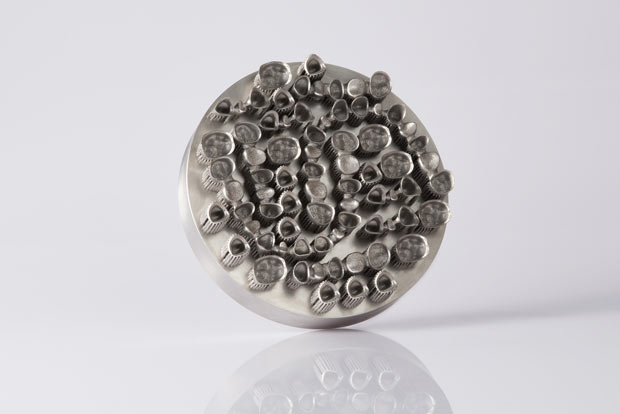 The EOS M 100 has a round build platform and a laser scan speed of up to 23 ft. per second (7.0 m/sec). Here, the platform holds 70 dental crowns and bridges made of EOS CobaltChrome SP2 that the EOS M 100 manufactured in approximately three hours. Image courtesy of EOS GmbH.
If you've been noodling the idea of getting DMLS manufacturing in-house or expanding your 3D metal production capabilities for all of those small amounts of parts you need, the EOS M 100 could be the right solution. Hit today's Pick of the Week and learn more about it. Good stuff.
Thanks, Pal. – Lockwood
Anthony J. Lockwood
Editor at Large, Desktop Engineering


Anthony J. Lockwood is Digital Engineering's founding editor. He is now retired. Contact him via [email protected].
Follow DE
Join over 90,000 engineering professionals who get fresh engineering news as soon as it is published.






About Us · Contact Us · Editorial Team · Advertising · Privacy Policy · Subscriber Services · © 2026 Digital Engineering 24/7 · Peerless Media