Helping design and engineering professionals discover, evaluate and specify technologies and processes that shorten the design cycle and enable success.


Sponsored

May 2026 Special Focus: Artificial Intelligence in Design and Simulation
In this Special Focus Issue, learn about the latest developments in the integration of artificial intelligence into engineering workflows.

Design & Simulation Software Guide 2025
In this Special Issue, Digital Engineering presents its second annual guide to design and simulation software vendors.
Five matches of this year's FIFA World Cup® are set to be held in Mexico City's iconic Estadio Azteca, officially known as "Banorte Stadium" and temporarily renamed "Mexico City Stadium" by FIFA® for its 2026 tournament. Together with Rio de Janeiro's Maracanã Stadium, Estadio Azteca is one of only two stadiums to have hosted two FIFA World Cup finals. Unlike the Maracanã, though, the Azteca that hosted legends like Pelé decades ago is still recognizably the same stadium that's hosting the World Cup today.
No stadium has witnessed more historic World Cup moments. In 1970, Pelé won his third World Cup here. In 1986, Maradona scored both the "Hand of God" and the "Goal of the Century" here, arguably the most controversial goal and the greatest goal in football history, separated by only four minutes.
When it hosted the 2026 opening match between Mexico and South Africa, Estadio Azteca became the first stadium in history to host matches in three FIFA World Cups. Reverently referred to by fans as el gigante ("the giant", as immortalized in song by Andrés Calamaro) and El Coloso de Santa Úrsula for its massive capacity, the Azteca is sacred ground for football ("soccer" for American readers).
As anyone who has ever set foot in a colossus like the Azteca can tell you, a visceral part of the stadium experience is the sound. Together, tens of thousands of spectators can create a tremendous wall of noise. However, the PA system's role in shaping the experience of a match shouldn't be overlooked. In anticipation of more exciting World Cup matches at Estadio Azteca, my team and I at COMSOL analyzed the acoustics of el gigante's sound system using modeling and simulation.
The sound of a football stadium is about much more than acoustics. Every supporter knows that their home stadium sounds better than any other stadium in the world when their team scores. This is one of the great experiences of football fandom.
As engineers, however, we need to quantify the sound of a stadium. FIFA specifies requirements for quantities such as reverberation time, speech transmission index, and the uniformity of the sound field in the stands (Ref. 1). These metrics help ensure that spectators can clearly hear announcements and other information provided through the PA system.
Typical design targets include:
These quantities can be measured, but they can also be estimated using simulation.
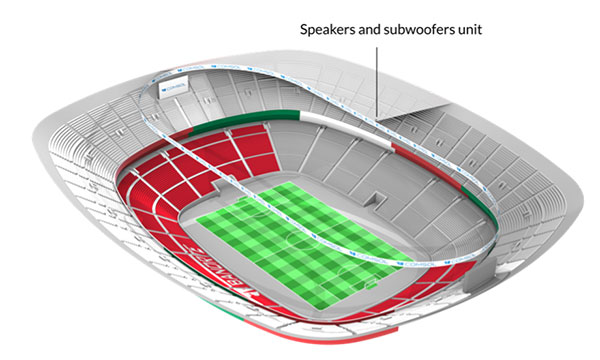
The newly renovated Estadio Azteca appears to use several hundred loudspeakers distributed around the venue (Ref. 2). Based on publicly available photographs, large loudspeaker clusters hang from the roof and provide coverage of the seating areas.
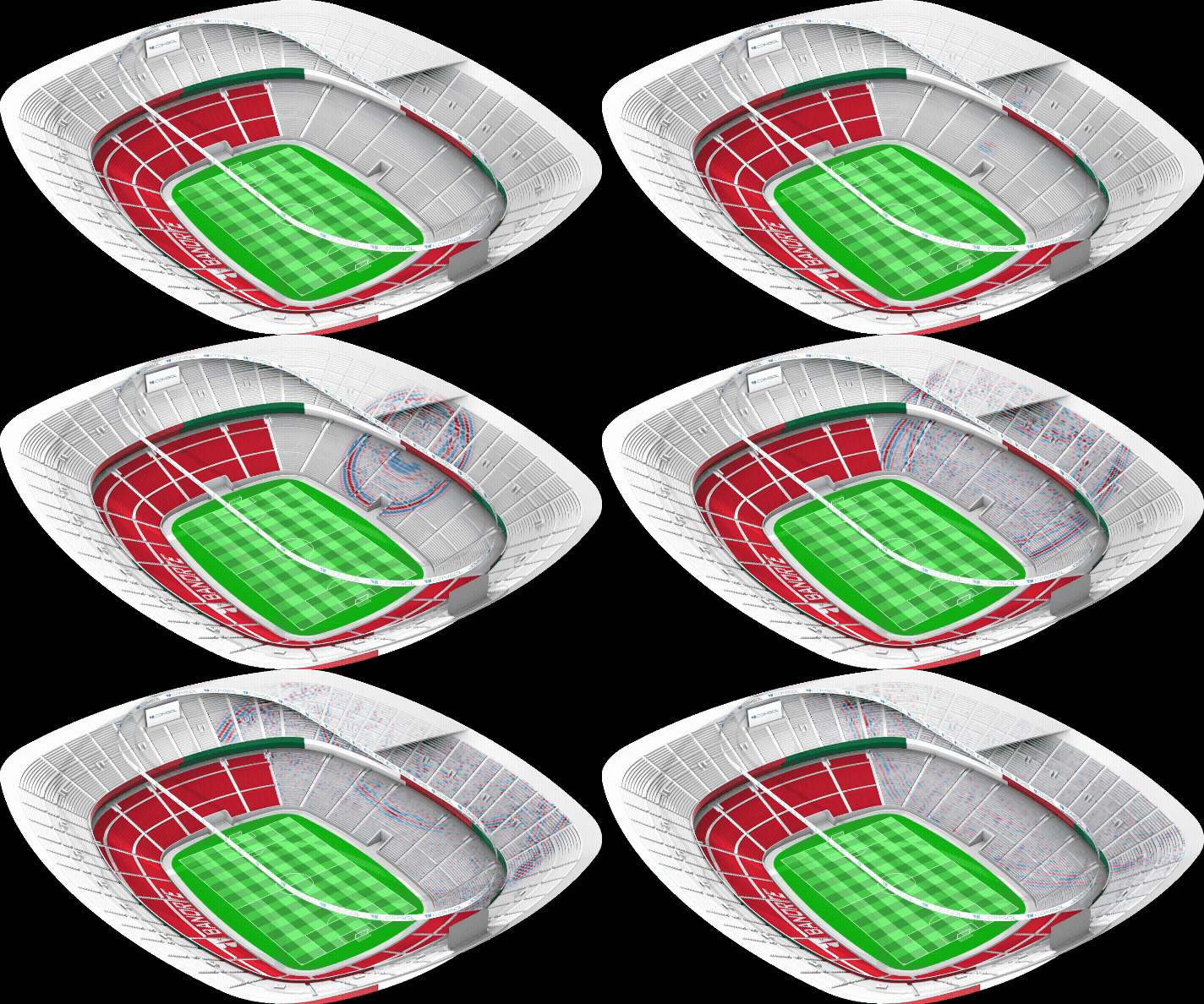
To investigate the acoustics, we created a simplified stadium model in COMSOL Multiphysics. At low frequencies, sound behaves like a wave and phenomena such as diffraction become important. These effects are captured by solving the acoustic wave equation in the time domain. Figure 2 shows the acoustic pressure generated by a loudspeaker cluster suspended from the roof. The simulation included close to 100 million degrees of freedom and was carried out on two NVIDIA® RTX™ 6000 Ada Generation GPUs in less than two hours.
As frequency increases, wave-based simulations become increasingly expensive. For higher frequencies, it is often more efficient to represent sound as rays.
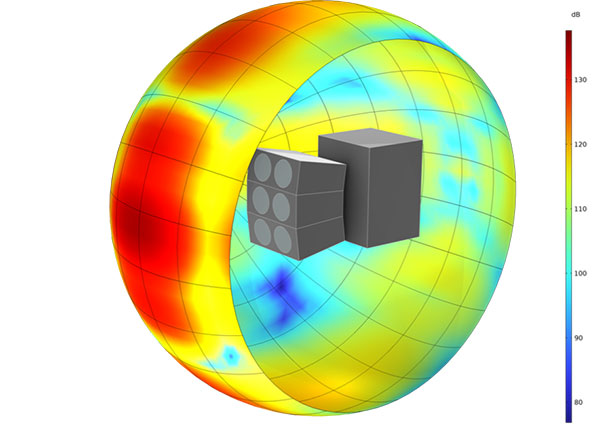
To do this, we first computed the radiation pattern of a simplified loudspeaker cluster using the boundary element method. This radiation pattern was then used as the source definition in a ray acoustics model.
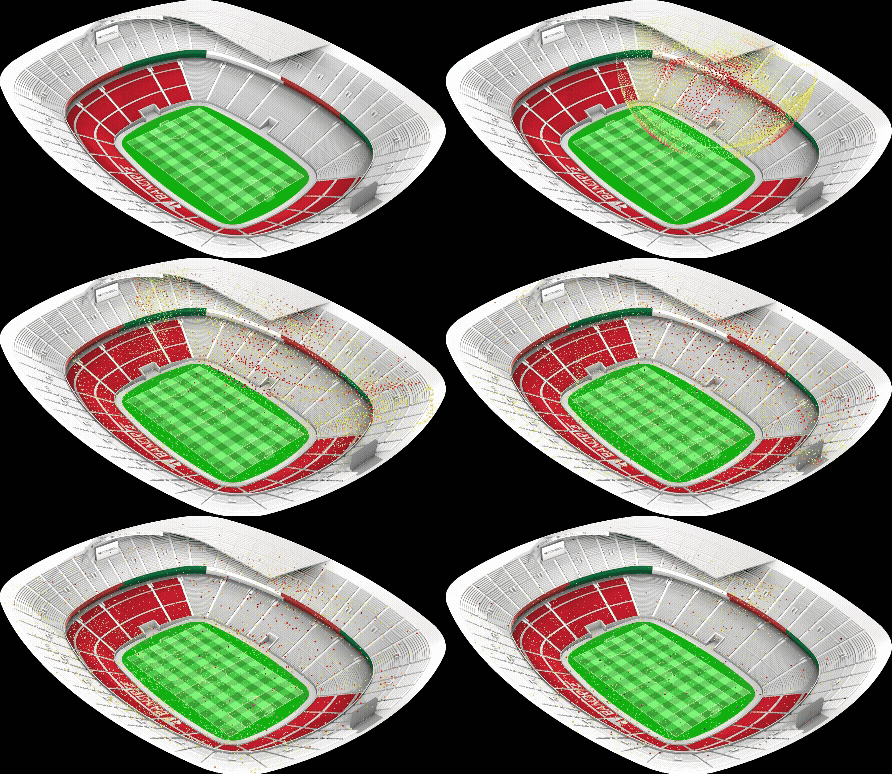
The resulting ray simulation is shown in Figure 4.
As you can see in Figure 5, the sound pressure field generated by a single loudspeaker cluster is considerably less uniform than FIFA's target of ±3 dB. In practice, however, several loudspeaker clusters contribute to the same area, resulting in much more uniform coverage.
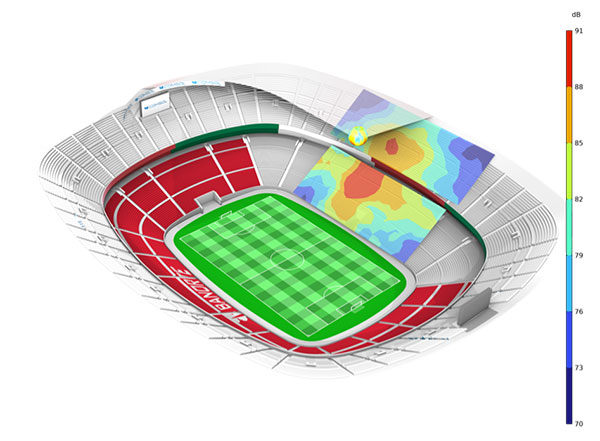
By placing all loudspeaker clusters into the model, it becomes possible to estimate sound pressure levels, reverberation time, and speech transmission index throughout the stadium.
Several different modeling approaches are needed to design the sound system of a modern stadium. In our case, we combined wave-based acoustics for low frequencies, a boundary element model for loudspeaker characterization, and ray acoustics for large-scale sound propagation at higher frequencies.
Together, these models can provide an accurate picture of the quality of the sound at the Azteca.
But there is one aspect that we did not consider: the roar of the crowd. That is the real sound of the giant.
More than 80,000 people experienced this thunderous wall of sound during the opening match between Mexico and South Africa. Some of them may have felt the same rush that Andrés Calamaro sings about in "Estadio Azteca", where he describes the stadium as a giant that has "crushed" him. This feeling is not fear but awe. Anyone who grew up loving football recognizes that feeling when entering a huge stadium for the first time. In my case, it was walking into Estadio Centenario in Montevideo holding my father's hand.
Although the simulations presented here are based on established acoustics modeling techniques, they were created primarily for fun. A professional acoustics study of Estadio Azteca would require significantly more detailed information about the stadium geometry, loudspeaker system, materials, crowd distribution, and operating conditions than is publicly available.
The loudspeaker system used in the simulations was reconstructed from publicly available photographs and information from media reports. We therefore make no claim that the model accurately represents the actual sound system installed in Estadio Azteca for the 2026 FIFA World Cup.
Adidas and Trionda are registered trademarks of adidas AG.
ChatGPT is a trademark of OpenAI OpCo, LLC.
FIFA and FIFA World Cup are registered trademarks of the Fédération Internationale de Football Association.
NVIDIA is a registered trademark and NVIDIA RTX is a trademark of NVIDIA Corporation.
COMSOL AB and its subsidiaries and products are not affiliated with, endorsed, by, sponsored by, or supported by any of the foregoing trademark owners.
Ed Fontes is VP of Development at COMSOL.


COMSOL is a global provider of simulation software for product design and research to technical enterprises, research labs, and universities. Its COMSOL Multiphysics® product is an integrated software environment for creating physics-based models…

Ebook download: Powering Clean Energy Solutions
In this ebook, we explore 6 cases where modeling and simulation were used to help overcome these new design challenges. Topics include water turbines, sand-based heat storage, hydrogen fuel cells, and more.

Join over 90,000 engineering professionals who get fresh engineering news as soon as it is published.






About Us · Contact Us · Editorial Team · Advertising · Privacy Policy · Subscriber Services · © 2026 Digital Engineering 24/7 · Peerless Media