Helping design and engineering professionals discover, evaluate and specify technologies and processes that shorten the design cycle and enable success.


Sponsored
 Dear DE Reader:
A guy I knew used spreadsheets for his word processing. It sort of worked, mind you. But that's not what spreadsheets are designed to do best. Many engineers use spreadsheets for critical jobs that can be done more easily and more efficiently with the right tool. Bills of materials are a classic example. Simply put, an inappropriate tool for your critical job likely does not have the smarts to fully account for everything you need to know or do. Today's Editor's Pick of the Week looks at an interesting tool designed for those of you analyzing the effects of part and assembly variation on the fit and performance of your products with the wrong tool.
Sigmetrix earned its chops developing tolerance analysis software and consulting. They're the people behind the robust CETOL 6σ tolerance stackup analysis solution for predicting the impact of complex 3D interactions. It integrates with CATIA, PTC Creo, SOLIDWORKS and others.
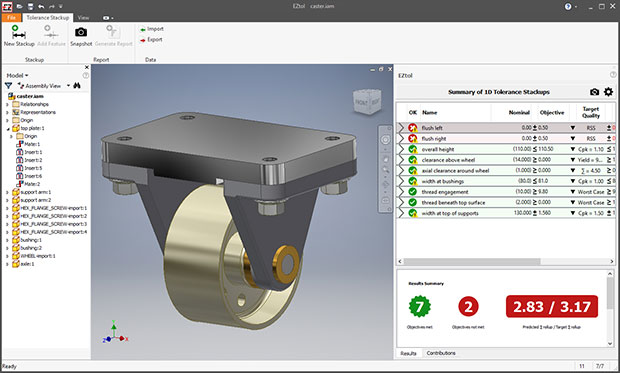 Sigmetrix has announced a May 1st release date for EZtol, its new one-dimensional (1D) analysis solution for understanding the impact of part and assembly variations on product fit and performance. Image courtesy of Sigmetrix LLC.
Well, they have a new tool that you people using spreadsheets or hand calculations for tolerance stackup analyses should check out. Called EZtol, this one-dimensional (1D) tolerance stackup analysis software is engineered to make it easy for you to create, manage and report single or multiple 1D tolerance analyses in an assembly.
What EZtol does is analyze your 3D design model using the actual nominal distances between surfaces/features in it. By the way, it works with files from nearly any major CAD system. It helps ensure that your analysis includes all components in the loop. It calculates the worst-case, RSS and statistical results automatically.
EZtol reports metrics like Cpk, Sigma, DPMO and percentage yield. It organizes a summary table with your objectives and the results of each stackup analysis. Visual cues tell you if the requirements have been met or not, and you can drill down for details.
EZtol creates at-a-glance graphical views of the decision-making details you need. It'll also tell you when the tolerance stackup results might underestimate the actual variation that will occur during production so that you can decide if you need a more powerful analyzer. Not sure pen-and-paper or a spreadsheet can do that for you with efficiency.
EZtol will be officially released on May 1, but you can try it throughout April and see for yourself how it stacks up. There's a link to get you started at the end of today's Editor's Pick of the Week write-up. Good stuff.
Thanks, Pal. – Lockwood
Anthony J. Lockwood
Editor at Large, DE


Anthony J. Lockwood is Digital Engineering's founding editor. He is now retired. Contact him via [email protected].
Follow DE
Join over 90,000 engineering professionals who get fresh engineering news as soon as it is published.






About Us · Contact Us · Editorial Team · Advertising · Privacy Policy · Subscriber Services · © 2026 Digital Engineering 24/7 · Peerless Media