Helping design and engineering professionals discover, evaluate and specify technologies and processes that shorten the design cycle and enable success.


Sponsored
 Dear Desktop Engineering Reader:
 It’s an understatement of Monty Python proportions to say that CD-adapco is a noted developer of CFD (computational fluid dynamics) technology. So you’re likely to respond to the news that the v10.04 release of its flagship simulation analysis system STAR-CCM+ introduces a finite element-based solid stress solver with the engineer’s astonished cry of “Huh, that’s something.” Indeed. And that’s why STAR-CCM+ v10.04 is today’s Pick of the Week.
Incorporating computational solid mechanics functionality in STAR-CCM+ makes a lot of sense. For one, CD-adapco has this vision called Multidisciplinary Design eXploration (MDX). Basically, MDX means that you need engineering tools that couple and cooperate with multiple disciplines because coupled physics is the right way to accurately simulate a product or a system under real-world conditions.
Two, CD-adapco believes analysts and engineers should spend their time productively and not firing up an external application with its own unique interface and skillset every time they want to model something needing a dollop or more of finite element analysis (FEA). This new computational solid mechanics functionality comes as an operational component of STAR-CCM+ v10.04. No new license required. It uses the same the interface, and it gives you the flexibility to use the right analysis tool on a problem as it warrants.
Now, let’s be clear. They’re not saying you can ditch your license for one of their co-simulation partners like Abaqus or even stop using STAR-CCM+’s finite-volume analysis technique. There always are times when you need the heavy artillery. This is for when you need to get over some hump with a little FEA action and advance your design without the fuss of using more power than necessary. As a bonus, this new functionality can help recoup the time you spend relearning multiple applications or enlisting the expertise of different teams.
STAR-CCM+ v10.04 is also an interesting release in other ways. In particular, it introduces a new Adjoint Solver for Coupled Solid Energy that enables sensitivity analysis of solid conduction problems. You can use this new solver on fluids or solids in isolation or with STAR-CCM+’s existing Adjoint Flow Solver for sensitivity analysis and optimization of conjugate heat transfer problems.
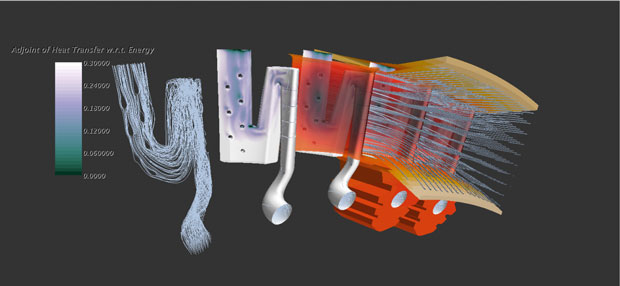 STAR-CCM+ v10.04 debuts a new Adjoint Solver for Coupled Solid Energy that enables sensitivity analysis of solid conduction problems. This screen shows a scalar plot of magnitude of adjoint heat transfer with respect to energy on the internal surface of a cooled turbine blade. Image courtesy of CD-adapco.
So, begin learning more about STAR-CCM+ v10.04 in today’s Pick of the Week news write-up. The links at the end take you to some of CD-adapco’s deeper descriptions of v10.04’s enhancements. In a nutshell, the v10.04 release of STAR-CCM+ is indeed something you should find interesting.
Thanks, Pal. – Lockwood
Anthony J. Lockwood
Editor at Large, Desktop Engineering


Anthony J. Lockwood is Digital Engineering's founding editor. He is now retired. Contact him via [email protected].
Follow DE
Join over 90,000 engineering professionals who get fresh engineering news as soon as it is published.






About Us · Contact Us · Editorial Team · Advertising · Privacy Policy · Subscriber Services · © 2026 Digital Engineering 24/7 · Peerless Media