Helping design and engineering professionals discover, evaluate and specify technologies and processes that shorten the design cycle and enable success.



Digital Engineering April 2026
In the latest issue of Digital Engineering, we take a look at the latest innovations in design for additive manufacturing, including the use of natural language inputs, social media cosplayers, and AI integration. The issue also includes a feature…

January Special Focus Issue: Design for Additive
In this Special Focus Issue of Digital Engineering, learn about the latest advancements in design for additive manufacturing, including new software tools, additive in automotive, custom medical devices, and more.
The award was the result of the Fraunhofer Institute’s work on bladed disks (blisks) that form the core of turbines. Using selective laser melting (SLM), the Institute was able to create a 3D printed blisk. Use of AM technology has reduced material consumption for blisks by around 60% and decreased the manufacturing time by around 30%.
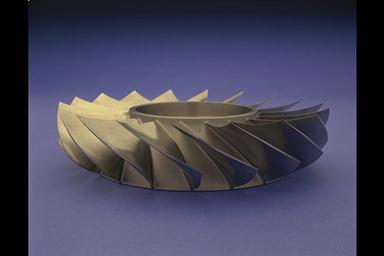
Researchers at the Fraunhofer Institute are part of a team that includes the Fraunhofer Society and the German Federal State of North-Rhine Westphalia. The group is known collectively as Aachen Fraunhofer Cluster for Innovation, and conducts R&D on “Integrative Production Technology for Energy-Efficient Turbomachines.”
The process to create the blisks uses SLM to lay down a layer of nickel or titanium-based alloy, slowly building the compressor blades. Along with being less expensive and faster than traditional methods of manufacturing, using AM in the creation of aerospace parts creates an opportunity to build lighter products, with a net result being better fuel consumption and a smaller environmental footprint.
Aerospace seems to be turning to AM more and more often to solve problems. For more information about how AM is transforming the aerospace industry check out these Rapid Ready Tech posts here and here.
Below you’ll find a video about how turbine engines work. The methods involved are subtractive, but I think you’ll still find the overview informative.
Source: Industrial Laser Solutions


John Newman is a Digital Engineering contributor who focuses on 3D printing. Contact him via [email protected] and read his posts on Rapid Ready Technology.
Follow DE
Join over 90,000 engineering professionals who get fresh engineering news as soon as it is published.






About Us · Contact Us · Editorial Team · Advertising · Privacy Policy · Subscriber Services · © 2026 Digital Engineering 24/7 · Peerless Media