Helping design and engineering professionals discover, evaluate and specify technologies and processes that shorten the design cycle and enable success.



May 2026 Special Focus: Artificial Intelligence in Design and Simulation
In this Special Focus Issue, learn about the latest developments in the integration of artificial intelligence into engineering workflows.

April 2026 Special Focus Issue: Generative Design
In this Special Focus Issue, Digital Engineering takes a look at how generative design solutions can be used across different types of design problems and with a variety of manufacturing approaches to accelerate design space exploration, and…
 NVIDIA launches Grid 2.0 at VMWorld 2015
In April 2015, analyst firm IDC published a whitepaper titled "Driving business value with desktop virtualization." To the excitement of virtualization advocates, IDC estimated, "Every $1.00 invested in migration to CVD [centralized virtual desktop] will yield $4.51 in return for an ROI of 351%." It's an attractive proposition to move enterprise hardware from the people's desks to a centralized cloud (private or public).
IDC wrote, "Organizations migrating from a traditional PC environment to CVD face an initial investment of $539 per user, which includes the costs for virtualization software as well as servers, cages, racks, space, and installation to support the back end. The combined benefits of the CVD environment — lower annual infrastructure costs, lower staff support costs, and lower user productivity costs — will pay for the initial migration in around six to seven months."
If you think PC and workstation vendors are quivering in fear of the trend, you'd be wrong. The IDC paper is, in fact, sponsored by HP. It suggests leading hardware providers know they cannot hope to stem the tide. So many have decided to ride the wave instead.
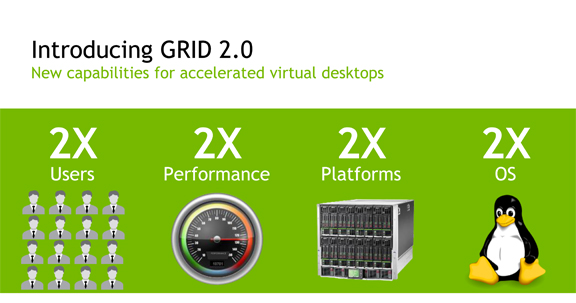
This week, as VMWorld gets underway in San Francisco's Moscone Center, GPU maker NVIDIA launched Grid 2.0, a GPU-powered virtual desktop infrastructure (VDI) solution for enterprises. Version 2.0 is marked by several improvements: the addition of Linux OS support and increased density in capacity. Will Wade, NVIDIA's product manager for Grid, pointed out, "Linux is big in automotive and manufacturing, especially for analysis."
According to NVIDIA, Grid 2.0 "doubles user density over the previous version." In other words, the hardware can host to a greater number of virtual machines. Wade said, "We have run benchmark studies on our [NVIDIA Tesla] M60 cards, supporting up to 32 virtual machines. That doubles the number of users we previously supported with the K2 cards. So you now get the same level of performance with twice as many users."
With Grid 2.0, NVIDIA began supporting blade servers for the first time. HP, Dell, Lenovo, and Cisco are among the vendors offering Grid 2.0 products.
Previously, the use of VDI may have been confined to entry-level and mid-range design software users, but Wade said, "We're beginning to see an expansion of usage. Now, with Grid 2.0, you can scale from entry to high-end users. The M60 (GPU for servers) is the equivalent of the Quadro 5000 (GPU for professional workstations), so the performance is very high."
VDI allows GPU sharing. When deployed across a pool of users, the processing power of a GPU that's idle can be harvested by the rest of the users who need more visualization or computing performance. It creates a setup where product lifecycle management (PLM) software users with low computing and visualization demands may share GPUs with CAD users with higher demands.
NVIDIA has setup a Grid test for those interested in experiencing VDI performance. You can test-drive Grid 2.0 here.


Kenneth Wong is Digital Engineering's resident blogger and senior editor. Email him at [email protected] or share your thoughts or suggestions at digitaleng.news/facebook.
Follow DE
Join over 90,000 engineering professionals who get fresh engineering news as soon as it is published.






About Us · Contact Us · Editorial Team · Advertising · Privacy Policy · Subscriber Services · © 2026 Digital Engineering 24/7 · Peerless Media