Helping design and engineering professionals discover, evaluate and specify technologies and processes that shorten the design cycle and enable success.



Digital Engineering April 2026
In the latest issue of Digital Engineering, we take a look at the latest innovations in design for additive manufacturing, including the use of natural language inputs, social media cosplayers, and AI integration. The issue also includes a feature…

January Special Focus Issue: Design for Additive
In this Special Focus Issue of Digital Engineering, learn about the latest advancements in design for additive manufacturing, including new software tools, additive in automotive, custom medical devices, and more.
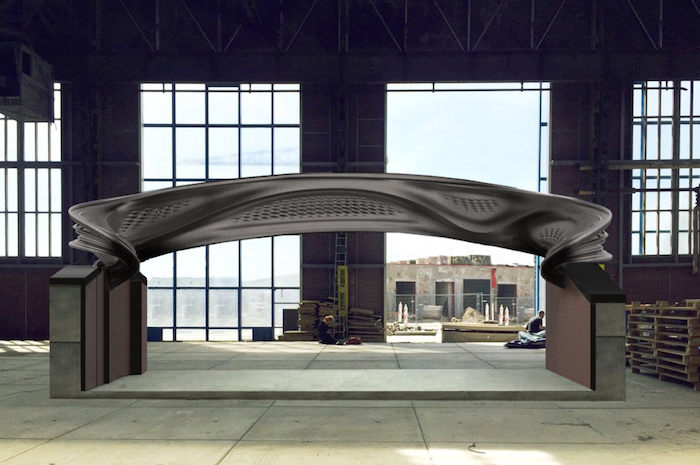
That’s not some pipe dream, that’s a bona fide bridge project currently underway in Amsterdam. Driven by the startup MX3D and backed by the Amsterdam City Council, the proposed 12-meter-long stainless steel bridge has been in development for a couple of years and got a boost this week with the news that Autodesk and partners were developing a smart sensor network that would leverage digital twin and machine learning technology to help make the first-of-its-kind 3D printed bridge smarter and safer.
 MX3D is 3D printing a 12-meter-long stainless steel bridge for an Amsterdam canal. Image Courtesy of Autodesk
“We are overlaying an IoT project to ensure we capture as much data as possible from the bridge,” says Alec Shuldiner, IoT researcher at Autodesk and project manager for the collaboration with MX3D, who called the initiative a great example of data-centric engineering. “Robotic 3D metal printing is so far out there, there is no engineering knowledge about how things produced in this manner are going to perform. We want to build up that knowledge by capturing as much data as we can throughout the process.”
Autodesk RevIt software was used to prototype the bridge, and simulation software played a role in determining where on the bridge sensors should be placed in order to capture the optimal signals for monitoring things like vibration and stress points, Shuldiner explains. Beyond that, Autodesk is leveraging its SeeControl IoT platform (now called FusionConnect) and cloud service technology developed in its research labs to perform high-velocity data ingestion from the bridge sensors with additional pre-processing work in the cloud. Project Dasher, also from Autodesk’s research group, will serve as a visualization hub for aggregating and presenting data collected from the bridge sensors in a 3D digital twin, a living model reflecting the current status of the physical bridge in real time, which engineers could leverage to monitor performance and safety and facilitate any required changes.
 Autodesk is developing a smart sensor network to monitor the 3D printed bridge’s health in real time using a digital twin. Image Courtesy of Autodesk
Autodesk partner The Alan Turing Institute is responsible for developing machine learning algorithms as well as designing and installing the sensor network on the bridge to collect structural measurements like strain, displacement and vibration along with environment data such as air quality and temperature. The machine learning algorithms will inform insights that help engineers measure the health of the bridge in real time and monitor changes over its lifespan. It will also keep tabs on what’s happening on the bridge—for example, how many people are crossing over it and how quickly.
While the actual Amsterdam bridge isn’t likely to go under construction for another year or two, Autodesk is working on its technology deliverables using a prototype of the bridge constructed in its Pier 9 fabrication space in San Francisco. The next step is to create a second prototype on site in Amsterdam within the next year to do further validation and testing of the real-time sensor network technology.
“It will be comparable in size to the actual bridge and even in the same place,” Shuldiner explains. “That gets us closer to the real thing.”
To learn more about the MX3D 3D printed bridge project, check out this video.


Beth Stackpole is a contributing editor to Digital Engineering. Send e-mail about this article to [email protected].
Follow DE
Join over 90,000 engineering professionals who get fresh engineering news as soon as it is published.






About Us · Contact Us · Editorial Team · Advertising · Privacy Policy · Subscriber Services · © 2026 Digital Engineering 24/7 · Peerless Media