Helping design and engineering professionals discover, evaluate and specify technologies and processes that shorten the design cycle and enable success.



Digital Engineering April 2026
In the latest issue of Digital Engineering, we take a look at the latest innovations in design for additive manufacturing, including the use of natural language inputs, social media cosplayers, and AI integration. The issue also includes a feature…

January Special Focus Issue: Design for Additive
In this Special Focus Issue of Digital Engineering, learn about the latest advancements in design for additive manufacturing, including new software tools, additive in automotive, custom medical devices, and more.
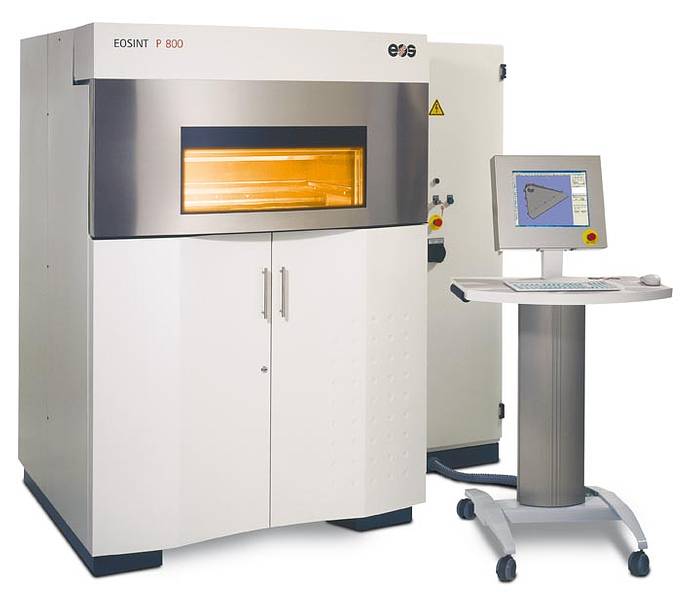
The process uses a CO2 laser that can run at temperatures of 385°C (725°F) to build layers with a thickness of 0.1mm (.004”). The high temperature allows the EOS P800 to sinter high-performance polymers, such as polyether ether ketone (PEEK) and polyaryl ether ketone (PAEK). The result allows for the direct part production of strong, complex plastic parts.
High temperature laser sintering is a 3D printing process that is growing in popularity for making strong plastic production parts. While it is true that aerospace, defense, energy, medical and transportation are natural consumers, there are many more industries that will benefit from this processing and material technology.–Jim Williams, Paramount CEO
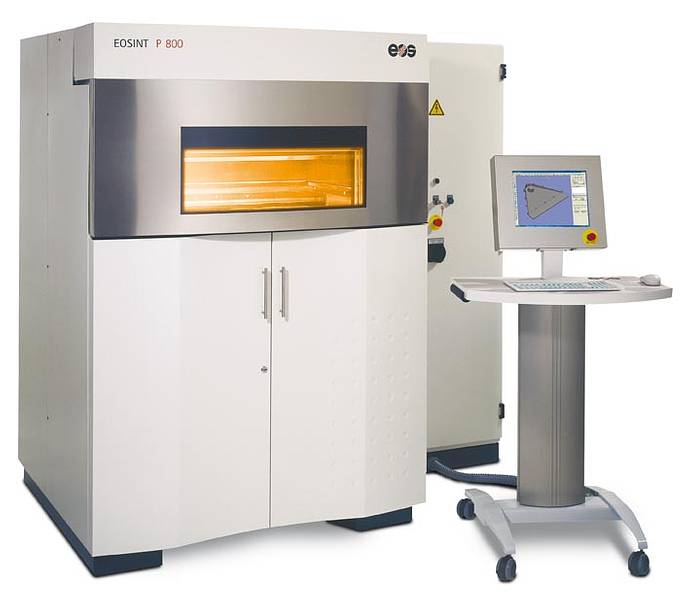
The high melting points (around 340°C) and high tensile strength (around 90 Mpa) of PEEK and PAEK make them valuable for parts in pumps and pistons, along with the previously mentioned aerospace and medical fields. Combining the speed of production typical of AM with the strength of PEEK and PAEK makes HTS a potential replacement for standard methods of production for similar parts, which is more expensive and time intensive.
Paramount Industries is working on ways to further increase the versatility of HTS-built parts with the production of carbon-fiber-reinforced PAEKs. According to the company, carbon-reinforced PAEK has a higher tensile strength and is electrostatic dissipative. Paramount has received assistance from the U.S. Air Force Small Business Innovation Research (SBIR) as part of the F-35 Joint Strike Fighter Program.
Below you’ll find a video from Paramount that highlights the materials discussed.
Sources: PRWeb, EOS, Paramount Industries


John Newman is a Digital Engineering contributor who focuses on 3D printing. Contact him via [email protected] and read his posts on Rapid Ready Technology.
Follow DE
Join over 90,000 engineering professionals who get fresh engineering news as soon as it is published.






About Us · Contact Us · Editorial Team · Advertising · Privacy Policy · Subscriber Services · © 2026 Digital Engineering 24/7 · Peerless Media