Helping design and engineering professionals discover, evaluate and specify technologies and processes that shorten the design cycle and enable success.



Digital Engineering April 2026
In the latest issue of Digital Engineering, we take a look at the latest innovations in design for additive manufacturing, including the use of natural language inputs, social media cosplayers, and AI integration. The issue also includes a feature…

January Special Focus Issue: Design for Additive
In this Special Focus Issue of Digital Engineering, learn about the latest advancements in design for additive manufacturing, including new software tools, additive in automotive, custom medical devices, and more.
Metal additive manufacturing (AM) in 2025 can produce high-end premium applications such as aerospace components (think intricate engine parts or lightweight structural elements), customized medical implants, or defense-ready rapid manufacturing of drones. Increasingly, everyday applications using metal AM also abound. The wide-ranging applications and industries associated with such applications are the result of ongoing improvements in metal AM technology via its hardware and software. DE checks in with several vendors in the metal additive manufacturing space (EOS, Materialise, and HP) to gather their perspective on metal AM—its potential within the biggest industry sectors, materials and methods impacting metal AM at present, and even thoughts on reshoring and how it impacts metal AM for better or for worse.
Our experts give fresh insights as to where within industries metal AM is increasingly being put to use. Following are a few of the industry segments:
Energy
“Metal additive manufacturing (AM), particularly laser powder bed fusion (LPBF), has already played a transformative role in power generation and the energy sector,” says Joel Sam, business development manager–Metals, EOS. “As turbines, motors, and energy systems continue to evolve toward greater power density and efficiency, AM enables designs that were previously impossible—complex internal cooling channels, lightweight structures, and fully integrated features within a single part.”
Sam explains how instead of replacing a casting or machining process, metal AM provides engineers with “the freedom to rethink the part altogether.” For instance, with power systems, according to Sam, this can translate to heat exchangers with enhanced surface area-to-volume ratios, combustion hardware built to work with advanced fuels, or turbomachinery components that blend high creep resistance with advanced cooling.
Oil and Gas
Spare parts production may provide a viable avenue for use of metal AM in the oil & gas sector, says Bart Van der Schueren, chief technology officer, Materialise. “The long operational lifetimes (often 50 to 60 years) of oil and gas installations mean there’s a continuous need for replacement components. On-demand production via AM helps minimize downtime and avoids lengthy supply chains.”
Aerospace
In sectors where traditional methods go up against cost, product complexity, or supply chain limitations, Arvind Rangarajan, global head of Product and Strategy of HP Additive Manufacturing Solutions, says metal AM is rapidly making inroads.
“In aerospace, for example, we see growing use for investment casted parts like turbine impellers, combustor cans, and hot gas manifolds—components that demand heat and corrosion resistance but are not classified as flight-critical,” Rangarajan says.
Van der Schueren of Materialise concurs with the increasing impact of metal AM in aerospace, especially with regard to defense.
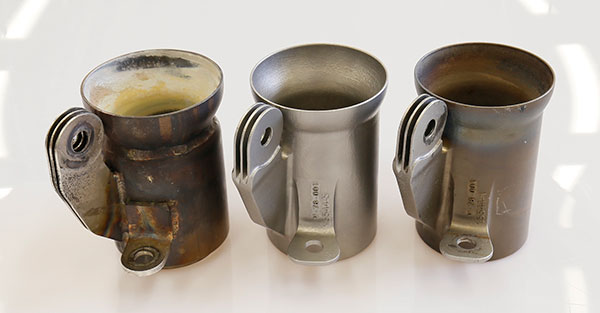
Aerospace is a promising sector for metal 3D, according to Materialise. These aerospace components are linked to a use case with Vocus GMbh. Image courtesy: Vocus GmbH.
“Additive manufacturing is already evolving from a prototyping method to producing selected end-use parts,” Van der Schueren says. “The Holy Grail is in the production of class 1 and class 2 components (dynamically loaded parts) —the pathway though isn’t straightforward. This is where the defense sector is offering a key opportunity, where the end-use parts—such as those for drones or other unmanned systems—can be deployed faster. This environment allows for accelerated learning and innovation, as printed parts in defense can be used to gather qualification data without the heavy certification burdens that exist for civil aviation.”
He elaborates: “In aerospace manufacturing, changing an already-certified flight component on an existing airplane can cost millions of euros. As a result, aerospace companies are hesitant to switch production technologies mid-production lifecycle. However, once the defense sector demonstrates the reliability of AM components in non-human-critical systems, that evidence creates a strong incentive for aerospace companies to incorporate metal AM into new designs from the very beginning. This proactive integration in the design phase can help mitigate certification and requalification costs, paving the way for the expanded use of AM in the aerospace industry as a whole.”
Healthcare
In regulated environments such as healthcare, HP’s Rangarajan says, “AM is gaining traction with sharper surgical tools and patient-specific surgical guides.”
Van der Schueren, of Materialise, which is heavily involved in the healthcare space, notes metal AM’s feasibility for personalized implants (default) and standard implants, adding also how dental is “going full speed. In the medical field, metal AM is already the default way to produce personalized implants with highly complex lattice structures that improve tissue integration. Beyond customized implants, we are also increasingly seeing the production of standard implants using metal AM. This trend is especially pronounced in dental applications, where the ability to create optimized, patient-specific designs has been adopted at a rapid pace.”
Automotive
Price sensitivity is a key influencer in the automotive sector, according to Van der Schueren. That said, he notes, “While I don’t expect a breakthrough in mainstream automotive production using metal AM in the next five years, there is definite potential in specialized applications in the production of cars and car components, such as tooling for injection molding. Here, additive manufacturing can enable features like conformal cooling that reduce cycle times and offer cost savings.”
Consumer Electronics
In this space, Van der Schueren of Materialise sees niche opportunities: “Metal AM is finding its niche in producing small, complex components that conventional manufacturing struggles to achieve cost-effectively.” He cites an example of production of ultra‐thin, functional hinges in foldable smart phones—often in titanium. ”As high-end manufacturers explore these solutions, technology could make its way into more diverse electronics applications,” he shares.
HP’s Rangarajan also mentions the consumer electronics segment with regard to development of intricate liquid cold plates and lightweight, high-strength parts for wearables and drones.
Construction
In the construction sector, Materialise’s Van der Schueren sees metal AM as having potential in niche scenarios.
“It opens up possibilities for free–form metal structures and specialized components produced through methods like metal welding robots. However, given the scale and cost dynamics in construction, these applications will be confined to specialized projects rather than mainstream production,” he explains.
“Within the landscape of metal AM, LPBF [laser powder bed fusion] has established itself as the technology most likely to dominate production applications,” EOS’ Sam says. “This technology can produce parts with fine features, thin walls, and near-net surface quality, which reduces the need for costly post-processing.”
Sam notes that LPBF has played a significant role in qualification work, especially for highly regulated industries like aerospace and medical. “This maturity means that there is already a well-developed ecosystem of process parameters, in-situ monitoring tools, and quality assurance methods. That gives manufacturers confidence to adopt LPBF not just for prototypes, but for serial production.”
Van der Schueren agrees, noting that he sees LPBF as “the workhorse of metal AM at present. It delivers high detail and resolution essential for complex geometries while maintaining a balance between accuracy and production speed.”
But he gives a nod to other technologies, including binder jetting, which he suggests “holds promise, though its breakthrough has been slowed by challenges in post‐printing sintering and thermal treatments.” He also mentions direct energy deposition (DED), including both wire- and powder-based variations, which “is gaining traction for larger parts or applications where post-processing (such as CNC machining) can efficiently finish the component.
“Each technology has its niche, and while LPBF currently dominates, we’re likely to see these alternate methods capture more specialized roles as the technology matures,” Van der Schueren says.
EOS’ Sam also sees the potential with binder jetting and DED, as well as wire arc additive manufacturing (WAAM): “Binder jetting shows promise for very high-volume, lower-complexity parts where sintering is acceptable. Directed energy deposition is valuable for very large parts or for repair applications where deposition rates matter more than resolution. Extrusion processes, like wire arc additive manufacturing can expand accessibility to new users at lower cost points.”
Alloys are gaining ground as a viable material option in metal AM, experts say. “The materials landscape is shifting toward alloys once considered too difficult or costly to process through conventional means. Tungsten carbides, tool steels, and nickel-based superalloys, for example, traditionally required investment casting or proved nearly impossible to weld. These materials are now becoming viable through additive manufacturing, with adoption being accelerated by supply chain challenges and demand for faster turnaround,” HP’s Rangarajan says.
He continues, “These market pressures, including supplier hesitation around high-mix, low-volume production, and the need for part consolidation, are driving AM design innovation. Gains in tool life, thermal efficiency, and lightweighting, particularly in aerospace and automotive, are further reinforcing adoption.”
EOS’ Sam says customers are looking more closely at material properties when considering alloys: “Customers are now requesting materials with higher fatigue resistance, better thermal stability, and improved crack resistance during printing. That has led to the rise of new high-strength aluminum alloys for lightweighting, tool steels for high-performance tooling applications, and copper alloys for thermal and electrical conductivity. Beyond simply adapting conventional alloys, the industry is also beginning to design ‘AM-native’ materials, such as aluminum Al5X1 by EOS: a lightweight, high-strength, corrosion-resistant, anodizable alloy.”
Experts also reflect on the benefits of reshoring and point to the impact it can have on adoption of AM. “Instead of carrying thousands of parts in warehouses, companies can print components as needed, locally and on demand,” Sam of EOS explains. “For industries where supply chain security and compliance are critical, such as aerospace, defense, or energy, this capability is becoming a differentiator. Manufacturers can ensure that parts are produced domestically, with full traceability of powder batches, build parameters, and inspection data. That reduces risk while increasing resilience. Still, it’s important to note that reshoring with AM isn’t automatic. Success requires investment in qualification, a trained workforce, and access to a reliable powder supply. The companies that approach reshoring with this full picture in mind are the ones making the transition successfully.”
Van der Schueren also recognizes certain benefits with reshoring as it ties into metal AM: “I believe metal AM facilitates reshoring of production due to its inherent flexibility. With metal printing, the entire production can be more decentralized. All you need are digital assets, a suitable printer, raw material, and skilled operators to manage quality and process controls. This means companies are better able to produce critical components locally, thereby reducing reliance on distant, global supply chains while also enhancing traceability and production responsiveness.”
Van der Schueren sees a clear ongoing transition.
“While metal AM started primarily as a prototyping and tooling solution, we are now seeing its gradual adoption for end-use components. In aerospace, static components—like nozzles—are already being manufactured by AM, and I expect that experience from testing and qualification in the defense sector (using parts in non-human-critical systems such as drones) will eventually pave the way for broader implementation in civilian aircraft.
“In automotive, despite the price sensitivity, there’s movement in areas such as tooling for injection molding (especially where conformal cooling can boost performance) and high-value specialty parts,” Van der Schueren says. “I anticipate that as process control and certification standards continue to improve, metal AM will increasingly support end-use manufacturing.”
EOS’ Sam says that one of the greatest shifts in metal AM is the transition from prototyping and tooling into true end-use production. “In the early years, AM was often seen as a way to iterate designs quickly or create specialized tooling inserts,” Sam says. “Today, we are more often in the era of serial production, particularly in the space, turbomachinery, and medical industries. Aerospace OEMs already have certified LPBF parts flying in engines and systems. Biomedical companies produce thousands of titanium hip, knee, and shoulder implants that go into human bodies.
“Automotive has historically been slower to adopt LPBF due to higher volume expectations and razor-thin margins,” Sam says. “But with the rise of electrification, AM is continuing to gain traction in tooling components (like inserts for high-pressure die casting), lightweighting structures, and custom components for low-volume or luxury vehicles. Time will tell if LPBF technology can become cost effective enough to compete with traditional methods for serial production of end-use components in the consumer automotive sector.”
In the future, Sam of EOS says to continue to expect use of metal AM in premium, high-end applications. But don’t rule out the potential for more consumer applications. “At the high end, metal AM is already well established in premium, mission-critical applications. Rocket engines, turbine components, and medical implants represent areas where performance demands are so high that the design freedom of AM is not optional, but essential. Some consumer application examples are rising and may become more common in the near future. Some consumer electronics companies, notably Apple and Apiar, have implemented metal AM to create watch housings. Metal LPBF will likely never be able to compete with traditional methods for most consumer-level applications, but over time there will be more use cases for components found in luxury goods.” DE

EOS enables their customers to produce innovative and high quality products based on industrial 3D printing technologies. EOS is a global technology and quality leader for high-end solutions in the field of additive manufacturing (AM). Founded in…
Industry Focus: Designing for Industrial Machinery and Heavy Equipment
The articles compiled in this special digital issue focus on how vendors are reacting to the need to digitize the factory floor and connect it all the way back through the enterprise to front-end product design and development.

Stephanie is the Associate Editor of Digital Engineering.
Follow DE
Join over 90,000 engineering professionals who get fresh engineering news as soon as it is published.






About Us · Contact Us · Editorial Team · Advertising · Privacy Policy · Subscriber Services · © 2026 Digital Engineering 24/7 · Peerless Media