Helping design and engineering professionals discover, evaluate and specify technologies and processes that shorten the design cycle and enable success.



May 2026 Special Focus: Artificial Intelligence in Design and Simulation
In this Special Focus Issue, learn about the latest developments in the integration of artificial intelligence into engineering workflows.

April 2026 Special Focus Issue: Generative Design
In this Special Focus Issue, Digital Engineering takes a look at how generative design solutions can be used across different types of design problems and with a variety of manufacturing approaches to accelerate design space exploration, and…
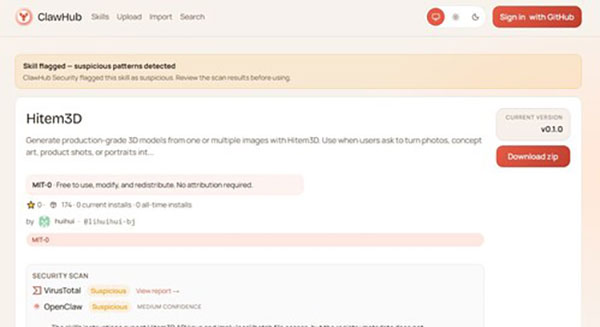
Hitem3D, developed by Math Magic, has recently been published as a callable Skill on OpenClaw's ClawHub, enabling developers to invoke image-to-3D generation through structured agent workflows.
The release allows OpenClaw agents to execute 3D generation tasks via application programming interface-based Skill invocation.
Packaging 3D Generation as a Callable Skill
The Skill encapsulates Hitem3D's generation capabilities into a standardized execution flow. Within OpenClaw, agents first verify API credentials, then detect task types—such as single-image, multi-view, batch processing, or portrait generation—before confirming parameters including model version, resolution, output format, and generation mode.
Once configured, the agent submits the generation job via API, polls execution status, and returns downloadable results along with a structured parameter summary. In cases of failure, workflows may include retry guidance, such as adjusting resolution or input quality.
Parameterization for Flexible Use Cases
The Skill exposes a defined capability matrix, allowing developers to control model variants, resolution tiers, output formats such as GLB, OBJ, STL, FBX, and USDZ, as well as generation modes including geometry-only or integrated texturing. This enables the same workflow to support use cases from previews to fabrication-oriented outputs.
At the model level, Hitem3D applies a structure-aware integrated texture generation approach, integrating geometry and texture generation within a unified workflow designed to improve surface consistency and downstream compatibility. This helps reduce visible seams and avoids many common texture-related issues.
Designed for Downstream Usability
The system reduces isolated or unsupported mesh elements, improving downstream usability. Outputs are compatible with common slicing software, where models can be prepared using standard repair tools.
Models may require minor adjustments before printing. In internal tests, most outputs were processed with minimal manual intervention, often using built-in auto-repair features. Wall thickness can be adjusted for typical FDM and resin printing requirements.
Developers can explore the Skill implementation and integrate it into their agent workflows at: https://clawhub.ai/lihuihui-bj/hitem3d.
Hitem3D v2.0 is available worldwide. Explore sample outputs at hitem3d.ai and hitem3d.ai/3dprinting/use-case.
About Hitem3D
Hitem3D, pioneered by Math Magic (founded 2024), converts single or multi-view images into production-ready 3D models for 3D printing, and industrial design. The platform serves users in more than 150 countries and integrates into professional digital production workflows.
Sources: Press materials received from the company and additional information gleaned from the company’s website.


DE's editors contribute news and new product announcements to Digital Engineering. Press releases may be sent to them via [email protected].
Follow DE
Join over 90,000 engineering professionals who get fresh engineering news as soon as it is published.






About Us · Contact Us · Editorial Team · Advertising · Privacy Policy · Subscriber Services · © 2026 Digital Engineering 24/7 · Peerless Media