Helping design and engineering professionals discover, evaluate and specify technologies and processes that shorten the design cycle and enable success.



May 2026 Special Focus: Artificial Intelligence in Design and Simulation
In this Special Focus Issue, learn about the latest developments in the integration of artificial intelligence into engineering workflows.

April 2026 Special Focus Issue: Generative Design
In this Special Focus Issue, Digital Engineering takes a look at how generative design solutions can be used across different types of design problems and with a variety of manufacturing approaches to accelerate design space exploration, and…
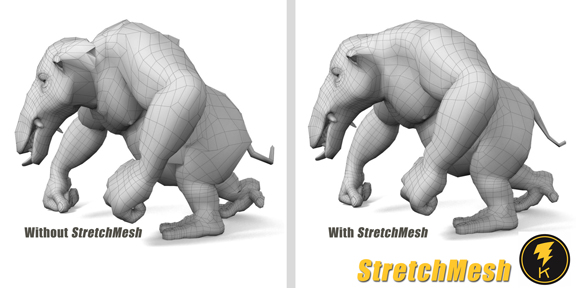
In software development, even giving away software seems to come with an expense. Last week, Kickstand, responsible for the popular StretchMesh plug-in for Autodesk Maya software, decided to “[launch] a campaign to evolve StretchMesh Surface Deformation software into Open Source technology.”
But apparently, it needs about $15,000 to fund the open-source transformation. So the company decided to use Indie Gogo, a social media-driven fundraising portal, to raise money at http://www.indiegogo.com/StretchMesh-for-Autodesk-Maya. (At the moment, it has only collected $745. With the deadline Dec 31 approaching quickly, the project will need more help from fans with deep pockets to meet its goal.)
According to Kickstand, “By making the source code available to the 3D community, Kickstand opens the door for artists working in Maya to incorporate the surface deformation technology into their 3D workflow. The StretchMesh Open Source initiative also allows programmers and developers of software programs such as Autodesk 3D Studio Max and Softimage, NewTek LightWave, Luxology modo, and Maxon Cinema 4D to incorporate advanced surface deformation functionality in future product releases.”
Describing its StretchMesh software, the company writes, “StretchMesh is a plug-in for Autodesk Maya which gives geometry an inherently stretchy characteristic. As geometry is deformed using native Maya deformers or other plug-ins, StretchMesh gives the geometry a built-in stretchy quality by preserving the relationship between vertices. Collision objects can be added to simulate the underlying anatomy over which the skin slides. A "stiffness" map can be painted to accommodate areas where stretchiness is not desired.”
The Achilles heel in parametric modeling -- a method employed by most mechanical CAD packages -- is its lack of easy surfacing tools. (You can create complex surfaces, but it takes you too many steps that you’ll be tempted to give up.) The challenge has prompted many automotive and consumer good designers to employ a special surfacing program like Autodesk Alias, Maya, or Rhino, then import the geometry into a mechanical CAD program to add other components. An open-source surfacing plug-in will be a welcome addition to the list available.


Kenneth Wong is Digital Engineering's resident blogger and senior editor. Email him at [email protected] or share your thoughts or suggestions at digitaleng.news/facebook.
Follow DE
Join over 90,000 engineering professionals who get fresh engineering news as soon as it is published.






About Us · Contact Us · Editorial Team · Advertising · Privacy Policy · Subscriber Services · © 2026 Digital Engineering 24/7 · Peerless Media