Helping design and engineering professionals discover, evaluate and specify technologies and processes that shorten the design cycle and enable success.



May 2026 Special Focus: Artificial Intelligence in Design and Simulation
In this Special Focus Issue, learn about the latest developments in the integration of artificial intelligence into engineering workflows.

Design & Simulation Software Guide 2025
In this Special Issue, Digital Engineering presents its second annual guide to design and simulation software vendors.
OPTIS (Toulon, France), provider of light simulation solutions, and Noesis Solutions (Leuven, Belgium), which specializes in performance optimization, announce the interoperability of their respective CATIA V5-integrated solutions enabling improved optical performances and light effects in industries as varied as automotive, aircraft, consumer goods, packaging, electronic display and architecture.
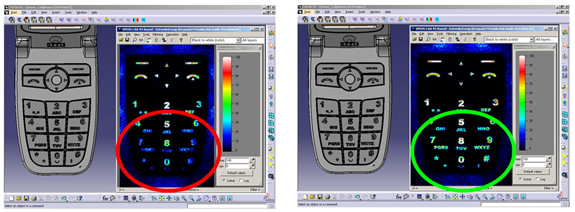 Automatic optimization of a mobile phone keypad lighting. Left: Before optimization the keys are hardly visible. Right: After optimization there is uniform light distribution. |
The interoperability between OPTIS’ SPEOS CAAV5-based software and NOESIS PLM Optimization CAAV5-based software means that users will be able to easily optimize the performance, visual appearance, and color of the lighting systems they design.
OPTIS and NOESIS, both CAA V5 partners of Dassault Systemes, give CATIA V5 users unique, direct access to advanced capabilities: optimization, tolerancing, and robustness evaluation capabilities to assist their lighting system design, within one single, intuitive environment and as part of their overall PLM cycle.
Due to these optimization capabilities, the SPEOS CAAV5-based software will, for the first time, be able to detect which of the numerous parameters should be adjusted in order to achieve the desired output results.
The interoperability of SPEOS CAAV5-based with PLM Optimization CAAV5-based software will help users explore more design options and in greater depth. Consequently they will be able to develop products of superior performance and appearance, whatever the design criteria – by optimizing color, contrast level, light uniformity, intensity, information legibility, reduction of the number of light sources, and perceived quality, while allowing them to keep to tighter time constraints.
For details, go to OPTIS or Noesis Solutions.
Sources: Press materials received from the company and additional information gleaned from the company's website.


DE's editors contribute news and new product announcements to Digital Engineering. Press releases may be sent to them via [email protected].
Follow DE
Join over 90,000 engineering professionals who get fresh engineering news as soon as it is published.






About Us · Contact Us · Editorial Team · Advertising · Privacy Policy · Subscriber Services · © 2026 Digital Engineering 24/7 · Peerless Media