Helping design and engineering professionals discover, evaluate and specify technologies and processes that shorten the design cycle and enable success.



May 2026 Special Focus: Artificial Intelligence in Design and Simulation
In this Special Focus Issue, learn about the latest developments in the integration of artificial intelligence into engineering workflows.

Design & Simulation Software Guide 2025
In this Special Issue, Digital Engineering presents its second annual guide to design and simulation software vendors.
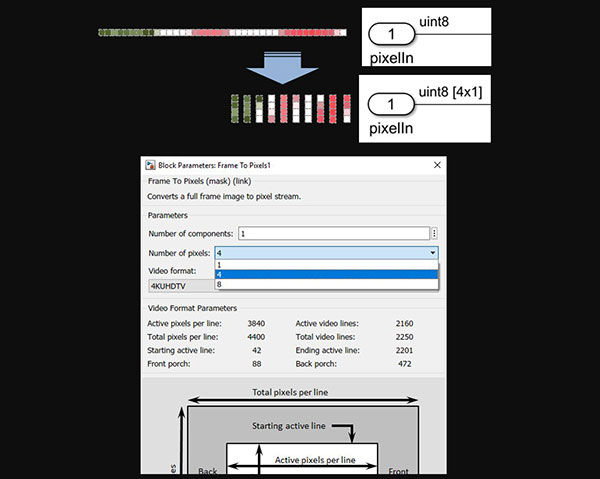
MathWorks announces that with the recent availability of Release 2019b of the MATLAB and Simulink product families, Vision HDL Toolbox includes native multipixel streaming support to process high-frame-rate (HFR) and high-resolution videos on FPGAs. Video, image processing and FPGA design engineers can speed the exploration and simulation of behavior and implementation tradeoffs when processing 4k or 8k video and videos with resolutions of 240fps or higher.
Vision HDL Toolbox offers blocks that can process four or eight pixels in parallel, with the underlying hardware implementation automatically updated to support simulation and code generation with the specified parallelism. This capability helps hardware engineers collaborate with image and video processing engineers to explore and simulate vision processing hardware behavior at a high level of abstraction. By adding HDL Coder to this design workflow, engineers can generate synthesizable, optimized target-independent VHDL or Verilog code directly from their verified high-level models.
“Implementing vision processing algorithms on FPGA, ASIC and SoC devices requires clever tradeoffs between throughput and resource usage, and 4k, 8k and high-frame rate video multiplies this challenge,” says Jack Erickson, principal product marketing manager at MathWorks. “Exploring the solution space and simulating at a high level of abstraction helps engineers converge more rapidly on an architecture before committing to Register-Transfer Level (RTL). Vision HDL Toolbox and its native multi-pixel-per-clock processing automatically implement all the details so engineers can focus on developing hardware-ready algorithms that meet their requirements.”
Vision HDL Toolbox provides pixel-streaming algorithms for the design and implementation of vision systems on FPGA, ASIC and SoC devices. It provides a design framework that supports a diverse set of interface types, frame sizes, and frame rates. The video and image processing algorithms in the toolbox model hardware implementations include latency, control signals and line buffers.
The toolbox algorithms are designed to generate readable, synthesizable code in VHDL and Verilog (with HDL Coder). The generated HDL code is FPGA-proven for frame sizes up to 8k resolution and for HFR video.
Sources: Press materials received from the company and additional information gleaned from the company’s website.

The MathWorks is the world's leading developer of technical computing and Model-Based Design software for engineers and scientists in industry, government, and education. With an extensive product set based on MATLAB® and Simulink®,…

DE's editors contribute news and new product announcements to Digital Engineering. Press releases may be sent to them via [email protected].
Follow DE
Join over 90,000 engineering professionals who get fresh engineering news as soon as it is published.






About Us · Contact Us · Editorial Team · Advertising · Privacy Policy · Subscriber Services · © 2026 Digital Engineering 24/7 · Peerless Media