Helping design and engineering professionals discover, evaluate and specify technologies and processes that shorten the design cycle and enable success.


Alert!
Digital Engineering ceased publication on July 1, 2026. This website remains available as an archive of engineering content.
For inquiries or information, please email [email protected].
May 2026 Special Focus: Artificial Intelligence in Design and Simulation
In this Special Focus Issue, learn about the latest developments in the integration of artificial intelligence into engineering workflows.

Design & Simulation Software Guide 2025
In this Special Issue, Digital Engineering presents its second annual guide to design and simulation software vendors.
The idea of flying on an unmanned aircraft might rightfully make many air travelers queasy, but the truth is, routine operations of modern aircraft are largely automated. “The aircraft is flown by a computer with the humans only taking control during takeoffs and landing,” says Paolo Colombo, senior director of strategy, aerospace and defense, Altair, part of Siemens.
“Aircraft already rely heavily on semi-automated systems,” adds Juan Valverde, aerospace and defense industry manager, Mathworks. “For instance, autopilot handles cruise, altitude adjustments, etc. At many airports equipped with Category III Instrument Landing Systems (ILS), fully automated landings—known as auto landing—are supported under specific conditions, like low visibility.”
Matthieu Paquet, principal application engineer, Ansys, part of Synopsys, adds, “I wouldn’t say one hundred percent but close to one hundred percent [of the aircraft] is already automated somehow.”
That does not mean human pilots are no longer needed. They’re responsible for using their experience and judgment to set the inputs that make the airplane take off and land safely. And their presence ensures if something goes wrong midair, whether equipment malfunction or a bird strike, they can intervene and take corrective action. With many souls on board, that assurance is priceless. In this article, we look at the simulation regimens that make aircraft automation possible, and what the future holds for commercial aviation.
People generally do not like the idea of cold, detached algorithms making life-or-death decisions, but in aviation, there are good reasons for relying on them. Paquet points out, “[Algorithms] are not touched by panic or stress, and they give you a higher level of precision.”
Human visions cannot penetrate fog and clouds, but sensors can, in a manner of speaking, see through them. When it comes to multitasking, machines are much better at it than humans, and when performing repetitive tasks, they’re less prone to fatigue or boredom.
“Computers are continuously managing engines to optimize fuel consumption and avoid overstress, taking care of weight distribution by pumping fuel from one tank to another when needed. They can also manage the HVAC (heating, ventilation, air conditioning) system to improve cabin comfort,” explains Colombo. “Machines excel at monitoring dozens of variables simultaneously and responding faster than a human to stabilize a system and optimize its performances, or performing complex, boring repetitive tasks in a consistent way.”
In split-second decisions, machines governed by algorithms can react much faster. “There’s a mathematical equation that governs what the machine sees, and what it must do,” notes Paquet.
Even for operations under the human pilot’s control, automation can act as a safeguard. “Some systems detect anomalies, helping guide pilots through the proper emergency procedures, even intervening when a pilot’s inputs risk exceeding flight laws, such as operating outside the flight envelope or surpassing parameters like maximum speed for gear or flaps extension,” says Colombo.
Due to the size and operating environment of airplanes, physical testing of their functions is costly. It’s relatively easy to conduct crash tests and destructive tests on, say, a bicycle or a new smartphone. Not so with airplanes.
“When you are testing autonomous taxiing, you are trying to see if the plane can detect the workers on the ground and not drive into them. If you try this in the real world, you have to risk someone’s life. In simulation, you can crash into the virtual human as many times as you want. Nobody gets hurt,” observes Paquet.
In autonomy testing, sensor data visualization plays an important role. The plane—specifically, the software controlling its navigation—needs to be able to read and interpret Lidar data, camera data, and thermal imagery and then react to them appropriately.
“Ansys has a solution called Ansys Autonomy Solution for Aerospace and Defense. STK, a component of it, integrates multiple solvers to simulate the flight dynamics of an aircraft. You can simulate the traffic agents around the plane; you control the so-called intruders in your scenarios,” says Paquet. “You can use AVxcelerate to generate the sensor data and connect it to STK to simulate the plane’s mission.”
The company also offers Ansys SCADE, a software suite for ensuring the reliability of embedded software. “SCADE generates software code that is certified for safety critical operations,” says Paquet, adding that Ansys is working with several regulatory agencies to develop and implement the SAE ARP 6983, a process standard for implementing machine learning in avionic systems.
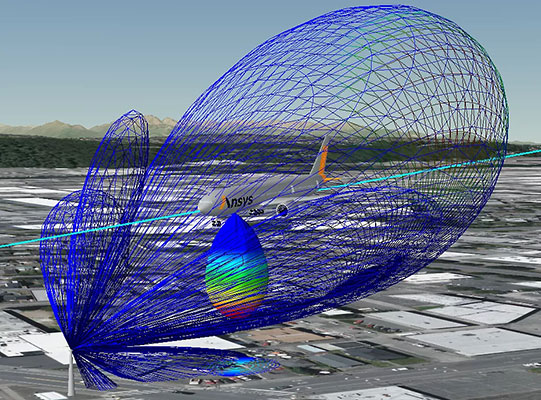
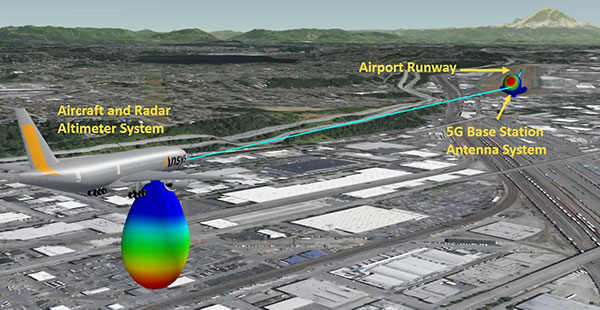
STK simulation shows landing geometry as the aircraft passes close to the 5G C-band base station in the scenario. Projection of the radar altimeter gain contours can be seen on the ground beneath the aircraft.
Valverde says, “[MathWorks’] MATLAB and Simulink are commonly used to design algorithms supporting different levels of autonomy, test responses to unusual flight scenarios, etc. Model-based design techniques are widely used, including code generation, to follow processes and comply with the objectives captured in aerospace certification standards such as ARP4754B, ARP4761A, DO-254, and DO-178C.”
The company’s software can incorporate the model, control software, and hardware in the loop, where real-time embedded software is tested in realistic scenarios to ensure performance and reliability. Its customers include Bell Helicopter, which develops fly-by-wire commercial helicopters.
“The embedded coder generates C/C++ directly from models, and the HDL coder generates HDL code, reducing manual coding errors and supporting compliance with certification standards,” explains Valverde.
Another customer is Lockheed Martin, which uses MATLAB and Simulink to speed up the development of the guidance, navigation, and control (GN&C) system for its Interface Region Imaging Spectrograph (IRIS) observatory, currently in orbit to capture images and ultraviolet spectra of the sun.
“They used Embedded Coder to generate C code for these components, adding a small amount of hand-generated ‘glue’ code for a Moog Broad Reach Engineering radiation-hardened microprocessor and its executive software. Using a custom MATLAB user interface, the team exercised a variety of Simulink test cases for each GN&C flight software unit,” according to the case study published by MathWorks.
Colombo identifies the different aspects making up a comprehensive flight mission simulation as follows:
Colombo adds, “This layered approach is what makes it possible to move safely from automation that follows instructions to autonomy that can make informed decisions. Ultimately, autonomy in aviation isn’t about flying planes without pilots; it’s about creating systems resilient enough to handle the unpredictable world we live in.”
Taxiing—the aircraft’s movements from the terminal gate to the runway—is one of the few operations that currently remains human-driven. “There’s just too much movement and information, like the luggage cars and aircraft marshallers,” says Paquet. “Also, it’s a high-risk task. If there’s an accident on the runway, it stops the airport operations for hours.”
But he also views advancements in the automotive industry as a precursor to what might happen in aviation in the future. As autonomous driving gains acceptance and the technology matures, it will likely be integrated into aviation as well. “When you look at taxiing, it’s essentially driving the plane onto the runway,” Paquet says. “There are companies and regulatory committees working on auto-taxiing and auto-takeoff.”
Valverde believes AI is extending the reach of automation in areas like adaptive flight control, predictive maintenance, or real-time route optimization, among others, though most are still being researched. “However, AI is not yet widely certified for use in safety-critical flight systems. Tasks that involve unpredictable emergencies or require nuanced human judgment—such as evaluating conflicting risks during abnormal events—remain difficult to automate reliably,” he clarifies.
He also notes that MathWorks has developed an end-to-end example of a runway sign classifier, which could potentially support an emergency braking system during taxiing, illustrating how AI might enhance situational awareness and safety in ground operations.
Currently, commercial aviation is heading toward high automation, but, the experts interviewed for this article believe it’s highly unlikely to become fully autonomous. Even when full automation becomes part of commercial flights, human pilots are expected to remain in the cockpit.
Colombo says, “They are active managers of automation, programming it, supervising it, and stepping in when the unexpected occurs. Most of the automation requires human input. Pilots, before taking off, put data into the FMS [flight management system], so the autopilot and the FADEC [Full Authority Digital Engine Control] know how to manage the engines’ power and what route must be followed. Automation cannot make decisions outside of the spectrum of situations it was programmed for, and that’s why pilots need to take control in any emergency or when an anomaly is detected.”


Altair transforms design and decision making by applying simulation, machine learning, and optimization throughout product lifecycles. Altair offers software in five categories related to Computer Aided Engineering (CAE) and High Performance…
Accelerating and Advancing CAE
GPUs are changing the nature of engineering simulation, according to a new ebook from Jon Peddie Research (JPR). It explains how GPU acceleration is improving CAE workflows.

Kenneth Wong is Digital Engineering's resident blogger and senior editor. Email him at [email protected] or share your thoughts or suggestions at digitaleng.news/facebook.
Follow DE






About Us · Contact Us · Editorial Team · Advertising · Privacy Policy · Subscriber Services · © 2026 Digital Engineering 24/7 · Peerless Media