Helping design and engineering professionals discover, evaluate and specify technologies and processes that shorten the design cycle and enable success.



May 2026 Special Focus: Artificial Intelligence in Design and Simulation
In this Special Focus Issue, learn about the latest developments in the integration of artificial intelligence into engineering workflows.

April 2026 Special Focus Issue: Generative Design
In this Special Focus Issue, Digital Engineering takes a look at how generative design solutions can be used across different types of design problems and with a variety of manufacturing approaches to accelerate design space exploration, and…
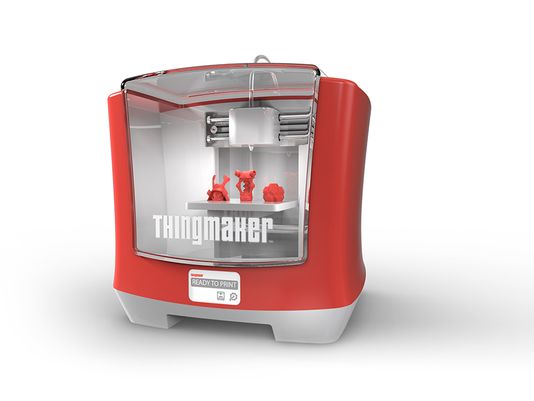
In the 1960s (which I am not old enough to remember) Mattel launched an interactive toy called the ThingMaker that allowed kids to create bugs, monsters and other slimy objects by pouring goo into molds. Eventually demand for the ThingMaker died down, and parents everywhere breathed a collective sigh of relief that their carpets were safe. Fast forward 50 years and Mattel, in partnership with Autodesk, is relaunching the ThingMaker as a 3D printer.
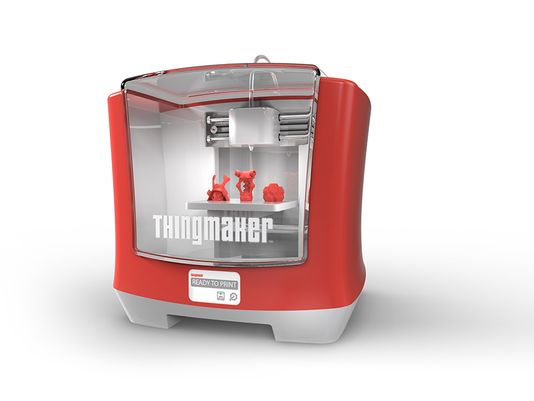 The ThingMaker is being billed as the first commercial 3D printer targeted at a family audience. Courtesy of Mattel.
The new ThingMaker takes the form of a $299 3D printer, with a linked app for iOS and Windows. The app offers a basic CAD program that lets kids (and adults, no doubt) create their own digital designs to be printed out of the ThingMaker. Although meant for use with Mattel’s new system, word is the app will also communicate with other 3D printers, which might be useful for schools or individuals who already own said devices.
The ThingMaker itself is a surprisingly attractive 3D printer, even with its bright orange casing. It has a lid that must be closed for printing to commence, which should help keep small fingers out of molten plastic. The system uses standard PLA filament and works in the same manner as other fused deposition modeling type systems by deploying melted plastic from an extruder head.
With most 3D printers, the question of what to print is part of the equation, but in this case it’s what users will be allowed to print that is a better question. Mattel owns scores of copyrights and has oodles of licensed properties. Will users be allowed to print out Hot Wheels or Barbies? The answer is maybe. Mattel seems to be in the process of deciding exactly what will and what will not be available to print.
The new ThingMaker will launch in the fall, and Mattel intends to track what people are making with the app before deciding on future plans. Below you’ll find a video about the old ThingMaker in all its gooey glory.
Source: USA Today


John Newman is a Digital Engineering contributor who focuses on 3D printing. Contact him via [email protected] and read his posts on Rapid Ready Technology.
Follow DE
Join over 90,000 engineering professionals who get fresh engineering news as soon as it is published.






About Us · Contact Us · Editorial Team · Advertising · Privacy Policy · Subscriber Services · © 2026 Digital Engineering 24/7 · Peerless Media