Helping design and engineering professionals discover, evaluate and specify technologies and processes that shorten the design cycle and enable success.



Digital Engineering April 2026
In the latest issue of Digital Engineering, we take a look at the latest innovations in design for additive manufacturing, including the use of natural language inputs, social media cosplayers, and AI integration. The issue also includes a feature…

January Special Focus Issue: Design for Additive
In this Special Focus Issue of Digital Engineering, learn about the latest advancements in design for additive manufacturing, including new software tools, additive in automotive, custom medical devices, and more.
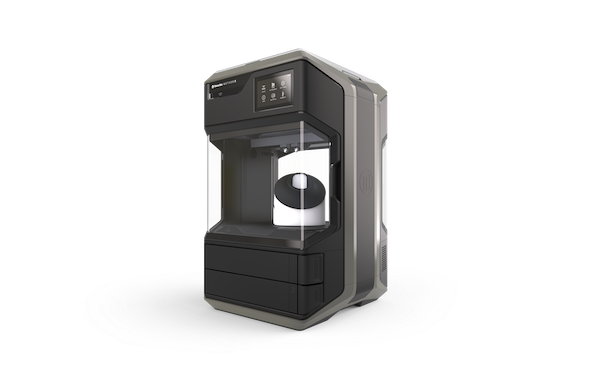
Makerbot is building on its vision for industrial-grade desktop 3D printing with the METHOD X, what it dubs a manufacturing workstation architected for the production of end-use parts, manufacturing tools, and functional prototypes.
The new desktop 3D printer’s ability to print in real ABS material in a 100°C build chamber using Stratasys SR-30 soluable supports allows dimensional accuracy and precision typically associated with higher-grade and more expensive industrial 3D printers, Makerbot officials said. Specifically, they claim METHOD X can print parts that are up to 26% more rigid and up to 12% stronger than modified ABS formulations used on most existing desktop 3D printers. In addition, the 100°C Circulating Heated Chamber significantly reduces part deformation, producing parts that are less susceptible to warping or cracking and that sport an optimal surface finish, they added.
“The combination brings manufacturing closer to the desktop and engineering,” says Nadav Goshen, Makerbot CEO. “The ability to print with Real ABS enables dimensional accuracy, and the soluable supports frees you to print whatever geometry you like.”
Makerbot is positioning the METHOD X for manufacturing use cases, including small production runs of end use parts, for manufacturing tools like jigs and fixtures, and for instances that require a strong material like ABS to withstand harsh environments. The printer is also a good fit for creating functional prototypes in ABS that closely mimic injection-molded parts prior to part production, officials say.
In comparison, the original Method printer, which is now being offered at a reduced price of $4,999, is being aimed at early stage prototyping for design engineers looking to expand the iterative process and who don’t require the mechanical properties of ABS for their applications. Goshen said he foresees engineering departments using the Method for early stage design and employing the METHOD X for production-class printing.
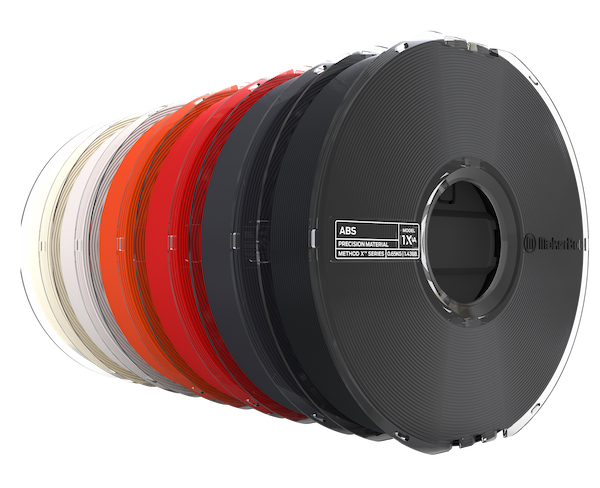
The METHOD X prints real ABS material that is stronger than modified ABS formulations on traditional desktop 3D printers. Image Courtesy of Makerbot
METHOD X’s support for Stratasys SR-30 soluable support material is also a key differentiator for the new printer. Goshen says the printer is the only offering in its price class to support SR-30 materials, which ensure easy and fast removal and thus enable greater design freedom, including the ability to print unrestricted geometries such as large overhangs, cavities, and shelled parts.
Other industrial capabilities on the METHOD X include Dry Sealed Material Bays, Dual Performance Extruders, Ultra-Rigid Metal Frame, and automation capabilities that create a controlled printing environment for faster and more efficient production. The METHOD X, priced at $6,499 and slated to ship in late August, is also equipped with 21 onboard sensors to monitor and control temperature, humidity, material detection, among other environmental factors.
“This combination doesn’t exist in the desktop 3D printer market today,” Goshen says. “It’s what engineers are used to when printing on industrial systems that cost three or more times as much as METHOD X.”
To learn more about the METHOD X, watch this video clip.

At MakerBot, we believe the easier the user experience, the more you can focus on developing your ideas. Whether you're already 3D printing or just starting out, learning how to read, write, and talk about your process with the right terms…

Beth Stackpole is a contributing editor to Digital Engineering. Send e-mail about this article to [email protected].
Follow DE
Join over 90,000 engineering professionals who get fresh engineering news as soon as it is published.






About Us · Contact Us · Editorial Team · Advertising · Privacy Policy · Subscriber Services · © 2026 Digital Engineering 24/7 · Peerless Media