Helping design and engineering professionals discover, evaluate and specify technologies and processes that shorten the design cycle and enable success.



Digital Engineering April 2026
In the latest issue of Digital Engineering, we take a look at the latest innovations in design for additive manufacturing, including the use of natural language inputs, social media cosplayers, and AI integration. The issue also includes a feature…

January Special Focus Issue: Design for Additive
In this Special Focus Issue of Digital Engineering, learn about the latest advancements in design for additive manufacturing, including new software tools, additive in automotive, custom medical devices, and more.
Reverse engineering legacy parts, whether from the Space Shuttle or a Bugatti, used to be a challenging process. In the case of an old Bugatti, the processes used to make parts are largely unknown, which can be a problem in itself. For the restorer of a 1922 Type 38 Bugatti, a particular problem was recreating a water pump manifold that was so badly corroded that some areas were nonexistent.
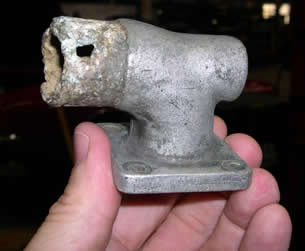 Original water pump manifold for 1922 Bugatti with damage from corrosion visible around the tube that accepts a flexible rubber water hose. |
A Bugatti water pump manifold looks like a 1-inch diameter tube with a flat mounting base, 90-degree bend in it, and a flange at one end for a flexible rubber tube. On closer examination, the manifold is full of irregular shapes. It has no perfect circles and the extrusions are narrower at one end than the other. Basically the part was an organic shape.
How do you make a water pump manifold for a 1922 Type 38 Bugatti? Nobody knows for sure how the original part was created. It could have been made from a hand-carved wood pattern, not uncommon for many legacy parts. In any case, it was not a straight tube with a 90-degree bend, flange, and mounting surface.
Yet the part had to be recreated while maintaining the original detail to preserve the aesthetics of the part. This required creating a CAD drawing true to the organic detail that included the deteriorated features.
Using a NextEngine 3D Scanner, a 3D mesh and the original color were captured. The process of scanning the part — multiple scans were made to ensure fidelity of digital part — took 35 minutes.
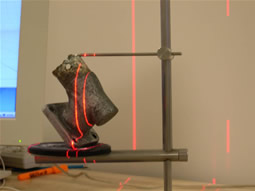 | 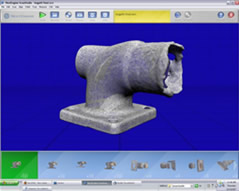 |
| Scanning the manifold with NextEngine's multi-beam laser scanner. | Finished scan of original part. |
The digital part mesh was brought into RapidWorks, which is based on Rapidform XOR from Rapidform. The digital part was used as a reference for building the final part. Intelligent Tools in RapidWorks software identifies shapes to speed the reverse-engineering process. The reverse engineering time in RapidWorks was 45 minutes. The total time to get to a CAD model was an hour and a half.
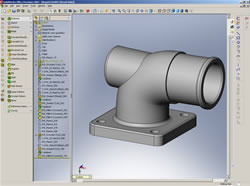 Finished CAD part reverse engineered in RapidWorks and transferred to SolidWorks, shown here as a transferred SLDPRT. |
RapidWorks’ Segmentation Wizard used the features on the mesh as a reference for creating CAD drawing features. A CAD feature tree was created true to the organic shape of the original Bugatti part.
The areas that had corroded away, including the flange and mounting surface, were rebuilt in RapidWorks. Additionally, the wall thicknesses were specified.
The feature tree was transferred to SolidWorks using RapidWorks Live Transfer functionality to create an SLDPRT file for a database. Either RapidWorks or SolidWorks can create IGES, STEP, or STL files. Using these formats, the part could be placed in an assembly to validate fit with other parts. Also, the file could be used for FEA analysis to determine stress and contact issues, etc.
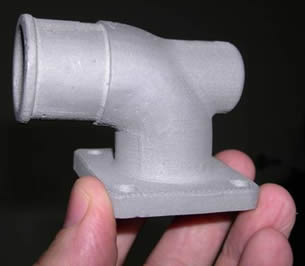 New physical part ready to be mounted on the Bugatti engine. |
The SolidWorks part file was printed using a Dimension 3D ABS printer. The resulting plastic part was used to make an investment casting. The mold was heated to melt away the plastic part leaving a cavity in the silica/sand mold and then a cast aluminum part made from the mold. The finished manifold matched the original, in shape and dimensions.
Basically, for less than $5,000 and two hours of designer time, a CAD drawing of the not-so-simple legacy part was reverse engineered. That means two things: One, it'll take just a few jobs to cover the costs of your NextEngine 3D scanner. Two, you'll have a lot more time to go out cruising.
For full details about the NextEngine 3D scanner, go to NextEngine.
See why DE chose this Pick of the Week.
Watch a YouTube broadcast of the Bugatti story.


DE's editors contribute news and new product announcements to Digital Engineering. Press releases may be sent to them via [email protected].
Follow DE
Join over 90,000 engineering professionals who get fresh engineering news as soon as it is published.






About Us · Contact Us · Editorial Team · Advertising · Privacy Policy · Subscriber Services · © 2026 Digital Engineering 24/7 · Peerless Media