Helping design and engineering professionals discover, evaluate and specify technologies and processes that shorten the design cycle and enable success.




Sponsored
Artificial Intelligence for Design and Engineering Workflows
In this white paper, learn how artificial intelligence and machine learning can improve design and simulation.
Technology Focus: Designing for Optimization & Simulation
Simulation is pervasive, with people from different departments and backgrounds discovering new ways to put it to use, in all of its varied forms.
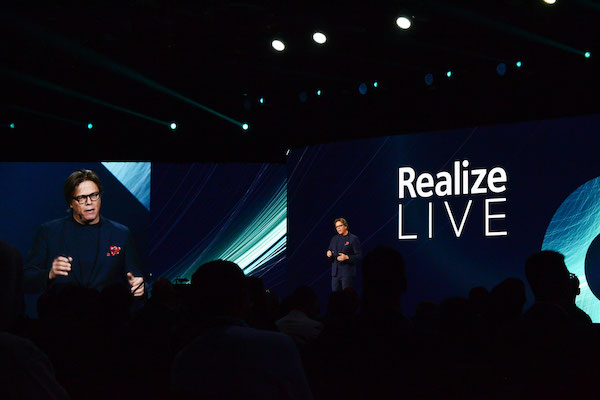
Siemens’ Realize Live Americas conference kicked off the week of June 2 in the Motor City of Detroit, drawing close to 3,000 attendees to Huntington Place Convention Center where content focused on real transformation in real time.
During the event, many tracks highlighted collaborative work Siemens has done with countless partners. Following are several highlights from the partnership between NVIDIA and Siemens.
Olympia Brikis is director of industrial AI research at Siemens. There, she is working on building the next generation (generative) in AI applications for operations, automation, engineering, electrification and mobility.
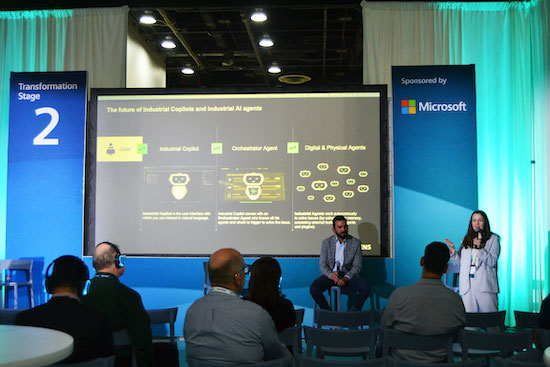
Brikis presented “Transforming Shopfloor Operations: Gen AI-powered Industrial Copilots” alongside Alvin Clark, senior AI engineer, at NVIDIA.
She opened by explaining the concept of industrial copilots and “how they transform the shop floors of today and of tomorrow. We’re particularly going to dive into how Siemens and NVIDIA are working together to bring this technology to the shop floor to make it possible for generative AI to assist us in critical infrastructure environments that are closed or where we don’t necessarily want connectivity to the cloud.”
Industry challenges that merit consideration of copilot solutions include:
lack of skilled labor for shop floor tasks;
machine downtime that raises costs;
a need for quick response to machine failures.
The solution Brikis and Clark presented is the Industrial Copilot, a generative AI-powered assistant that aids shopfloor employees, maintenance engineers and service techs to address machine issues faster while having full transparency on machine data, which are designed to lead to increased productivity.
The Industrial Copilot on-premise version with NVIDIA means that data stays on the shopfloor, software runs locally on Siemens Simatic IPCs powered by NVIDIA GPUs. Also of note is that Siemens uses NIM and NeMo microservices for foundation models used in the Copilot.
“Everybody, when [they hear] the notion of ‘Copilot,’ thinks of a chatbot that is providing us with data. But right around the corner, we’re at the cusp of AI agents—agents that are going to perceive, they’re going to reason, they’re going to plan, and they’re going to execute,” says NVIDIA’s Clark.
He adds, “So instead of just providing operators with data for them to use, they’re going to be collaborating with operators to get jobs done.”
In another session, “Accelerating Automotive Transient Aerodynamics CFD Simulation at BMW,” Ian Pegler, CAE Developer Relations at NVIDIA, gave a talk highlighting how BMW is leveraging Siemens tools accelerated by NVIDIA to accelerate automotive transient aerodynamics simulations.
Specifically, the results showed the impact of accelerating Simcenter STAR-CCM+ simulations on the newest NVIDIA Grace Blackwell and Blackwell GPUs and NVIDIA CUDA-X libraries. Pegler shared how this acceleration has improved BMW simulation throughput by 3x at equivalent cost Pegler also highlighted how to visualize the results as a photorealistic digital twin by using NVIDIA Omniverse APIs.
Pegler’s takeaways were
discover how to notably cut down CFD turnaround time by tapping into NVIDIA CUDA-X libraries,Blackwell and Grace Blackwell GPUs power capabilities in Simcenter STAR-CCM+;
reconsider CAE visualization with photorealistic rendering driven Siemens Simcenter Star CCM+ powered by NVIDIA Omniverse;
learn how BMW uses these technologies to advance their aerodynamics workflow.
“Ultimately, how can GPUs help you? They can help you on the large transient cases that take a long time, on large meshes—that’s where GPU is going to help you the most. Also, GPUs can really help with design inspiration. Lastly, the workstation GPUs—datacenter GPUs—can open up the levels of simulation you can do,” says Pegler.
A third talk, “Photorealistic Digital Twin Visualization in Teamcenter Powered by NVIDIA,” was headed by Enzo Krka, senior product manager XR Visualization and Industrial Metaverse, Siemens, and Shuo Zhang, director of developer relations, Strategic Partners, NVIDIA.
The software solution spotlighted in this session was on Teamcenter Digital Reality Viewer, powered by NVIDIA Omniverse APIs, which enables real-time ray tracing capabilities to allow companies to visualize photorealistic digital twins of products. Users can have real-life visualization of datasets common in engineering and manufacturing to speed up product development cycles and cut down on errors, according to the presenters.
They jointly shared how Siemens is integrating NVIDIA Omniverse and AI into its Teamcenter product capabilities. They addressed Siemens Industrial Metaverse vision and how NVIDIA solutions play into that vision.
The Industrial Metaverse, according to Krka and Zhang, enables the ability to “collaborate, experience and interact with the comprehensive digital twin.” It’s “a place where fast engineering decisions are made leveraging precise robust data—real and digital.”
Via the metaverse, it’s possible to
Visualize the digital twin in its context, gleaning useful insights
Meet in real time to review the digital twin in collaboration
Interactively evaluate and simulate digital twin behavior
Monitor and manage assets in close loop with the twin.


Since its founding in 1993, NVIDIA (NASDAQ: NVDA) has been a pioneer in accelerated computing. The company’s invention of the GPU in 1999 sparked the growth of the PC gaming market, redefined computer graphics, ignited the era of modern AI and…

Cut Retrieval-Augmented Generation (RAG) Hallucinations by 50%
Most teams hit the same wall with enterprise AI: LLMs that hallucinate, pipelines that don’t scale, and infrastructure that’s harder to design than the models themselves.

Brian Albright is the editorial director of Digital Engineering.
Contact him at [email protected].

Join over 90,000 engineering professionals who get fresh engineering news as soon as it is published.






About Us · Contact Us · Editorial Team · Advertising · Privacy Policy · Subscriber Services · © 2026 Digital Engineering 24/7 · Peerless Media