Helping design and engineering professionals discover, evaluate and specify technologies and processes that shorten the design cycle and enable success.



Design & Simulation Software Guide 2025
In this Special Issue, Digital Engineering presents its second annual guide to design and simulation software vendors.

Design & Simulation Software Guide
In this Special Issue, Digital Engineering presents its inaugural guide to design and simulation software vendors, including listings for CAD, CAM, simulation, generative design, PLM, rendering and visualization, design for additive manufacturing,…
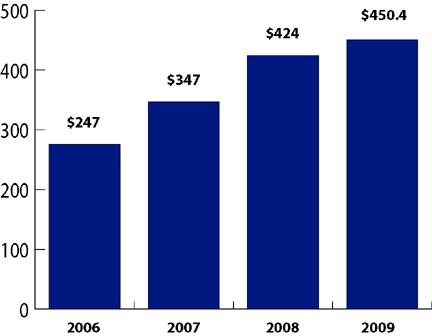
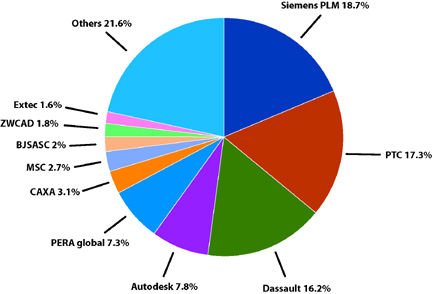
Pick up anything -- anything lying around you. There's a pretty good chance the label reads "Made in China." From the workstation sitting on your table to the sunglasses dangling on your nose bridge, most products manufactured today must pass through the Dragon's heartland at some stages of their lifecycles.
Recently, CIMdata, which publishes annual reports on the product lifecycle management (PLM) market, turned its gaze towards the Great Wall of China. What the analysts discovered was a market that managed to grow despite a bruised global economy. In its China PLM Report, published in April, CIMdata noted, "The global economy was in a major recession during 2009. However, with the heavy investment in infrastructure and the growing needs of its domestic market, the GDP (gross domestic productivity) of the People’s Republic of China still grew 8.7%."
In this report, CIMdata analysts tallied up revenues from sales of mechanical computer-aided design (MCAD), simulation and analysis, collaborative product definition management (cPDm), numerical control (NC), computer-aided manufacturing (CAM), and digital manufacturing.
"In China, PLM has been widely applied in large discrete manufacturers, particularly aerospace and defense, automotive, and high-tech companies," the report stated. "[While] still small, PLM investments within China are growing rapidly. Growth was sustained in spite of the global economic downturn in 2009. In 2009, the China PLM market grew 6.2%. The growth rate of the China PLM market is forecasted to be 12% in 2010." By contrast, global PLM market is expected to grow only by a single digit in percentage, according to CIMdata.
In this recorded interview, Ken Amann, CIMdata's research director, discussed China's resilience, the unique characteristics of the country's PLM market, what it would take to break into it, and how domestic (Chinese) PLM vendors are becoming a force unto themselves.



Kenneth Wong is Digital Engineering's resident blogger and senior editor. Email him at [email protected] or share your thoughts or suggestions at digitaleng.news/facebook.
Follow DE
Join over 90,000 engineering professionals who get fresh engineering news as soon as it is published.






About Us · Contact Us · Editorial Team · Advertising · Privacy Policy · Subscriber Services · © 2026 Digital Engineering 24/7 · Peerless Media