Helping design and engineering professionals discover, evaluate and specify technologies and processes that shorten the design cycle and enable success.



Design & Simulation Software Guide 2025
In this Special Issue, Digital Engineering presents its second annual guide to design and simulation software vendors.

Design & Simulation Software Guide
In this Special Issue, Digital Engineering presents its inaugural guide to design and simulation software vendors, including listings for CAD, CAM, simulation, generative design, PLM, rendering and visualization, design for additive manufacturing,…
Galorath, which offers software for cost, schedule, and risk management, recently published "The 2025 Industry Report on Cost, Schedule, and Risk."
The report was based on responses from a sample pool of 180 vetted senior and mid-level executives, belonging to IT/software development, energy, healthcare, transportation, automotive, aerospace, manufacturing, defense, and electronics. Data collection took place in the first quarter of 2025, with looming concerns about the impact of tarriffs, regional conflicts, supply chain disruption, and political tension.
The survey identified the top forecasting features that organizations wanted but didn't yet have: automation of reperative tasks (71%), real-time data integration (68%), and enhanced reporting and visualization tools (56%). Galorath noted, "89% of organizations cite cost volatility including unpredictable swings in labor, changing materials costs, and other input changes as their top operational threat in 2025."
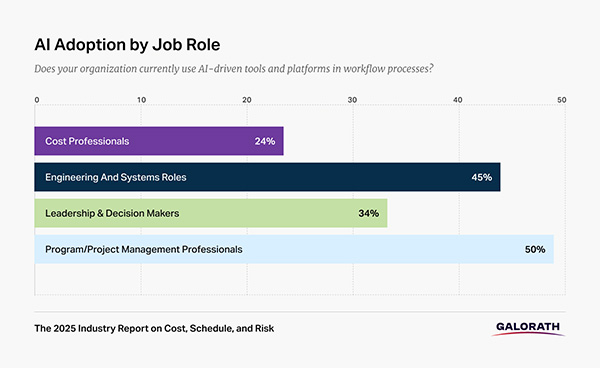
Responding to the question "Does your organization currently use AI-driven tools and platforms in workflow processes?," 76% of cost professionals reported no adoption. In contrast, 45% of engineering teams reported adoption. A surprise was that only half of the program managers reported adoption, limited to reporting tools. Overall, Galorath discovered 56% considered AI-driven estimation tools to be crucial to long-term success, yet 63% of organizations had not implemented AI-driven estimation tools.
The report's authors noted, "The data suggests that organizations are doing their best to plan, only to be disrupted by changes they can’t control. And while no company can predict the future, the demand is growing for systems that help prepare for it."
The report also showed, "Compliance is no longer a back-office task; it has become a front-line concern that shapes project scope, cost, and delivery—and the stakes are growing."
In the open-ended prompts, survey respondents jotted down their priorities and concerns: "track carbon emissions across complex supply chains; validate ethical sourcing beyond [Tier 1] vendors; interpret overlapping ESG [ethical, social, governance] rules from multiple jurisdictions." Survey showed 42% of respondents considered ESG considerations “extremely important." Another 45% said ESG played a “moderate role," and 21% said regulations played a “major role” in their estimation process.
Galorath offers SEERai, described as a product for "cost engineers with a conversational approach." Its product for manufacturing is SEER-MFG, which offers predictive analytics, process evaluation, work breakdown structures, risk analysis, material and production modeling, and labor and resource forecasting, among others.


Kenneth Wong is Digital Engineering's resident blogger and senior editor. Email him at [email protected] or share your thoughts or suggestions at digitaleng.news/facebook.
Follow DE
Join over 90,000 engineering professionals who get fresh engineering news as soon as it is published.






About Us · Contact Us · Editorial Team · Advertising · Privacy Policy · Subscriber Services · © 2026 Digital Engineering 24/7 · Peerless Media