Helping design and engineering professionals discover, evaluate and specify technologies and processes that shorten the design cycle and enable success.



May 2026 Special Focus: Artificial Intelligence in Design and Simulation
In this Special Focus Issue, learn about the latest developments in the integration of artificial intelligence into engineering workflows.

April 2026 Special Focus Issue: Generative Design
In this Special Focus Issue, Digital Engineering takes a look at how generative design solutions can be used across different types of design problems and with a variety of manufacturing approaches to accelerate design space exploration, and…
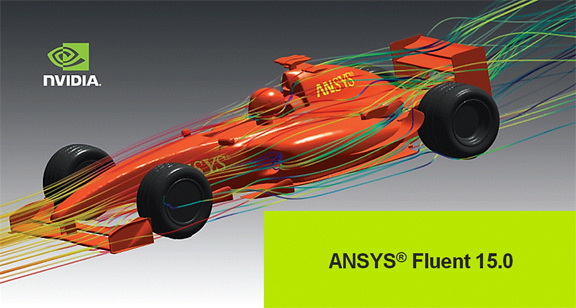
Just a month ahead of NVIDIA GPU Technology Conference 2014 (GTC 2014, March 24-27, San Jose, California), simulation software maker ANSYS is announcing its computational fluid dynamics (CFD) solver can run significantly faster if you augment the CPU with NVIDIA GPUs.
Since compute-intensive simulation programs tend to test the limit of CPUs, software vendors like ANSYS seek to speed up the number-crunching by refining their solver codes to take advantage of the GPU's parallel processing power. In 2013, ANSYS made it possible to improve the performance of ANSYS Mechanical -- designed to test and simulate mechanical behaviors -- using NVIDIA GPUs.
David Cusano, chief technology officer and vice president of Parametric Solutions Inc., an ANSYS customer specializing in gas turbine design, observed, "By adding NVIDIA GPU accelerators, our engineers cut the time for typical ANSYS Mechanical models in half, doubled the performance of maxed out CPU systems and often saved an entire day's worth of work. Now, with support for GPU acceleration in ANSYS Fluent 15.0, complex CFD simulations can be accelerated in a similar fashion, especially when paired with new, higher performance NVIDIA Tesla K40 GPU accelerators."
Under typical high performance computing (HPC) cluster licensing, adding additional CPU cores to speed up complex simulation jobs usually requires additional licensing fees. However, in the case of ANSYS, the GPU-acceleration may come at little or no added cost (except, of course, the cost of the GPUs that must be acquired).
According to Barbara Hutchings, ANSYS' director of strategic partnerships, "ANSYS customers get access to the entire GPU socket via the interchangeable GPU socket vs. CPU core licensing. Customers don't need to make a separate purchase decision. GPUs are enabled by the full range of ANSYS HPC products.


Kenneth Wong is Digital Engineering's resident blogger and senior editor. Email him at [email protected] or share your thoughts or suggestions at digitaleng.news/facebook.
Follow DE
Join over 90,000 engineering professionals who get fresh engineering news as soon as it is published.






About Us · Contact Us · Editorial Team · Advertising · Privacy Policy · Subscriber Services · © 2026 Digital Engineering 24/7 · Peerless Media