Helping design and engineering professionals discover, evaluate and specify technologies and processes that shorten the design cycle and enable success.




April 2026 Special Focus Issue: Generative Design
In this Special Focus Issue, Digital Engineering takes a look at how generative design solutions can be used across different types of design problems and with a variety of manufacturing approaches to accelerate design space exploration, and…

Electrum utilizes the 3DEXPERIENCE platform on the cloud to develop their new electric motorcycle
Electrum, a new brand of electric motorcycles, utilizes the 3DEXPERIENCE platform. Their mission is to support Indonesia’s shift to low-carbon, sustainable transport and to ultimately help the country’s government achieve its vision of net…
 The challenge for the Turkish Aerospace Industries (TAI) is to cater to a growing pool of engineers without constantly adding workstations to its IT infrastructure.
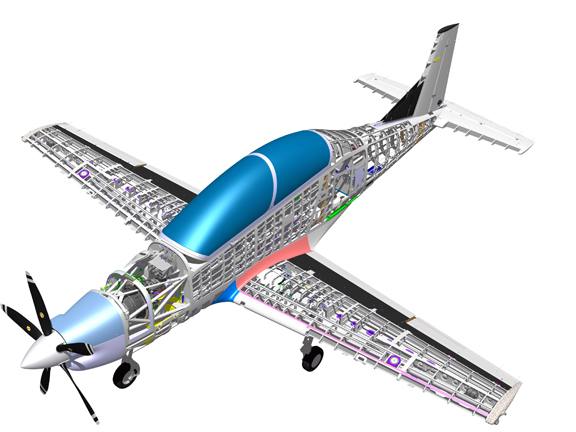 TAI adopted NVIDIA Grid technology to allocate the virtualized graphics as needed among its engineers, many of whom view and edit CAD models.
About 15 minutes' drive from the Temple of Augustus in Ankara, Turkey, stood the Turkish Aerospace Industries (TAI), an establishment of the Turkish Armed Forces Foundation. The organization's work spans from fixed and rotary wing aircraft to Unmanned Aerial Vehicle (UAV) and space systems. It's home to about 1,500 engineers, but the number is expected to double in the new few years.
Many of those engineers are shuttling heavy CAD data between Siemens PLM Software's NX and Oracle AutoVue, working from thin clients and business PCs connected via a secure intranet to the TAI's IT infrastructure. Their operations typically demand the computing power of professional workstations. TAI began using Citrix XenDesktop and XenApp to in its virtualized infrastructure, but it was a 1:1 user-GPU setup.
Serdar Kaya, IT System Engineer, TAI, explained the drawbacks: "A common problem we faced was that an engineer would be working on Project A where he might require additional memory or more graphics power than usual, so we’d install more RAM and higher-end graphics cards into his workstation. But then this engineer would switch over to Project B a few weeks later, which had lesser requirements, and it would not necessarily be worth it for us to uninstall the extra RAM or extra GPU. Now multiply that by thousands of engineers."
He felt TAI needed a more dynamic method to allocate graphics horsepower among the engineers as needed. He said, “In this environment where we are constantly expanding, and our engineers require varying amounts of graphics power each day from project to project, simply buying and maintaining more workstations and more graphics cards became costly and unmanageable. We needed to be able to simplify overall and also increase our user density."
Seeking a flexible setup to cater to the growing pool of engineers, Kaya and his colleagues were introduced to NVIDIA Grid technology, which allows virtual GPU sharing. TAI adopted servers equipped with NVIDIA GRID K1 boards for engineers who usually work with with CAD viewers and office applications; and servers with NVIDIA GRID K2 boards for those who work with the more-demanding CAD applications.
With NVIDIA GRID vGPU (virtual GPU) Manager, a maximum of eight users could simultaneously share the power of a single GPU. Thus, breaking away from its previous 1:1 GPU setup, the IT department could distribute the virtualized graphics power to a wide range of simultaneous users based on the demands of the projects. This allows TAI to address the needs of a larger number of engineers without additional hardware space in the server room.
According to NVIDIA, TAI plans to outfit its Ankara facility with several more GRID K1- and K2-equipped servers. Kaya said, "NVIDIA GRID is like nitrogen for virtual desktop infrastructure. You use nitrogen in your car engine when you require an extra boost of power -- and that’s exactly what GRID has done for our virtual machines."
The use of remote graphics or virtual GPU is expected to be one of the topics at the upcoming NVIDIA GPU Technology Conference (GTC, March 17-20, San Jose McEnery Convention Center). The keynotes will be live-streamed at http://www.ustream.tv/channel/gpu-technology-conference-2015.
For more on TAI's use of Grid technology, read NVIDIA's case study here.


Kenneth Wong is Digital Engineering's resident blogger and senior editor. Email him at [email protected] or share your thoughts or suggestions at digitaleng.news/facebook.
Follow DE
Join over 90,000 engineering professionals who get fresh engineering news as soon as it is published.






About Us · Contact Us · Editorial Team · Advertising · Privacy Policy · Subscriber Services · © 2026 Digital Engineering 24/7 · Peerless Media