Helping design and engineering professionals discover, evaluate and specify technologies and processes that shorten the design cycle and enable success.



Digital Engineering April 2026
In the latest issue of Digital Engineering, we take a look at the latest innovations in design for additive manufacturing, including the use of natural language inputs, social media cosplayers, and AI integration. The issue also includes a feature…

January Special Focus Issue: Design for Additive
In this Special Focus Issue of Digital Engineering, learn about the latest advancements in design for additive manufacturing, including new software tools, additive in automotive, custom medical devices, and more.
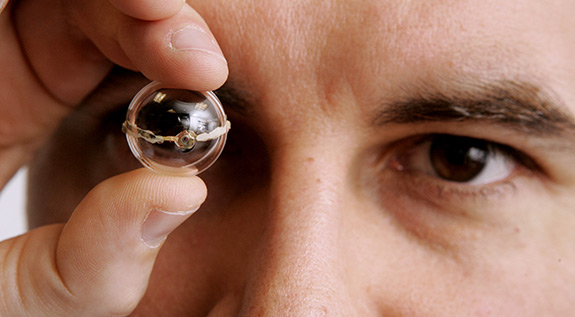
Princeton has put this aspect of AM to work in developing new ways to combine plastics and active electronics. One of the first proof-of-concept objects to be built using these principles is contact lenses that incorporate quantum dots and semi-conductors. The finished lens is capable of projecting beams of colored light.
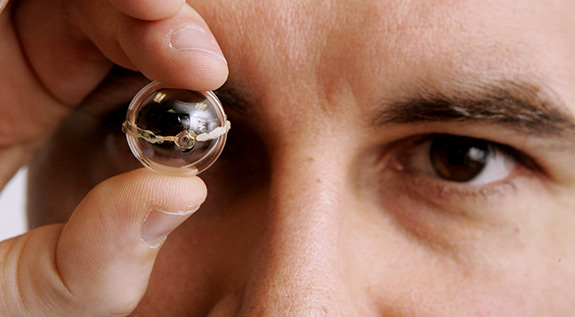 3D printed contact lens integrated with QLED technology. Courtesy of Frank Wojciechowski.
One might question what possible practical applications might be developed for shooting beams from your eyes, other than amusing your cats or impersonating one of the Borg. Formed from hard plastic, the lenses in question aren’t actually wearable, either. Lead researcher Michael McAlpine, an assistant professor of mechanical and aerospace engineering, has an answer.
"This shows that we can use 3D printing to create complex electronics including semiconductors," said McAlpine. "We were able to 3D print an entire device, in this case an LED. We used the quantum dots as an ink. We were able to generate two different colors, orange and green."
The project was also used to determine the feasibility of leveraging AM to build objects that incorporate materials that usually require diametrically opposed microfabrication techniques to build. As an example, one material might generally require heat as part of the fabrication process, while another material already included in an object might not react in a positive manner to the presence of heat. AM makes it possible to combine these materials in a single process.
"For example, it is not trivial to pattern a thin and uniform coating of nanoparticles and polymers without the involvement of conventional microfabrication techniques, yet the thickness and uniformity of the printed films are two of the critical parameters that determine the performance and yield of the printed active device," said Yong Lin Kong, project researcher and lead writer of “3D Printed Quantum Dot Light-Emitting Diodes” the paper published in Nano that documented the experiment.
Below you’ll find a short video about multi-material printing.


John Newman is a Digital Engineering contributor who focuses on 3D printing. Contact him via [email protected] and read his posts on Rapid Ready Technology.
Follow DE
Join over 90,000 engineering professionals who get fresh engineering news as soon as it is published.






About Us · Contact Us · Editorial Team · Advertising · Privacy Policy · Subscriber Services · © 2026 Digital Engineering 24/7 · Peerless Media