Helping design and engineering professionals discover, evaluate and specify technologies and processes that shorten the design cycle and enable success.



Digital Engineering April 2026
In the latest issue of Digital Engineering, we take a look at the latest innovations in design for additive manufacturing, including the use of natural language inputs, social media cosplayers, and AI integration. The issue also includes a feature…

January Special Focus Issue: Design for Additive
In this Special Focus Issue of Digital Engineering, learn about the latest advancements in design for additive manufacturing, including new software tools, additive in automotive, custom medical devices, and more.
 maceuticals.
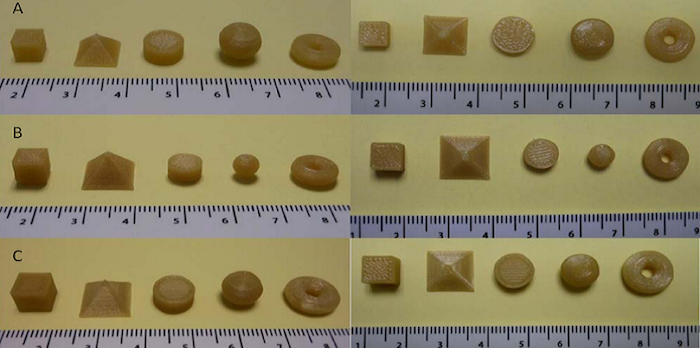
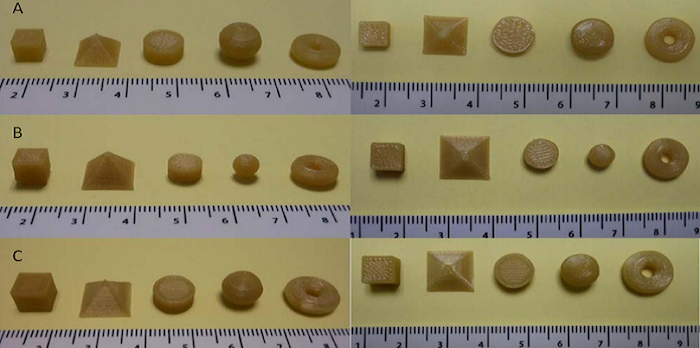
We've written before about novel production methods that could help customize dosages via printed pills and implants. Now a team at the UCL School of Pharmacy, University College London, has come up with a hot-melt extrusion 3D printing method that can produce medication in different geometric shapes (pyramids, squares, donuts, etc.) that can improve drug release performance.
You can read more about the research in the International Journal of Pharmaceutics.
The researchers printed five different geometries: cube, pyramid, cylinder, sphere and torus. They used hot melt extrusion to spread medication through a water soluble polymer (in this case, polyvinyl alcohol, or PVA, from MakerBot) to create a drug-infused filament that contained acetaminophen. The tablets were designed in AutoCAD and printed using a Makerbot Replicator 2X Desktop 3D printer.
Why make such odd shapes? Because surface area-to-volume ratios can help determine the kinetics of drug release. A pyramid, for example, can deliver drugs more efficiently than any of the other geometries (with the surface area kept constant).
Using the technology, pharmacies or even consumers could theoretically produce pills with customized dosages, and do so in shapes that would ensure the correct release time.
Forbes outlined some of the potential advantages and drawbacks of this model in a recent column by Dr. Robert Glatter.
Source: Forbes


Brian Albright is the editorial director of Digital Engineering.
Contact him at [email protected].

Join over 90,000 engineering professionals who get fresh engineering news as soon as it is published.






About Us · Contact Us · Editorial Team · Advertising · Privacy Policy · Subscriber Services · © 2026 Digital Engineering 24/7 · Peerless Media