Helping design and engineering professionals discover, evaluate and specify technologies and processes that shorten the design cycle and enable success.



Digital Engineering April 2026
In the latest issue of Digital Engineering, we take a look at the latest innovations in design for additive manufacturing, including the use of natural language inputs, social media cosplayers, and AI integration. The issue also includes a feature…

January Special Focus Issue: Design for Additive
In this Special Focus Issue of Digital Engineering, learn about the latest advancements in design for additive manufacturing, including new software tools, additive in automotive, custom medical devices, and more.
Speed is of keen interest to Chinese AM companies looking to either catch up with, or surpass, their Western counterparts in the AM business. Prismlab may well have achieved that goal with the development of multiple new AM systems. Each system is based on stereolithography (SLA) technology, but, according to the company, operates up to 10x faster.
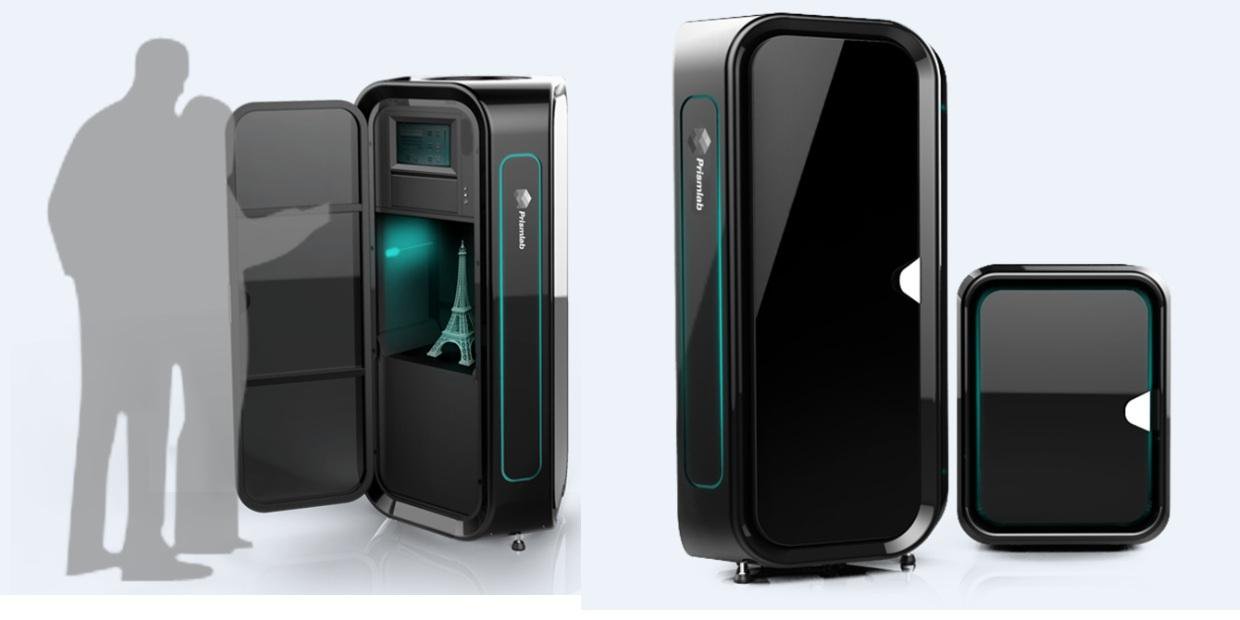
 An artistic render of what the Rapid series from Prismlab might look like in your office. Courtesy of Prismlab.
The Rapid series of AM systems represents Prismlab’s first attempts at producing marketable 3D printers. If the final products look anything like the artist renders, the Rapid systems will be sleek and thin, looking rather like a giant iPhone. Below you’ll find listed technical specs for the smallest (Rapid 200) and largest (Rapid 600) Prismlab’s systems.
| Rapid 200 | Rapid 600 | |
| Build Volume | 4.25 x 7.56 x 7.56 in. | 12.76 x 22.68 x 22.68 in. |
| XY Resolution | 50/33 micron (adjustable) | 100/75 micron (adjustable) |
| Z Resolution | 50/100 micron (adjustable) | 100/50 micron (adjustable) |
| Build speed | 300G/H | 1500G/H |
Assuming those specs are completely on the up-and-up, the Rapid systems would provide a marked improvement in speed over existing 3D printers. If rumor is anything to go by, however, it seems as though Prismlab may actually be reporting conservative build speed numbers.
Other companies are also trying to speed up 3D printing, and most of the successes thus far seem to be coming from outside the US. If other countries continue to put more stock into innovation than US companies, who often seem to sink more into advertising or legal action, will Asia be the future of AM?
Below you’ll find a video demonstrating Prismlab’s systems.
Source: Prismlab


John Newman is a Digital Engineering contributor who focuses on 3D printing. Contact him via [email protected] and read his posts on Rapid Ready Technology.
Follow DE
Join over 90,000 engineering professionals who get fresh engineering news as soon as it is published.






About Us · Contact Us · Editorial Team · Advertising · Privacy Policy · Subscriber Services · © 2026 Digital Engineering 24/7 · Peerless Media