Helping design and engineering professionals discover, evaluate and specify technologies and processes that shorten the design cycle and enable success.


Sponsored
 Dear DE Reader:
Claims of affordable 3D printers on every workbench once evoked mutterings of Gertrude Stein's “there is no there there” quip with “yet” tacked on the end. Yet there’s no getting around it now, professional-grade desktop 3D printing for engineers and makers is here. Today’s Check it Out link takes you to a dedicated webpage on a engineering-grade desktop 3D printer that shouldn't max out the budget.
Last fall, Ultimaker announced its next generation desktop 3D printers, the Ultimaker 3 and the Ultimaker 3 Extended. The primary difference between the two is build size. The former has an 8.5x8.5x7.9 in. (215x215x200 mm) build size versus the Extended unit’s 8.5x8.5x11.8 in. (215x215x300 mm).The webpage you land on covers this and much more in detail. It is a well-done bit of content presentation. Let’s cover some highlights.
When you arrive, scroll down to the section on printheads. The Ultimaker 3 has dual extrusion printheads with material-matching, swappable print cores. It seems like an interesting piece of technology. Click on the Ultimaker image to drill down on specific technical details. Make sure to take in the features video linked in this section. It's the full quick tour. You can also download the spec sheet here.
Next up is the “get a load of this” section with its demo of a complex gyro. Use the sliders to quickly see the raw 3D print morph into the post-processed print. Watch the cool time-lapsed video of the water-soluble support materials melting away.
Speaking of materials, the following discussion covers them. Besides the water-soluble material, currently available materials include nylon (polyamide), ABS (acrylonitrile butadiene styrene), chemical- and temperature-resistant CPE (co-polyester) as well as PLA (polylactic acid). More material options appear planned. But your takeaway here is that the Ultimaker gives you the flexibility to make concepts, functional prototypes and many end-use parts.
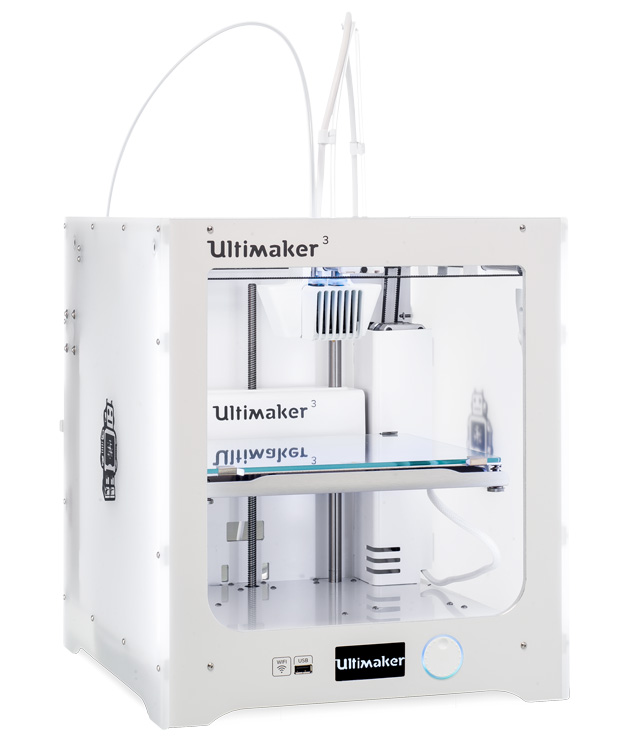 Ultimaker's new generation of desktop additive manufacturing systems, the Ultimaker 3 are designed to provide the flexibility to make concept designs through to end-use parts. Image courtesy of Ultimaker B.V.
The Ultimaker 3 webpage offers much more content for you to consider, such as case studies and links to additional details, blogs and support information. You can also place an order. Prices are listed in Canadian dollars but US pricing started at about 3500 bucks when the Ultimaker 3 was announced.
DE will have a formal review of the Ultimaker 3 in an upcoming issue. For now, hit today's Check it Out link and discover more about the system. Good stuff.
Thanks, Pal. – Lockwood
Anthony J. Lockwood
Editor at Large, DE


Anthony J. Lockwood is Digital Engineering's founding editor. He is now retired. Contact him via [email protected].
Follow DE
Join over 90,000 engineering professionals who get fresh engineering news as soon as it is published.






About Us · Contact Us · Editorial Team · Advertising · Privacy Policy · Subscriber Services · © 2026 Digital Engineering 24/7 · Peerless Media